Thursday, February 20, 2014

How to Advertise on Facebook for $1 a Day: 9 Tips

YouTube science channel Veritasium made a video that shows that buying Facebook ads based on likes doesn't work.  Click farms will like your page without really liking your page, and that means you're paying for likes you don't want. That's true.

But as I explained to my Facebook friends, there’s another way to advertise on Facebook that will let you circumvent click farm tactics, a way that can target thousands of potential customers and that costs less than a dollar a day.

My friends asked, “How?” I made this video to explain.


There are four basic steps:

1. Be human. Have a Facebook profile, and try to develop a good relationship with your customers, your potential customers, and anyone who is likely to like you or whatever it is you do. Granted, this probably isn't going to work for some ginormous company, but some ginormous company probably isn't going to worry about click farms biting into their advertising budget.

2. Don't advertise for likes. Duh! Facebook gives you other options, so choose one of the other options.

3. Limit your reach. I limit advertising so it only goes to the friends of people who like my page. Now you're probably thinking, “But that includes friends of people from click farms.” Yeah… People from click farms don't have friends, so that’s not something I'd worry about. If you like your own page, your ads will go to your Facebook friends. And if they like your page, it will go to their friends. If you have a small business in a small town, you can do something similar by limiting advertising to your small town and its neighbors.

4. Put something in the Interests field. One book reviewer said that anyone who likes The Big Bang Theory is sure to like my funny, geeky sci-fi novel, Why My Love Life Sucks, so I put that in Interests. Even if a click farm guy has a friend, that friend isn’t going to see my ad unless he or she has also liked The Big Bang Theory, and what are the odds of that?

Screen grab from my Facebook page's Ad Manager showing how I've limited the reach of my ads to the people most likely to be interested in them
So that’s it. You've circumvented those click farm tactics.

Now here are five more tips:

1. Base Facebook ads on your "latest post." This keeps things fresh and lets you try out different things.

2. Don't sell. Inform, help, entertain, ask fun or interesting questions, provide worthwhile content, but don't sell. Okay, maybe once every ten posts or so, but 90% of your posts shouldn’t involve selling.

3. Post visual stuff, and post often. people on Facebook love to see videos, photos, drawings, and that sort of thing, particularly if they relate to real people like themselves--and like you! Posting often means you're less likely to bore your friends and your friends’ friends. I try to post at least once a day, but I really should post more often. Eight times a day would be better. Also, when it comes to words, remember brevity is…
 
A few words, a nerdalicious face (Gilbert Garfinkle, the geeky hero of Why My Love Life Sucks), some humor, and good targeting make for a promising ad.

4. Ask your friends for likes. Make friends on Facebook and ask them nicely to like your page. This will expand your reach to your friends’ and your friends’ friends. I'm shy, so it took me a while to get around to doing this. When I finally did, I was surprised to see the likes on my page go up from 305 to almost 500. Yes! They like me, they really like me!

5. Like yourself first. Use your Facebook profile to like, comment, and share the posts on your page. The more people interact with your posts, the more the ad connected with that post will get seen. So be one of the people who interacts with your posts.

As for how to keep your budget under $1 a day, set your ad to “bid for impressions.” 

Click farms can manipulate clicks and likes, but they can’t manipulate impressions. 

Facebook will suggest a bid. Mine are usually around 10 cents for a thousand impressions, so setting my budget for a $1 a day gets me up to 10,000 impressions. And it only costs me $1! 


Even with a limited reach, this ad was clicked on six times--and it only cost $0.89.

If that sounds like a good deal, give it a try. And good luck!

Monday, February 17, 2014

Veritasium's Facebook Fraud video

This video has been making the rounds on Facebook, and what it says is true: most of the likes on Facebook pages are fake.


But this doesn't mean you shouldn't advertise on Facebook. Facebook offers one of the most cost effective methods of advertising online. It's cheap, can be targeted to a specific audience, and it can work. The trick is to use it in a way that doesn't waste your money pursuing likes that aren't going to help you.


This is the original video by Veritasium. Right now I'm working on my next post, which will explain how you can make Facebook ads work for you for no more than a dollar a day. It's a method I figured out through trial and error, a method that shows my ads to a very specific audience of up to 33,000 people, for one dollar or less per day. It works for me as a writer and indie publisher, and it can be adapted to work for any indie author, published author, and just about any small business. 

Wednesday, January 29, 2014

What's wrong with this screen grab shot?

Here's a screen grab from my Verizon account. Notice something a little...odd? 


Monday, January 27, 2014

Bathsheba’s Daughters: Our Story Begins With an Open Window and a Fall

There’s an odd similarity between the earliest story told about the great-grandmother I’m named after and the earliest story my parents used to tell about me: both involve an open window and a fall.

I’ve already told you about my mother’s earliest memory, how her grandmother held her hand and ran home with her from a pogrom in Jerusalem. I don’t know what my grandmother’s earliest memory or story was, although I do know several fascinating tales from her childhood and teen years that I plan to tell you in another post. The earliest story told about my great-grandmother, however, is so remarkable that it became a part of our family’s legacy.

My great-grandmother was named Bat-Sheva, a name that has been passed down in our family going all the way back to the biblical Queen Bat-Sheva, my royal ancestor and original namesake, the wife of King David and the mother of King Solomon.

My great-grandmother was born in Poland sometime in the 1870s. At the time of this story she was still a toddler, only two or three years old. Her father was a rabbi who also edited a newspaper, making him the first newspaper writer of five generations of newspaper writers in my family, ending with me (unless, somehow, my daughter carries on that legacy or marries a journalist).

I don’t know much about where they specifically lived, although I do know it was in a building that was at least three-stories high, so I have to guess it was a city. I know it was three-stories high, because that’s an important part of the story.

One day when my great-grandmother was just two or three years old, she climbed up to an open window on the third floor and fell out.

Her father saw her.

He saw his precious little daughter fall out of that third-story window, and there was nothing he could do to stop it.

Naturally, he was terrified.

She was just a baby, and it was such a great fall. How could she possibly survive? He had to get down to her as quickly as possible, and he couldn’t waste a second running to the window. Instead, he ran out of the room and raced down the stairs.

He could hear his feet pounding with each step he took. He could hear his heart beating hard and fast with fear in his chest. But he couldn’t hear his daughter. She wasn’t screaming, wasn’t crying.

He called out her name, “Shevaleh! Shevaleh!”

But there was no response.

His precious little girl had fallen out of a third-story window, and she hadn’t made a sound. Why hadn’t she cried out? Why wasn’t she crying now? Why didn’t she answer him?

His mind, of course, came to the only logical conclusion. She wasn’t crying because the fall had knocked her unconscious. Or worse. It had killed her. He prayed to God that he was wrong.

He raced as quickly as he could to the ground beneath the open window.

And he could not believe his eyes.

There was his precious little girl, standing up, not a hair out of place, looking as if nothing at all had happened to her.

He scooped her up in his shaking hands.

“Shevaleh,” he asked, “what happened?”

“Zayde carried me down the stairs,” she replied, as if it was nothing out of the ordinary.

But it was out of the ordinary.  In fact, it was impossible. Not only were there no stairs out of the window, but his daughter’s Zayde, her grandfather, had died two weeks earlier.

Her father was so astounded by this miracle, he had the story printed up in Yiddish, and he posted notices about it everywhere he could. I once saw a photo of that notice, and I would publish it here if I could find a copy of that photo.

You might wonder if I believe this story.

I can’t say that I do, but I do believe that my great-great-grandfather believed it with all his heart, so I don’t disbelieve it either. Like with most things that can’t be proven, I try to keep an open mind.

When I wrote Rideof Your Life—a novel about teenage ghosts falling in love in an amusement park—I treated it as a fantasy. However, as I do with all my novels, I still wanted it to make the most sense that it possibly could.  It seems to me that if ghosts do exist, they must be like the people they were when they were still alive. My great-grandmother’s Zayde was a good man who would have saved his granddaughter if he could. Perhaps he did. I don’t know. I suppose it’s comforting to think he did, and that comforting feeling is something I tried to convey in Ride of Your Life. The afterlife is unknown, but that doesn’t mean it’s scary.

As I said, the earliest story my mother used to tell about me also involves a fall and an open window. Unlike my great-grandmother Bat-Sheva’s tale, however, there’s nothing even remotely miraculous or other-worldly about it. In fact, it’s kind of funny, which I guess is fitting. It is, after all, about me.

A few weeks before I was born, my parents flew to Israel with my sister, Eliedaat. My mother lied to get on the plane, because it was against the rules for a woman to fly in the ninth month of pregnancy. They went to visit my extended family, particularly my mother’s parents and siblings.

At some time during the trip, my grandfather commented about my sister:  “You could draw a little circle around that baby, walk away, come back an hour later, and still find her in that circle.”

My parents agreed. My sister, who was eleven months old, was a natural born sitter. A natural born stay-in-placer. If you wanted to find a baby to pose for an oil painting, this was your girl! She could sit for hours and hours and not move.

Understandably, this led to a false sense of security.   

Enter me.
The oldest of my four younger brothers, me, and my sister. I have a dead tooth in this photo. If you guessed I got it from a fall, you'd be right. We were playing a "let's see how far we can jump" game (my sister's idea), and it turns out it wasn't quite as far as the top of the shelves  after my sister had moved them the second time. The dead tooth eventually fell out, but I still have the huge scar on my right arm from when my sister decided we should play milkman with glass milk bottles. (She says we were bowling, but I'm pretty sure we were playing milkman.) It was also her idea to play doctor with cold medicine that she spooned out to us. There is a slight possibility she wanted to be an only child. 


I was born days after my parents and sister returned from Israel, two weeks and two days before my sister’s first birthday. On the day I was brought home from the hospital, my father took me upstairs to the only bedroom in the house they were renting and laid me down on a bed. It was a hot summer day, and the window was open.

He thought, “This is safe. She’s a newborn baby, so she couldn’t possibly move.”

Yeah, right.

I was not my sister.

He left the room, I’m guessing to check on my mom and my sister. And when he came back, I was nowhere to be seen.

And the window was open.

Now, I know this doesn’t make any sense. I can’t even imagine a scenario where this might make sense. But for some reason the way my father tells this story is that he thought I had fallen out of the window.

I guess when you’re confronted with the realization that your assumption about your newborn being unable to move turns out to be false, you start to question the exact degree to which it is false. If your newborn can, in fact, move, who’s to say she can’t also climb windowsills? Or jump out of windowsills? Or fly? Or perhaps he knew the story about my namesake falling out of a window, and his mind played the most bizarre version of “connect the dots” anyone’s mind has ever played.

Of course, I hadn’t fallen out the window.

There was no miracle, ghost, or magic involved. I hadn’t disappeared. A short while later, my loud screams made it clear that I had merely fallen off the bed and had jammed between the bed and the wall.

To my father, though, this was almost as astounding as it would have been if I had disappeared.

Here was a newborn who could move a heck of a lot more than his almost one-year-old daughter. I couldn’t just move a little. I could move a couple feet right off of a bed. And I was only a few days old.

Over the coming months, my ability to move astounded both my parents over and over. You would think they’d have learned their lesson after that first time, but no. They didn’t.

One of the funniest stories my mother used to tell about me is how when I was a few months old, she put me in one of those baby carrier seats on a counter in a store. She left me alone for a second, just a second. Next thing she knew, I was crying, because I had flipped the seat over and was crawling around on the counter with the seat strapped to my back, like I was a turtle and the seat was a turtle shell I didn’t really like.

Through the years, I’ve tried to find similarities between myself and the great-grandmother I’m named after, and there are a few. I found out during my mother’s Shiva, for example, that my great-grandmother loved games. Someone told me she kept a chess set in a green plastic basket under her bed and would take it out to play chess with him when he was a little boy. But although I love games in general, I don’t like chess. I’ve also heard she loved to read and was usually found with a book in her hand. But she read mostly religious books, and I read mostly nonfiction, humor, fantasy, and science fiction. And several people have told me I’ve inherited her artistic and creative side. But I write and draw, and she expressed her artistic and creative side by sewing and crocheting, which are two things I can’t do at all.

But we do share a name and stories that start with an open window and a fall.


Monday, January 13, 2014

Bathsheba's Daughters: Memory Dominos

Memories are like dominoes, all in a line. One thing in the now pushes a single memory and sets it into action. That memory pushes another, which pushes another, and so on.

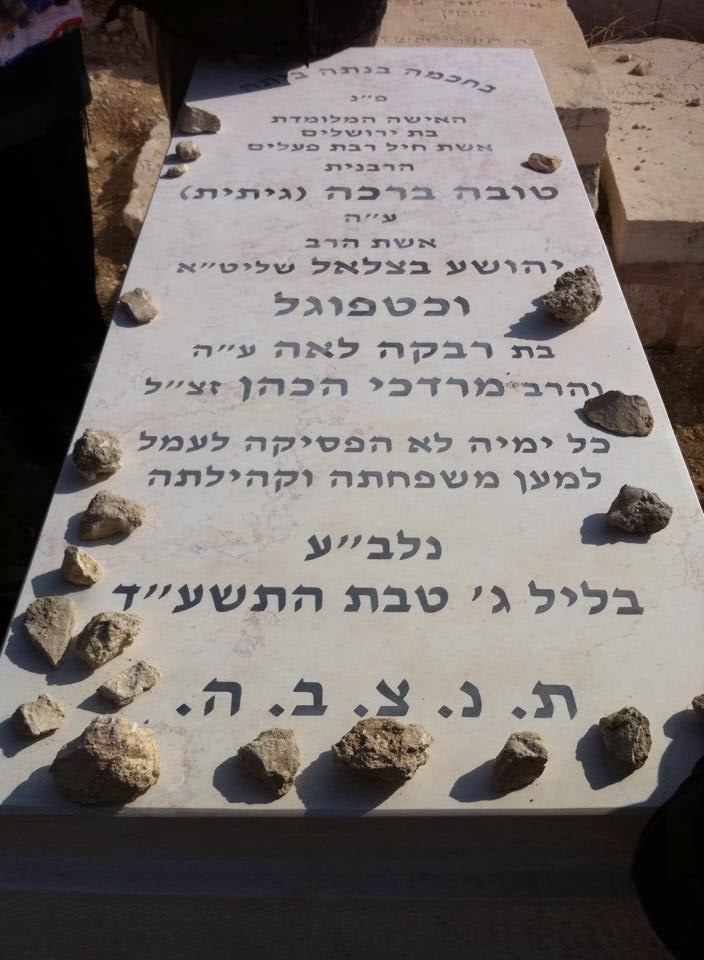
Last Sunday, my mother’s headstone was revealed, a Jewish ceremony that in Israel usually takes place 30 days after the funeral. I wasn’t there to see it, but my niece, Rinat, posted this photo on Facebook. 
My mother's gravestone. (Photo by Rinat Adler Horesh, 2014)
Rinat wrote, “"I don't believe 30 days have passed. It's hard to describe in a few words such an amazing person—a true woman of valor, full of life's joy, a saint by her own deeds and her ancestors', and simply a mother and grandmother to everyone! We so very love and miss our darling grandmother.”

The photo was a little push in the now. It set off a memory domino, which set off another memory domino, which reminded me of the reason why I decided I needed to write Bathsheba’s Daughters so many years ago.

My mother was buried on the Mount of Olives, as were her parents. My grandmother Rivka’s father and her grandparents were also buried there, but her mother—my great-grandmother Bat-Sheva, whom I’m named after—died in 1964, when the Mount of Olives was in Jordanian hands, so she was buried somewhere else in Jerusalem.

The photo set the memory of my mother’s funeral, a little over 30 days ago, into action, which set off the memory of my grandmother’s funeral, about 14 years ago.  

I remember sitting in the backseat of a car driving up to the Mount of Olives. 

My grandmother had died in her sleep in a senior home. Her health had been deteriorating, and while none of us knew that she would soon leave us, she seemed to know. She seemed to be telling us goodbye in her own subtle way. Although her body gave out, her mind remained sharp until the end, just like my mom's.

After the funeral, one of my cousins, Bat-Sheva Peli Seri, told me that Savtah (grandmother in Hebrew) had asked her, “What do I call you?”

My cousin had shrugged.

And Savtah had replied, “I call you Mamaleh (little mother), because you were named after my mother.”

It was true. Four of us are named after my great-grandmother Bat-Sheva, and my Savtah used to call all four of us Mamaleh. Telling my cousin the reason why was her little way of telling the four of us that no one we love ever leaves us, that the great-grandmother she loved stayed with her through us, and that she would stay with us, too, in our memories and our hearts.

But the final domino in that line of memories was set into action by something else.

On the way up to my Savtah's funeral, I looked at the houses on the side of the road, and I saw something shocking: some of the stones in the walls of the houses had Hebrew letters chiseled into them. 

They were gravestones. 

Someone had stolen gravestones from the Mount of Olives and had used them to build a house. And this wasn’t just one house. House after house in this little Arabic village in East Jerusalem had Jewish gravestones in their walls, each gravestone carrying the name of someone who was buried on the Mount of Olives, someone who had been loved and cared for, someone who now had an unmarked grave, because someone else wanted to erase the fact that they had ever lived at all.

Many of my ancestors are buried on the Mount of Olives, but their story is different, and it’s because of my Savtah Rivka and a kind soul who never forgot a kindness done to him.

I’ve already told you the story of my mother’s first memory, how she was just a toddler on a bus in British Mandate Palestine when she heard Arabic cries of “Slaughter the Jews!”  

The Arab riots continued until Jewish night squads, led by a British Christian officer by the name of Wingate, put a stop to them. But before they ended, some Jews who couldn't take it anymore eventually formed angry mobs determined to return blows for blows. Just like the Arabic rioters didn’t care who they attacked so long as the person was Jewish, the Jewish mobs didn’t care who they attacked so long as they were Muslim men.

My grandfather was a respected rabbi who had a good relationship with his Arabic neighbors. 

Before every Passover, he would sell his community’s chametz (bread, crackers, and other things that aren’t kosher for Passover) to a nearby sheik; and after Passover, when he bought the chametz back, the sheik would send my mother's family a silver tray piled high with bread and rolls. 

My grandfather also had an Arabic man who worked for him, taking care of things that Jews aren’t allowed to do on the Sabbath. I asked my mother what this man’s name was, but she didn’t remember, understandably, considering he had worked for her father when she was very little. She said it might have been Ahmad, so I’ll call him that for storytelling purposes. It’s shorter than saying, “the man who worked for my grandfather.”

 One day, the Jews in the streets were in a panic. There had been another riot in Jerusalem’s Old City. Arabic cries of “Slaughter the Jews!” were being met with Hebrew cries of “Death to the Arabs!” It was a very dangerous time.

Ahmad had been working that day at my grandfather’s synagogue, and he was terrified. How could he return home? The angry Jews in the streets would kill him!

“Don’t worry,” my grandfather said. “You can borrow my clothes and hat. They won’t kill a rabbi.”

Ahmad seemed apprehensive. While it was true the disguise could save him from the angry Jews, what would happen once he reached his own neighborhood? How would they react to this rabbi in their midst? 

“No,” my Savtah said. “Ahmad, you can take my clothes.”


She went to her closet and pulled out a dress, a coat, and a woman’s head scarf. Ahmad put the clothes on and wrapped the scarf around his head and face. Disguised as a woman, he headed out into the dangerous streets, never to return.

My grandparents worried about Ahmed, of course. He had worked for my grandfather for years, and they didn’t know what had happened to him. Had he made it safely home? They wanted to believe that he had, but there was no way to be certain.

Several years later, the British left Palestine. The Arabic countries in the region and beyond united to drive the Jews out, but the Jews fought back. When it was over, Jerusalem was divided. My parents’ families were on the western side of the city, which was in the hands of the newly formed state of Israel, while Ahmed and the Mount of Olives were on the eastern side, which was in Jordanian hands. Between 1948-1967, robbers stole Jewish gravestones from the Mount of Olives. They used them to build houses, like the ones I had seen from the backseat of a car heading up to my grandmother’s funeral.

My grandmother, Rivka Hacohen, probably in the 1960s

Following the Six Day War in 1967, Jerusalem was reunited once more, and Jews could once again visit the ancient Jewish cemetery on the Mount of Olives. So my grandmother went to visit her father and her grandparents’ graves, something she couldn't do for close to 20 years.

I imagine her journey was much like mine. I imagine she, too, was horrified to see those desecrated gravestones in the walls of the houses she passed on her way up. She must have wondered what she wouldn’t find once she reached the Mount of Olives. Would she be able to locate the places where her grandparents and father were buried? Or would she never know because of the workings of some heartless thief?

She reached the Mount of Olives, and who should meet her there but Ahmed! 

They both cried tears of joy, so happy they were to find each other alive after all they had been through. 

But that wasn’t all . . .

“Come, Miss Rivka, come!” he said in Arabic. My Savtah was multi-lingual, so there was no need for him to struggle in another language.  He ran up the hill and directed her to follow him.

And amazingly he led her to her father’s gravestone. It was still there!

“I’ve taken care of all of them,” he said, pointing to her grandparents’ gravestones. “I made sure no one would disturb them.”

They say the greatest mitzvah (good deed) is one performed for someone who cannot repay you. If that is true, Ahmed’s act was possibly one of the greatest mitzvahs anyone has ever performed. 

How could he possibly know that he would ever see my Savtah—the woman whose generosity had helped me return safely home—again? How could he possibly know that she would ever be able to visit her father and her grandparents’ gravesites again? 

Here he had performed this selfless act for almost 20 years with no way of knowing that anyone alive would ever benefit from it.


And that is the final memory domino in that line of memory dominos: the reason why it’s still possible to find my great-great-grandparents’ and my great-grandfather’s graves on the Mount of Olives. 

Perhaps it shows no good deed is ever wasted. Or perhaps it shows that even if we think it will be wasted, we have to try anyway, because you never know.  

Tuesday, December 31, 2013

Forget New Year's resolutions. Write a Wish List instead!

Yes, I know I'm not perfect. There are bad habits I'd like to break. I want to exercise more. I want to eat more vegetables. I want to lose weight. And I'd like to write every day and blog every day and start that vlog I've been meaning to start.

But I don't write New Year's resolutions.

I don't like the idea of them. It just seems so negative. They're all about what you don't like about yourself, things you want to change. They make you feel bad about your past. And that negativity continues when you inevitably fail to keep some of those resolutions. Then you feel doubly bad about yourself, first for the things you wanted to change, and then for your inability to change them.

That's why instead of writing New Year's resolutions, I write Wish Lists. These are lists of things I want to do or have. We're not talking about an Amazon Wish List. Many or even most of the things on them can't be bought. They're just whatever you wish for in the future, whether it's success, good health, a quiet place, or anything else you dream of.

I usually write a Wish List at the start of summer or a week or two before my birthday. The idea came to me when my husband told me he gets me lame presents because he doesn't know what I want. Now he has a list. Not everything on it is something he can give me, but that's okay. There are things he can, and things he can work out sort of giving me. Like he can't give me good weather to take more walks, but he can go for walks with me.

So instead of focusing on the negative, write a Wish List and focus only on the positive. And every time you wave your own magic wand and make one of your wishes come true, you can cross it off your list.


One summer, my family got together and wrote a list called "The Summer of 100 Wishes." It was fun crossing things off that list, like movies we wanted to see or trips we wanted to take. We probably did 50 things we wouldn't have done if we didn't have that list to spur us on.

My latest Wish List, which I wrote before my most recent birthday, includes things like "See a great stand-up comedy show." I was happy to cross that off my list after the opening night show at this year's New York's Comic Con.

So forget about making New Year's resolutions. Forget about feeling bad about yourself. Instead, make a Wish List.

What would be your top five wishes for 2014?

Monday, December 30, 2013

What Was and Wasn't Lost That Day

My mother is on the left, here pictured with her mother and younger sisters. Judging by the age of her youngest sister in this photo, this is probably from 1951, when my mother was 15. 


My mother’s story begins with running, a hand holding tight, a lost doll, and a dead body.

These are parts of the first memory she could recall, something that happened to her when she was only two or three years old, possibly even a bit younger.  

Like her mother, my mother was born in Jerusalem. My grandmother, however, was born when Jerusalem was under Ottoman rule; while my mother was born under British rule.

My mother was the middle child of seven siblings to survive to adulthood. She had three older brothers and three younger sisters. She also had three sisters she never knew who had lived and died in infancy before she came into this world. She was born on the very last day of 1935, so it’s possible that her first memory is tied in with the riots that took place Jerusalem’s Old City during the November of 1937.

On the first day she could remember vividly, she was a little girl, just a toddler, sitting on a bus with her grandmother, Savtah Bat-Sheva.

My mother, second from the top left, with her parents, sisters, and a baby (perhaps one of my cousins). My great-grandmother Bat-Sheva is on the right.

My mother remembered my great-grandmother— the one I’m named after—as always being dressed meticulously. She had a printed housecoat that she wore around the house, but when she went out, she wore a black dress with a white apron. While the housecoat was something she had been bought in a store, everything else she wore was tailored and handmade. The apron had lace on it with intricate details that she had crocheted herself. The scarf on her head was also her own handiwork. Between all that close-up crafting and her almost constant reading, her eyesight was very poor, and she had to wear thick glasses.

They sat on the number 11 bus in Jerusalem, side by side, on their way from my mother’s house to her grandparents’ house on the other side of Jerusalem. Occasionally, Savtah Bat-Sheva spoke a few words to her in Yiddish, the only language my great-grandmother could speak. My mother held a little rag doll in her hand, a gift from her grandmother. Had her grandmother made it herself? Probably, although there’s no way of knowing now. The only thing that matters is that it was a gift from her grandmother, who sat beside her and smiled down, her eyes, behind her thick glasses, shining with love.

As they passed She’ar Yaffo (Jaffa Gate), they suddenly heard shouting outside the bus. People were running. They were in a panic. They shouted, “Pogrom! Pogrom!” 

Other people were running behind them, angry men in Muslim attire, and they were shouting, “Itbakh Al Yehud!” Little Tova didn’t know that meant “Slaughter the Jews!” but she could tell the men were angry, and the people running away from them were terrified.

The bus stopped, and the doors swung open. Savtah Bat-Sheva held Tova’s hand tight, and Tova held her little doll’s hand tight. Young and healthy adults got off the bus and started running away from the Old City, away from the danger. A group of people carried bodies onto the bus. Some of those carried on were moving and groaning, but there was one bloodied person who was perfectly still. What was wrong with him? Why wasn’t he moving? Little Tova didn’t understand, but years later, she realized that the man had probably died from his wounds.  

The driver swung the doors closed. He drove as fast as he could on Jaffa Road to the center of Western Jerusalem and didn’t stop until he reached where Binyan Klal stands today. He opened the doors. “Quickly, quickly!” he shouted at the elderly and the women with children still on the bus. “Get off! I’m taking these people to the hospital!”

Savtah Bat-Sheva picked little Tova off the chair and pulled her to the door. Tova held her grandmother’s hand tight in one hand and her little rag doll tight in the other. They got off the bus and found themselves in a streaming river of people heading in both directions. Half the people were running away in a panic from the Old City. The other half were running toward the Old City in the hopes of finding their loved ones safe or to see what they could do to help. Little Tova saw legs running, everyone running.

But what about her dear old grandmother?

The thing my mother remembers the most about that day is that her grandmother ran.

How was this possible? Her Savtah Bat-Sheva, this old woman who spent most of the day sitting and crocheting or reading—running? 

But Savtah Bat-Sheva ran, then, ran for her life and her granddaughter’s life. 

And Tova had to move her tiny feet faster than she had ever moved them before to keep up. 
Her grandmother held her little hand tight, and Tova clutched her little rag doll tight. 

Then the rag doll slipped from her little hand. It fell into the street. Tova cried out, “My doll!” 

She reached back, but she couldn’t see it. There were too many people running around them. She wanted to stop. She wanted to go back to get her doll. But Savtah Bat-Sheva held her hand tight and continued to run. She ran and ran until little Tova finally reached her grandparents’ home in the Jerusalem neighborhood of Mea Shearim.

 My mother didn’t know exactly when this event took place or exactly how old she was at the time; she only knew that it was her first memory and she was very little. In a video interview I made with her, she asked me to try to work it out based on historical resources. So I looked it up.

The riots of November 1937 weren’t the first or the last of the riots, but she hadn’t even been born when the Jews of Hebron were massacred in 1929, and she would have been too young at the time of the riots that took place between April and November of 1936 to remember them. It could, however, have happened later. The Arab Revolt lasted until 1939 when they were stopped by “Charles Orde Wingate, an officer in the British army. Wingate, pro-Zionist and a Christian, organized Special Night Squads of Jewish volunteers to combat the attackers.” So my mother could have been anywhere from almost two years old to over three at the time of her first memory. (Source: http://www.jewishvirtuallibrary.org/jsource/History/riots36.html)

How does an event like that shape a person? 

You might think it would make them fearful, but my mother was fearless. You might think it would make them suspicious of other people, but my mother loved and was loved by almost everyone she met up until the end. 

During one visit to the hospital, my brother asked an orderly where my mother was.

“Who?” the orderly asked, not recognizing the name.

“The charming woman,” my brother replied, having no better way to describe her.

The orderly smiled and knew exactly who he was talking about.

If anything, I think it made my mother appreciate life all the more. It made her see it as a miracle. And even in the worst stories she told—stories of riots and war and death and destruction (with the exception of one story that I plan to get to later)—there was also a sense of wonder that life, the miracle of life, goes on.


Monday, December 23, 2013

My Mother's Stories

My mother, Tova Hacohen Wachtfogel, at age 72 during a visit to the United States for my son's bar mitzvah
A few weeks before my mother died in Jerusalem, she told me in a telephone conversation that stretched all the way to the United States about sitting down with her sister Sarah and reminiscing about the past. That day they had talked about the time they spent in Tel Aviv in the late 1950s, two young and beautiful ladies in a young and beautiful country—all three with ancient histories and fascinating stories—sipping coffee in a café.

My mom worked back then as a journalist, a children’s page editor, and a publishing assistant for the newspaper owned and run by her father and brothers. Her work didn’t make the front page, but, there in that café and everywhere she went, she had a front seat to history.

“You need to write your stories down,” I told her over the phone. “I want to read them, and I know I’m not the only one.”

Several years earlier, I had interviewed my mother for a book I was writing, which was a fictionalized version of her life in Jerusalem before, during, and a few years following Israel’s War of Independence in 1948. My mother had been twelve years old at the time of the war—a bat mitzvah girl—and the book was a project I was working on for a publisher who specialized in gifts for Jewish girls. The publisher had loved the story . . . until she asked me to add historic facts. The historic facts didn’t agree with her less than Zionistic friends, and her demand that I rewrite history to suit them didn’t agree with my principles and journalistic integrity, so the project fell through.

But I still had all these stories I had gathered when I was researching the book, and they were wonderful stories.

Perhaps it was for the best that the project fell through. Even before I started working on it, I had wanted to write a book about four generations of women in my family that spanned from the very early 1900s until the present in the Holy Land.  I wanted to write that book, Bathsheba's Daughters, because these women had great stories, stories that deserved to be shared. And a few weeks before my mother died, when we still hoped she might be with us for at least a few more years, I wanted her to share more of her stories. It was the greatest inheritance she could possibly leave behind.

“I’m not a writer,” my mother replied, this from a woman who was a journalist for decades.

“But you’re a good storyteller,” I told her.

“I’m not that good a storyteller,” she replied. “You know who’s a good storyteller? Your Aunt Sarah.”

“You are,” I said, although I suppose modesty prevented her from admitting it. “And if you don’t want to write your stories down, you could hire someone to write them down for you.”

She told me a great aunt of mine was doing that, paying someone to listen to her life’s story and turn it into a book for her kids and grandkids. “You should do that, too.”

She said it was a good idea and implied that she would think about it.

I’m sure she did. I’m sure it gave her a reason to want to stay around just a little longer. My mother was the kind of mom who would do anything for her children. Anything.

But God had other plans.

So now it’s up to me, the daughter who writes, the collector of stories.

When we were sitting Shiva for my mom, a few people came to me with stories. Stories about my mother, my grandmother, and my great grandmother. And I grabbed those stories with both hands.

I knew, for example, that my grandmother had been a bit of a rebel when she was a teenager, but I didn’t know that she would lean forward when the seamstress was measuring her for dresses, because she wanted the hemline to be higher than her parents would permit. I knew that my great grandmother was funny, creative and smart, but I didn’t know that under her bed in her old age she kept a green plastic shopping basket that contained a chess set, and I didn’t know that she would pull out that basket and play chess when a young distant cousin came to visit. Even in her old age, she still had a playful side.  

I shared the stories I had collected, too, but there were so many of them. I couldn't possibly tell them all.  

I told them about the book I had worked on and the book I had planned to write.

“I want to read that,” they told me. “Publish it, and I'll buy a copy.”

I promised to post the stories on my blog, and that is what I hope to be doing from time to time over the following weeks. Maybe if I write enough of them and collect enough photos and other material from my family, I’ll put it all together as that book I was planning to write, the one about four generations of women in the Holy Land.


I hope you’ll forgive me for this little detour. I know I usually write about writing, designing books, comedy, and geek stuff. But these stories about the women in my family deserve to be told. 

Monday, December 16, 2013

A story of Planes, Trains, a Taxi, Walking, Ice Skating, and Hitchhiking!


You know the movie Planes, Trains and Automobiles? Our return home from Jerusalem was a story of Planes, Trains, a Taxi, Walking, Ice Skating and Hitchhiking! 

The roads in and out of Jerusalem were closed on Saturday night because of all the abandoned cars still stuck in the snow. At 7:30 they opened to public transportation only, so we arranged to get a taxi to Ben Gurion Airport at 3 AM. The taxi picked us up, but it kept slipping and sliding on the road from my sister's house. At one point near the entrance to Jerusalem, the taxi got stuck. We got out and pushed. The driver told us to get out and walk up ahead to meet him, so there were were in the middle of the night, stomping around in deep snow and slipping on the glassy ice for about half a mile. Two ultra-orthodox men in a car behind us offered to give us a ride, so I climbed in with my daughter and son, and they took us up to the taxi. My husband, on the other hand, decided to run to the taxi instead. The taxi driver yelled at him, "Don't run!" because he was afraid my husband might have a bad fall and hurt himself, but somehow he managed.

We drove between the cars, buses, trucks, and other abandoned vehicles that were still stuck at the sides of the road. There were almost no other cars there. The closer we got to Tel Aviv, the more cars and the less snow we saw. I called my sister when we arrived at the airport to tell her we had made it. She said we were lucky, because they announced that the road out of Jerusalem was again closed to all traffic at 4:30. She said we were probably one of the last vehicles to make it out that morning!

We took an El Al plane to Zurich, Switzerland, spent five hours in the airport there, and then took a Swiss Air flight to Newark, NJ. This is a video I shot in the train at the airport in Zurich. There's something surprising on the train, so I decided to record it and share it with you. Pretty cool, huh?

The entire journey, from the time we got the taxi to the time we got home, took about 25 hours. What an ordeal. I wouldn't believe it if I hadn't been through it myself. 

Friday, December 13, 2013

Snow in Jerusalem

Pictures of snow in Jerusalem on December 13, 2013. The dog belongs to my sister. The smile belongs to my niece, Shir.