Showing posts with label fantasy. Show all posts

Friday, May 27, 2016

Words for Nerds #AtoZChallenge--X is for eXtreme Writing (the ONLY way to write)

Improv says you have to “commit 100%.”

One of my rules of comedy is that you should, “take it as far as it will go. All the way up to the edge . . . and then push.”

And as I’ve told members of my critique group (please excuse the PG language), “Don’t do anything half-assed. It should be full-assed or nothing!”

I honestly mean that.  

What I’m talking about is extreme writing—and it’s the only way you should write.

I think if you look at any successful book, you’ll see the author didn’t hold back, didn’t do things by half. Whatever the author was doing, the author did it all the way. You might like it. You might hate it. But either way, you have to respect that whatever the writer’s vision was, that writer went for it.

Take Harry Potter as an example. That book isn’t just about a boy with magical powers who waves a wand and recites spells. There’s a whole magical world around him that’s rich with detail. Hogwarts has a history. Letters are delivered by owls. Food comes alive. Trees can attack you. Staircases move. Paintings talk. Ghosts roam the halls. J.K. Rowling didn’t do things by half. She took it all the way up to the edge and then pushed.


Or Gilbert Garfinkle from Why My Love Life Sucks (The Legend of Gilbert the Fixer,book one). I didn’t set out to write a series about just any geek; I set out to write a book the ultimate geek. Gilbert isn’t just a hacker; he’s the ultimate hacker. He’s not just a nerd fighter; he’s the ultimate nerd fighter. He’s not just a fan of Star Trek; he’s a fan of pretty much every form of geek or nerd culture. And I wasn’t going to give him a little problem. I gave him the ultimate teenage geek’s ultimate nightmare: getting stuck with a gorgeous vampire girl who wants to be his platonic BFF, literally forever!

Now that’s extreme writing.

You don’t have to write fantasy, science fiction or comedy for your writing to be extreme. You can commit 100% to writing a quiet book, too. Just don’t set out to make a quiet book with a few exciting scenes, or an exciting book with a few quiet scenes. Whatever choice you make, stick with it! Commit to it! Don’t waffle. Unless, of course, you’re all about waffling, in which case, I want to see you waffle like an IHOP! I want to see you waffle like no one has ever waffled before! I want you to be the King or Queen of Waffles!


Like many people, The Shawshank Redemption is one of my favorite movies. I love it because the hero, Andy Dufresne, isn’t just ordinary—he is extremely ordinary. He isn’t just boring—he is extremely boring. He’s an accountant, for goodness sakes! His hobbies include playing chess and reading. How boring (in the eyes of most people, not a book addict like me) can you get? His favorite music is opera. Opera! Andy is as ordinary as a piece of coal, but here’s the thing about coal: under a great deal of pressure, a piece of coal can turn into a diamond. And that for me is the beauty of this movie. Andy Dufresne succeeds—not despite being extremely ordinary and boring—but because of it.  

And that, I think, is a metaphor for extreme writing. Take something that could be boring and ordinary, put it under the pressure of making it extreme, and watch it shine. 

It honestly doesn’t matter what you’re writing about. As long as you make it extreme, your story will be more compelling for it. 

Tuesday, May 10, 2016

Writing Words for Nerds #AtoZChallenge--M is for Magic (Is it real?)

Picture a scene. Harry Potter is playing Quidditch with his friends as the sun begins to set. The young wizards zoom and loop through the sky, chasing the winged golden snitch that remains ever out of grasp.


As night falls, a figure appears in silhouette on the horizon, her long hair flowing in the wind. She’s holding a staff and wearing a long cloak. An extreme close-up reveals the cloak is made of colorful patches. The young woman, still in silhouette, runs her fingers through her hair and raises her hand. There’s a sound, like a woman talking, but the words spoken aren’t of this world.

The young woman glows, and we can see her for the first time. Her hair is dark, her skin pale, and her clothes are colorful.

The dramatic music rises as we once again see Harry trying to catch the snitch. The camera shifts to the snitch itself and follows it zooming straight toward something. The music rises and suddenly ends as the snitch flies into the young woman’s outstretched hand.

“The time for games is over,” she says.

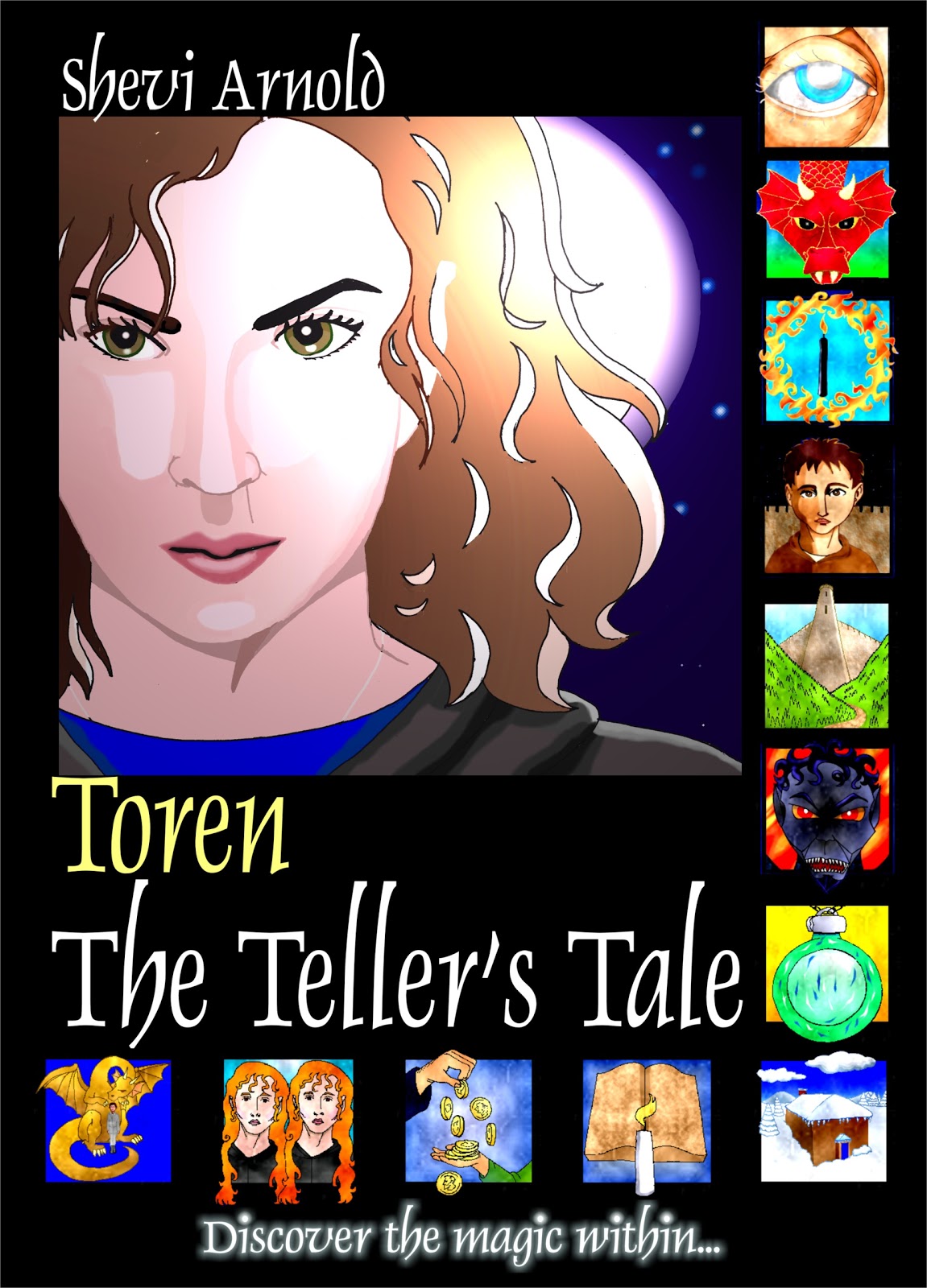
The screen fades to black. Enchanting music starts. The words “This time the magic is real . . .” appear on the screen and then fade. The last screen shows the words “Toren the Teller’s Tale” as the music comes to an end.

Sometimes I think of parts of my books as scenes in a film. This is the trailer that I like to imagine for the film version of Toren the Teller’s Tale. Sure, it will probably never exist in real life. But anything can be real in my imagination.


Toren the Teller’s Tale is about real magic. It’s about the magic of stories: the magic that lets you see and hear and touch and taste and smell a story, the magic that transports you to different worlds that could only exist in your imagination, the magic that lets you experience what it’s like to be a boy wizard or a hobbit or a young girl who loves telling stories and is about to discover the magic they hold. Toren the Teller’s Tale is about a kind of magic you know is real. You’ve felt it every time you’ve found yourself swept away by a story.

Those who aren’t very familiar with fantasy and science fiction often think there’s a clear divide between the two genres. Fantasy involves wizards and magic spells and magical creatures, like dragons. Science fiction involves the future and space ships and alien planets and things that could scientifically exist one day.

But there’s more overlap than most people realize. Anne McCaffrey’s Dragonriders of Pern books, for example, have dragons, but they’re science fiction.  Most people would say that Star Wars is a science fiction series, but never say that to a science-fiction purist. Sure, it has aliens, androids and spaceships, but it also has a form of magic called “the force” as well as Jedis, who are basically wizards that live on other planets, have robot companions, and fly spaceships. Star Wars regularly breaks the rules of science, which is fine as long as you don’t call it science fiction.

There are some who have pointed out that the Many Worlds theory of quantum mechanics basically means that all fantasy is actually science fiction, which is true.


That’s a topic that comes up in a conversation between Gilbert Garfinkle and Dungeon Master Dave in Why My Love Life Sucks, the first book in the Gilbert the Fixer series. Gilbert, the young aspiring mad scientist, can’t accept that he’s been turned into a vampire. His life is supposed to be a science-fiction novel. How is it possible that it now contains an urban fantasy trope? In his mind, that’s not scientifically possible.  It makes no sense. Dungeon Master Dave points out that the Many Worlds theory says otherwise. Because if an infinite number of worlds exist, some of those worlds must have vampires, as well as Gilberts that don’t believe in their existence.

The first book in the series shows Gilbert mostly grappling with his strange, new, unscientific predicament. By the second book (Why It Still Mega Bites, which should be out later this year), he’s come to accept that “magic is just science we don’t yet understand.”

Of course, he wasn’t talking about Quidditch.

Monday, May 02, 2016

Writing Words for Nerds #AtoZChallengs--F is for Fantasy

What I was a kid, I wanted to create worlds. I wanted them to spring forth from my imagination into existence. In short, I wanted to be God.

I soon discovered that job was already taken.

So I wanted to be the next best thing. I wanted to be a director, to make worlds people could see and hear on a movie screen or a TV at home. I held onto that dream for a long time, until I finally was forced to realize that directors were limited by budgets and the talent of the people they worked with and the whims of the producers at the studios they worked for.

So I scrapped that idea and decided to become a writer.


I've never understood why a writer wanted to work in a genre other than fantasy. It's kind of like getting a billion dollar budget with no strings attached and then telling the studio, "No thanks. I'd rather make a movie for under a million. I'll use my friends, our houses, and our own lights, furniture and costumes. It's going to be so much better because we didn't have enough money to do anything big."

As a writer, you can do anything in the fantasy genre. ANYTHING. A dragon that follows a storytelling girl around? Done. Teenage ghosts having the run of a theme park? Done. A geek getting turned into a vampire in New York? No problem. You don't even need to get a filming permit from the city.

The only rules are the basic rules of language and fiction, as well as whatever rules you create for your own universe. After that, the sky isn't the limit, because there are no limits.

And that's a big part of why I love writing and reading fantasy.

There's another part, too, in that fantasy is the most honest genre. It doesn't even try to pretend to be real. It's fantasy. It's a fable. It's a fairy tale. Other genres try to make you believe that they happened or will happen. Not fantasy, nope. We all know this stuff never happened, except in our imagination.

And yet...there's a deep truth in how fantasy touches us, the messages we get from it. Because we can peel away the untrue stuff like we're peeling an orange, we get to the heart more easily.

Fantasy stories are more easily about ideas. Anne of Green Gables is about a plucky orphan girl, but Harry Potter is about the individual's search for family. A Farewell to Arms is about a soldier in the first World War, but Lord of the Rings is about how even the smallest and most ordinary of us can be a hero.

Maybe  it's this deep and immediate truth that kids respond to and makes them want to dress up as Superman, Spiderman or Mulan. If he were around today, Jung might say we were born wired for fantasy. The archetypes of fantasy are a part of of our universal psyche. They can be found around the world and going back to the beginning of history. They can be found in our dreams.

I don't know about you, but I want my dreams to fly. On beds with bed knobs, in costumes with capes, or on red dragons, I want my dreams--and my stories--to fly.

Thursday, April 24, 2014

The Girls Heart Books blog tour for Ride of Your Life begins!

The Girls Heart Books blog tour for Ride of Your Life has begun! Even though it's not my most recent book, I decided to do a blog tour now in honor of the 30th anniversary of the Six Flags Great Adventure Haunted Castle Fire, which inspired the novel when I was still a teenager. The book tells the story of Tracy--a seventeen-year-old girl who died in the fire--and Josh--a seventeen-year-old boy who dies in an accident in the same theme park thirty years later.

Ride of Your Life won third prize in SmartWriter's Write It Now contest in the YA category, which was judged by Alex Flinn, the author of Beastly, Cloaked, and more. I hope you'll check it out.


Wednesday, November 13, 2013

Guerilla Market Your Book! A Guest Post by Peter Adler

Today I'm delighted to present a guest post by Peter Adler, author of Wyndano's Cloak. I asked Peter to share his tips on getting your book into bookstores and face-to-face sales.

Guerilla Market Your Book!
by Peter Adler

Author Peter Adler
In this era of online book marketing, it’s easy to forget the tried and true sales techniques of the past. That would be a shame. The old ways are not only effective but are immensely satisfying. 

Today, I’ll focus on the direct approach, where you engage face to face with potential customers. The ways this can happen are virtually infinite, and are only limited by your creativity and reluctance. 

The more conventional direct approaches include making a presentation at a bookstore, setting up a table at a convention, fair, or outdoor market; or appearing at a library show. Less conventional direct sales techniques utilize guerilla marketing. Let’s look at both conventional and less conventional approaches, emphasizing the latter.

Bookstore presentations fall into two categories:

1) A formal talk, which can include reading an excerpt, showing a video or slide show, and even having a party. One author I know pulls in two hundred or more children to do face painting. She gets donations from local businesses for the food, drinks, and raffle. The events are so well received in her community that she gets media coverage. Talk about bringing attention to your book!

2) Setting up a table and greeting customers as they walk into the store.

I’ve done both types. The most successful for me was the second approach, which I describe in depth in these two posts: Art of the Meet and Greet Part I and Art of the Meet and Greet Part II. 

If you decide to pursue a convention, fair, or outdoor market, but not a bookstore event, take a look at Part II anyway. The techniques I describe will be helpful. Hands down, I’ve sold more books with meet and greets than any other method. They’re fun, and I’ve made lasting contacts. 

For example, I’ve met librarians, teachers, and book-club members interested in having me do a presentation. I met a book blogger who bought and reviewed my novel, Wyndano’s Cloak. I admit, I was a bit terrified of what he’d say; he’d told me in no uncertain terms that he only reads adult suspense thrillers and mysteries, and he would tell me exactly what he thought of my book. Fortunately, he loved it. Not only did he post his review on his blog, Amazon, and Goodreads, but he approached me later for an interview. Then he came back a month ago and asked me to appear at a new indie bookstore, where he coordinates events.

The best part of meet and greets is the interaction with the customers, particularly children. Their excitement at reading books, their excitement at meeting an author, these are priceless. Several have written to me afterward, and as a writer, you know there is nothing better than touching the heart of a reader. Yes, readers who find me online can write to me too, but trust me, that live connection is deeper, more meaningful.

Which brings me to Guerilla Marketing. 

Listen up, folks. You’ve got to walk around with your Kindle! It’s a serious conversation starter.

While waiting for a concert to start, I was reading on my Kindle.  People who haven’t seen them are curious. I ended up demonstrating how it worked and showed the guy next to me what my book looked like. He took down my book info. At the very least, it was exposure. 

One day, I walked into my bank with my Kindle, housed in a green velvet cover my wife made. The teller asked if it was a Kindle, and we got to talking. I asked her what kind of books she likes. Don’t bypass that question. It’s your way of gauging if this person might like your book. With a bashful expression, she confessed she liked young adult fiction and Harry Potter. Bingo! That was my opening. I told her I wrote in that genre and showed her Wyndano’s Cloak on my Kindle. She said that it was exactly what she loved to read. The next time I came in, I brought a copy of the hardback. I ended up at a different window from hers, but I held up the book. She came over and asked if she could look at it. Her eyes were aglow when I left. Long story short, she bought it for her Kindle, loved the book, posted a review on Amazon, and loaned it to another teller. Every time I see her, we talk books and she asks when my next book will come out.

This being my first year in our new house, I had no idea whether children would show up for Halloween. In the past, they never did, but a hunch told me I better ask my neighbor. He said I could expect three bags worth of kids. It was an hour from sundown. I high-tailed it to the store, snagged candy, dashed back home, and started setting up. I already had the new book cover on our wall, so people would see it when I opened the door. I joked with my wife that it was free marketing as I handed out treats. All of sudden she cried, “You’ve got to print copies of the new cover and first chapter! And wear your Renaissance costume.” 

Our dining room window looks out on the front doorstep, so I set up the hardback and new cover on bookstands there. When children and parents came to the door, they saw the display. Free exposure! I gave out the chapter sample to the older kids, who seemed dazzled. They asked me what I was dressed up as. I replied, “The Mage of Aerdem,” referencing the fantasyland in the book. Everywhere else they got a few pieces of candy. Here they got a signed chapter from an author.

If you try any of the above, be polite, and never hard sell. Have fun. Enjoy making connections. Imagination is our stock-in-trade. Put it to use in your marketing. The possibilities are endless!

* * *

  
About the Author: A. R. Silverberry has won a dozen awards, including Gold Medal Winner in the 2011 Benjamin Franklin Awards for Juvenile/Young Adult Fiction; Gold Medal Winner in the 2010 Readers Favorite Awards for Preteen Fiction; and Silver Medal Winner 2011 in the Bill Fisher Award for Best First Book, Children’s/Young Adult. He lives in California, where the majestic coastline, trees, and mountains inspire his writing. Wyndano's Cloak is his first novel. Follow him at the links below!
A. R. Silverberry’s Website
Facebook
Twitter


Jen has settled into a peaceful life when a terrifying event awakens old fears—of being homeless and alone, of a danger horrible enough to destroy her family and shatter her world forever. She is certain that Naryfel, a shadowy figure from her past, has returned and is concentrating the full force of her hate on Jen's family. But how will she strike? A knife in the dark? An attack from her legions? Or with the dark arts and twisted creatures she commands with sinister cunning. Wyndano's Cloak may be Jen's only hope. If she’s got what it takes to use it . . . 


Monday, August 26, 2013

Character bios for Gilbert and Amber from Why My Love Life Sucks

I was asked to share the bios of the main characters from my latest novel, so here they are:


The main characters in Why My Love Life Sucks (The Legend of Gilbert the Fixer, book one) are Gilbert Garfinkle--a.k.a. Gilbert the Fixer--and Amber. Gilbert is the ultimate, teenage geek; and Amber is the gorgeous, vampire girl who wants to turn him into her platonic BFF--literally forever. The story is written from Gilbert’s point of view.


GILBERT GARFINKLE

Age: 17
Goal: to fix the world
Weakness: anything illogical
Favorite things: electronics, lockpicks, fixing things, inventing things, rock-climbing, aikido,  comic books, fantasy & science fiction, The Princess Bride, Albert Einstein, Dungeons & Dragons, his father, his Uncle Ian, his friends

Gilbert loves everything geeky: from Star Trek and Dungeons & Dragons to rock-climbing and inventing electronics. He has a compulsive need to fix things that are broken or can be improved on, and he plans on someday fixing the world. He’s already invented a few things to help him achieve that goal, including his Lablet, which is a cross between a laboratory and a computer tablet. At one time he tried to upload his own conscience into the Lablet, but it turned into a closed-lipped, depressed, animated robot instead. He has no idea why this happened. He is currently inventing a form of artificial intelligence with a will of its own. His father was a very successful chemical engineer who died at the age of 83 when Gilbert was still a toddler. His mother is a self-absorbed gold digger who only married his father for his vast fortune and who loathes even being in the same room as Gilbert. Uncle Ian, his mother’s lawyer, is the only person that Gilbert considers living family, even though they aren’t related. His best friend, Dylan, calls him “Little Dude,” and Gilbert calls Dylan “Big Dude.” He’s had a secret crush on the absolutely brilliant Jenny Chen since they were both six, and he considers Dungeon Master Dave his own personal Yoda, the mentor he turns to for advice. His life isn't perfect, but as far as he’s concerned, it’s pretty good...and it was going to be amazing until the Amber ruined his well thought out plans. His brilliant mind, eidetic memory, sarcastic sense of humor, lockpicking, aikido and rock-climbing skills, various gadgets, and friends are just what he needs to help him solve any mystery and get him out of any jam.

AMBER

Age: claims to be 17, although she appears to be 15
Goal: to turn Gilbert into a vampire and her platonic BFF--literally forever
Weakness: low self-esteem (although she hides it well)
Favorite things: bacon, pizza, candy, her friends, boys, dancing, laughing and smiling, and above all being liked

Why My Love Life Sucks is written from Gilbert’s point of view, and the first time we meet Amber is on the first page. As Gilbert lies paralyzed by her vampire bite, he looks back at the events of the night, starting with what happened when he brought her to his room: “Amber laughed. It was a nice laugh. I felt so relaxed, because she’s so beautiful. They say there’s no point in worrying about the things you can't control, and I figured I didn't have a chance in hell with her. Guess I was right, but not in the way I thought.” Aside from being drop-dead gorgeous, seemingly sweet, funny and quick, asking Gilbert to kiss her, and the whole turning-him-into-a-vampire thing, she remains mostly a puzzle for the start of the book, a puzzle Gilbert feels compelled to figure out. And he does figure out some of it by the end of this book. But there’s a lot more to Amber than meets the eye, and it will take the rest of the series for readers and Gilbert--and in some ways Amber herself--to truly know who and what she is.


Wednesday, August 21, 2013

What actors would you cast for Why My Love Life Sucks?


Some people have fantasy football teams. Others like to imagine a dream cast for the movie or TV versions of their favorite novels. Someone asks me for my dream cast for Why My Love Life Sucks (The Legend of Gilbert the Fixer, book one), so here it is: .


Jared Gilman as Gilbert Garfinkle


The star of Moonrise Kingdom has the geeky good looks, the right voice (he’s not from New York City, but South Orange is pretty close), and is almost the right age. I can picture him spouting Gilbert’s sarcastic lines, but is he capable of being super intense, like Gilbert? So far, all his roles seem to have had him acting chill. And at 14, I think he might already be too tall. But when I saw him again in a recent commercial for Verizon, I knew he has the look I want for Gilbert. He just needs his hair curled.

Dakota Fanning as Amber

I've long loved Dakota Fanning’s acting, particularly in Charlotte’s Web and Dreamer, although she might already be too old to play the 17-year-old who will forever look like she’s 15. Or maybe not? Of course, she'd have to change her hair color and put on some weight for the role of the voluptuous Amber. It would be nice to see her in a role that lets her smile a lot, because I've seen her on late-night talk shows, and she has a beautiful smile. And she does deserve a chance to play a vampire in a series that doesn't, you know, suck.  

Anneliese van der Pol as Delilah Jones

I don’t know what it is about her, but I have the feeling that Anneliese van der Pol from Vampires Sucks and That’s So Raven could play the beautiful, bullying queen bee who will use every trick in the book to get exactly what she wants. It’s a fun and crazy role, and I think she would have a great time with it.

Ryan Lee as Dylan Barry

Ryan Lee, from Super 8, has almost exactly the right look and mannerisms I wanted for Dylan, and he’s also the right age. The one problem is that Dylan--Gilbert’s best friend--is meant to be much, much taller than Gilbert, and Ryan Lee isn't exactly tall. Not a good match for the guy who calls Gilbert “Little Dude.” Aside from that, he would be the perfect choice.

Victor Garber as Ian MacIntyre

Gilbert’s Uncle Ian is a tall, suave, sophisticated, silver-haired lawyer with incredible charm, who has always been kind to Gilbert but not so kind to those who cross him. Unlike Gilbert and Amber, I’ve only ever pictured Uncle Ian as being played by one actor. Victor Garber is exactly how I picture him, and he’s a great actor who brings so much to any role he plays.

Yvonne Strahovski as Candy Garfinkle

I loved her as Sarah Walker, the gorgeous secret agent who falls for a super geek,  in the TV series Chuck, one of the most geeking awesome action-comedy shows ever! Candy Garfinkle is pretty much the opposite of Sarah Walker, but I still think that Strahovski has the talent--and beauty--to play Gilbert’s self-absorbed, gold-digging mother without making it campy.  

Nikki SooHoo as Jenny Chen

At 24, she’s much older than Jenny, but she has exactly the look I've always pictured for the love of Gilbert’s life. Nikki SooHoo has had many small roles on TV and in the movies, including playing the main character's best friend in heaven in The Lovely Bones. She also has a gymnastics background, which could come in useful considering that Gilbert and Jenny bond over rock-climbing, aikido, and ballroom dancing.

Seth Rogen as Dungeon Master Dave

The truth? I've always pictured Kevin Smith as Dungeon Master Dave, but Dave is supposed to be about 25, and Smith is too old to play him. Seth Rogen, though, would be a perfect second choice. Yes, he’s still a little older than Dave, but Rogen captures the geeky vibe of incredible humor, intelligence and calm that is Dave.

Friday, August 16, 2013

What Are You Geeky About?


Gilbert Garfinkle, the hero of my latest novel, Why My Love Life Sucks (The Legend of Gilbert the Fixer, book one), is the ultimate geek. He has vintage Star Wars sheets on his bed, and posters of dragons, sci-fi movies, and Albert Einstein on the walls of his tiny room in the basement. He takes apart video game systems because he so desperately wants to see what he can do to improve them.

Character sketch of super geek Gilbert Garfinkle, the hero of Why My Love Life Sucks (The Legend of Gilbert the Fixer, book one) by Shevi Arnold


Some people see being a geek as a bad thing, but I don’t, and neither does Gilbert.
In one scene he explains to Amber--the gorgeous, mixed-up vampire who wants to turn him into her platonic BFF literally forever--what it means to be a geek: ““Geeks are awesome. If other people can’t see that, it’s their problem. The very definition of being a geek is that you love something just because you love it, not because someone is telling you you should, but in spite of them telling you you shouldn’t. There’s no greater love than geek love. If you’re lucky, maybe someday you’ll find it too.”
I’ve always been super geeky about comedy, fantasy, and science fiction.
When I was little, I'd take them apart and analyze them, kind of like what Gilbert Garfinkle does with video game systems. If I didn’t like what I found, I would try to fix it. And sometimes I would take parts of a story and use them to create something new. This continued into my college years, when I majored in English Literature and Theater Studies. Actually, it continued through my time as an editorial cartoonist, illustrator, editor, consumer columnist, and arts-and-entertainment writer specializing in children's entertainment and, of course, comedy--and it continues to this day.
Nothing makes me as happy as tinkering with a funny, fantastic, incredible story.
So I ask you, “What are you geeky about?”
What is it that makes you so happy you don’t care what anyone else thinks?
Maybe you’ve found it, and maybe you’re not as ready to tell the world as I am and Gilbert is. Maybe you’re still afraid of what others might think. Well, don’t be. Others only judge because they don’t feel the joy that being truly geeky about something brings. Don’t let them steal that joy from you.
I’m geeky about writing stories that make people laugh, cry, and think, and that transport them to worlds only reachable through the imagination. I’m geeky about books. I’m geeky about Gilbert, and Why My Love Life Sucks. And I’m geeky about my fellow geeks who love books just as much as I do.

What are you geeky about? What do you love so much that you don’t care what anyone else thinks?

Monday, July 01, 2013

An interview with a grown-up teen novelist: Michelle Izmaylov

What advice would you give to a teenager who wants to be a published author? 

This is complicated. On one hand, you have to be realistic about the challenges facing you in the future and realize that you’re not going to get famous in a single day. Thinking otherwise sets up unrealistic expectations that may cause writers to get disillusioned with the publishing process as a whole. On the other hand, it’s important to remember that you will improve and people will begin to take notice of your writing in the long run. My best advice is to try your very hardest and keep on trucking no matter who tries to get you down, but also be realistic about how difficult getting published can be. Also, don’t count on writing to be your primary career. Even published author almost always have an alternative job that pays the bills. Writing isn’t all that financially lucrative, though it’s good for your spiritual health.

Do you think entering contests is a good idea? If so, is there a contest you would particularly recommend that young writers enter? 

Yes and no. The trouble with contests is that on one hand you definitely increase opportunities for exposure of your writing. On the other hand, it’s easy to lose self-esteem if you lose at a young age. The best thing is to enter contests with realistic expectations and to keep striving to get better even if things don't work out.

What’s the hardest part of writing and publishing a book?

The most challenging aspect is two-fold. First, procrastination and getting easily distracted while writing is a major issue (especially with how readily available the Internet is these days). Second, and more seriously, is the issue of revision. It’s one thing to write a first draft. It’s an entirely different story to have the perseverance in editing your own work, going over and over until you iron out problems that may have cropped up along the way. It’s even harder to get halfway through a novel and realize you didn’t actually write what you wanted to write. At that point it’s important to step back and understand when it’s better to start over, not to mention having the willpower to do so.

To what do you attribute your success? 

There’s a general rule of thumb that says it takes 10,000 hours of practice to get good at any given thing. I'm still nowhere near as good as I hope to be another five or ten years down the road, but I've spend a good amount of time working on various writing projects over the years that have helped refine my abilities. I also feel like it’s important to be more than just “an author.” Writing is for me a hobby, not a job. It’s something I turn to when I have inspiration rather than something I force out of myself. 

What are the advantages and disadvantages of publishing at your age? 

One of the easiest advantages to pinpoint is that the younger you are, the more unusual it is for you to have actually completed a book. Therefore it’s easier to get public and media attention, which will in turn help get word out about your writing. On the other hand, younger writers (including myself at my present age) still have a lot to learn about the world as we refine our philosophical perspectives and have new experiences to add to our existing repertoire. The younger you are, the more challenging it is to write an unusual and well-crafted work honestly worthy of public attention.

What’s the single best piece of advice you've received? 

One of the things that’s always stuck with me is put your nose to the grindstone and work hard. Fairytales can come true, but not from wishing. You have to work hard every single day to make them reality, which is what I’ve tried to do these past years of my life.

Thanks, Michelle!

Michelle Izmaylov's latest novel, Ricochet, is available from Amazon. 


Sunday, February 17, 2013

"Dammit, Jim, I’m a Writer, Not a Book Marketer!"


I’m a writer. I love everything about writing: dreaming up new stories, outlining, writing, and editing, editing, and editing some more. And I love sharing my stories with readers.

But I am not a book marketer. 

I don’t know how to sell stuff. I’m an introvert. I’m shy, and I’m modest. I hate tooting my own horn.

You can write the best book in the world, but no one
will buy it if you don't know how to market it.


So what’s an introverted, shy, and modest writer like me to do? “If you build it, he will come” only happens in fields of dreams. In reality, you can write the world’s greatest book, but no one will ever read it if they don't know it exists. You might as well have consigned it to the proverbial desk drawer. 

The reverse is also true. I've seen terrible writers sell tons of books because they are amazing salespeople. These are people who could sell anything, and books are just another product to them. Of course, I'm not one of those people. 

At least there are two things about book marketing I do know: I know how to write a good blurb, and I know how to design a great cover. Of course, both of those are step two in the process of marketing. Those things don’t matter if you can’t convince people to check out your cover or your blurb to begin with.

It’s that first step. That's the real problem for me. How do you get the right people to check my book cover and my blurb? And by “the right people,” I mean potential readers who are likely to enjoy my books; because I know that once they do check them out, the books will sell themselves. 

For example, how do I get proud geeks to check out Why My Love LifeSucks? Or how do I get girls who love fantasy novels to check out Toren the Teller's Tale? And how do I get teachers who are looking for a fun book that boosts self-esteem to combat bullying to check out Dan Quixote: Boy of Nuevo Jersey? How do I get Ride of Your Life into the hands of people who need to believe that there can be a happy ending after a deadly tragedy? 

I don't know. Do you? 

I need to think like, Gilbert Garfinkle, the hero of The Legend of Gilbert the Fixer series. I need to apply his method for fixing things to this problem I have with marketing. 

Step one, I need to break it down to its parts. And here they are:


Pros
Cons
1. Blogging, guest blogging, and blog tours
It’s all based on writing and graphics (my strengths); I have plenty of material; I can make it specific to my books; except for paid blog tours, it’s free; I can assemble useful blogs into a nonfiction book, which I can sell. (See 8)
Who will read it? How can I get people to read it? How do I find blogs that would be interested in my books? (The Indie Book Blog Database is a good place to start: http://hampton-networks.com/) There are affordable blog tours available in certain categories (I did two Bewitching Blog Tours, one for Toren the Teller's Tale and one for Ride of Your Life, and that worked well enough for both), but some categories don’t have them. Some tours are way overpriced, and there’s no guaranty anyone will see your posts. In the end, this could be a lot of work with no return on the time (and possibly money) invested in it.

2. Goodreads, LibraryThing, and other contests
Free, except possibly the cost of printing and shipping paperbacks to "winners."
Most of the people who participate are more interested in getting something for free than in your book. A giveaway on LibraryThing of 75 e-books resulted in only one Smashwords review that can be summed up as “I want a free copy of the next book in the series.” Still, I haven’t tried Goodreads yet, so that might be worth a try.

3. Facebook and Facebook advertising
Except for advertising and promoted posts, it’s free.
I hate tooting my own horn. I don’t want to be “that writer,” the annoying one who constantly screams, “Buy my book!” on Facebook. Ugh. But I will keep up the little bits of advertising I do for $1-2 a day. I just need to experiment with tweaking those for different audiences and with different content. I also need to keep interacting with my Facebook friends and groups.   

4. Twitter
Free. Fun. Hashtags make it easier to find the right audience, and I can join Twitter chats on suitable topics.
Time consuming. And once again, the squeaky wheel gets the grease (and I’m not comfortable with squeaking). Twitter is better geared for the salesman than the writer.

5. YouTube
Words and images together, two things I’m good at; another form of storytelling, which is always fun. I love storytelling in all its forms!    
Time consuming when done right, and with generally very little return on time invested. I could consider Vlogging, which is less time consuming, although I don’t feel comfortable in front of the camera. Maybe getting comfortable in front of the camera is something I should work on…

6. Pinterest
Pinterest is fun.
I have no real idea how to use it for book marketing.

7. Publish a picture book
I’ve already written and illustrated a few dummies. Parents love book readings at libraries and bookstores and will buy the book for their small children. I can also do paid elementary school classroom visits.

I’ll need to redo my picture books so that they’re under 24 pages, which will make them cheaper to publish in full color. That could be a lot of work. This won’t help me sell my middle-grade and teen novels.
8. Publish an adult nonfiction book
Makes it easier to do library and bookstore visits that will attract people who will buy my  book, since you can give a helpful presentation on the topic of your book to adult book buyers. Also makes you more attractive for radio and TV interviews. You can assemble blog posts into a nonfiction book, so that would let you accomplish two things at once.

Unless the topic of the book somehow relates to your other books, this won’t sell your other books.
9. Publish a Jewish book
Like an adult nonfiction book, this will open me up to giving presentations at synagogues, Jewish schools, and JCCs. I already have a finished book based on my mom’s childhood years in Jerusalem at the time that Israel became a state, but I’d like to expand it to include the life stories of four generations of women in my family in the Holy Land. I also have a semi-autobiographical, funny, middle-grade novel about growing up in a modern orthodox Jewish family, which I've written but haven't published yet.  

I don’t want to be categorized as a “Jewish author.” Yes, I’m Jewish, but I write mostly comedy, science fiction, and fantasy. This audience is unlikely to spill over to my other books. I don’t want to be pigeonholed. Plus, I'd have to spend time editing and possibly illustrating this book, which would take time away from my other books. 
10. Paid advertising (Google, TV, radio, magazines, websites)

Potentially a lot of exposure
People generally tune out ads, and they’re expensive! Plus, how can you be sure it’s the right audience?
11. Become a celebrity
People will buy anything a celebrity is selling.
The easiest way to become a celebrity is by doing something humiliating. No thanks!

12. Email newsletter
Relies on writing and visuals, and only those interested in it would sign up.
People generally ignore newsletters in their email inbox. Why would they open mine? Plus I’d need to pay a service to run it properly.

13. Approach bookstores
Getting my books into bookstores would be great.
They generally won’t take indie published books. Selling them on consignment is a possibility, but I don’t know how that works. I could do an event, but that works best for picture-book reading or nonfiction presentations.

14. Approach schools and libraries
Many writers make more money from school visits than they do from book sales. I have a great school program about bullying and self-esteem for Dan Quixote, and another good one on analyzing and writing fiction for my other books.

Who do I approach, how do I approach them, and how do I convince them my presentation is worth spending more on than another writer’s?
15. Podcsasting
Similar to blogging, but with a different audience, an audience that is on the move, driving somewhere or exercising. I have the equipment, like a great microphone.

I tend to get nervous when it’s just me talking to nobody. Sometimes I cough or say things wrong. With an autistic teenager at home, there's rarely any peace and quiet. And I don’t know if I have any material for the podcast listening audience that will draw them to my books.

16. Attending fairs, conferences, and suitable conventions
Fun, and I can definitely pick the right audience for each book (Toren the Teller’s Tale for Renaissance Faires or DragonCon; Why My Love Life Sucks for Sci-Fi, Trekker Cons, and ComicCons; Dan Quixote for education conferences)

Costs a lot, and unlikely to be worth the money. (However, I might be able to get speaking engagements at some of them, and they might even pay.)

So those are the options for step one, each with its pros and cons. I guess if there were one clear easy answer, everyone would be doing it.

I hate having so many choices, particularly when every one of them has its drawbacks. Do I waste my time this way or that way? Do I embarrass myself this way or that way? Do I feel awkward and inept in this context or that context? It’s quite a predicament.

All I know is that I’d rather be writing.

So what do you think I should do? What would you do in my situation? How would you handle marketing a middle-grade or YA humorous fiction, fantasy or science-fiction novel? What do you think works, and what doesn’t? 

I hope you'll leave your thoughts in the comments below.