Showing posts with label magic. Show all posts

Tuesday, May 10, 2016

Writing Words for Nerds #AtoZChallenge--M is for Magic (Is it real?)

Picture a scene. Harry Potter is playing Quidditch with his friends as the sun begins to set. The young wizards zoom and loop through the sky, chasing the winged golden snitch that remains ever out of grasp.


As night falls, a figure appears in silhouette on the horizon, her long hair flowing in the wind. She’s holding a staff and wearing a long cloak. An extreme close-up reveals the cloak is made of colorful patches. The young woman, still in silhouette, runs her fingers through her hair and raises her hand. There’s a sound, like a woman talking, but the words spoken aren’t of this world.

The young woman glows, and we can see her for the first time. Her hair is dark, her skin pale, and her clothes are colorful.

The dramatic music rises as we once again see Harry trying to catch the snitch. The camera shifts to the snitch itself and follows it zooming straight toward something. The music rises and suddenly ends as the snitch flies into the young woman’s outstretched hand.

“The time for games is over,” she says.

The screen fades to black. Enchanting music starts. The words “This time the magic is real . . .” appear on the screen and then fade. The last screen shows the words “Toren the Teller’s Tale” as the music comes to an end.

Sometimes I think of parts of my books as scenes in a film. This is the trailer that I like to imagine for the film version of Toren the Teller’s Tale. Sure, it will probably never exist in real life. But anything can be real in my imagination.
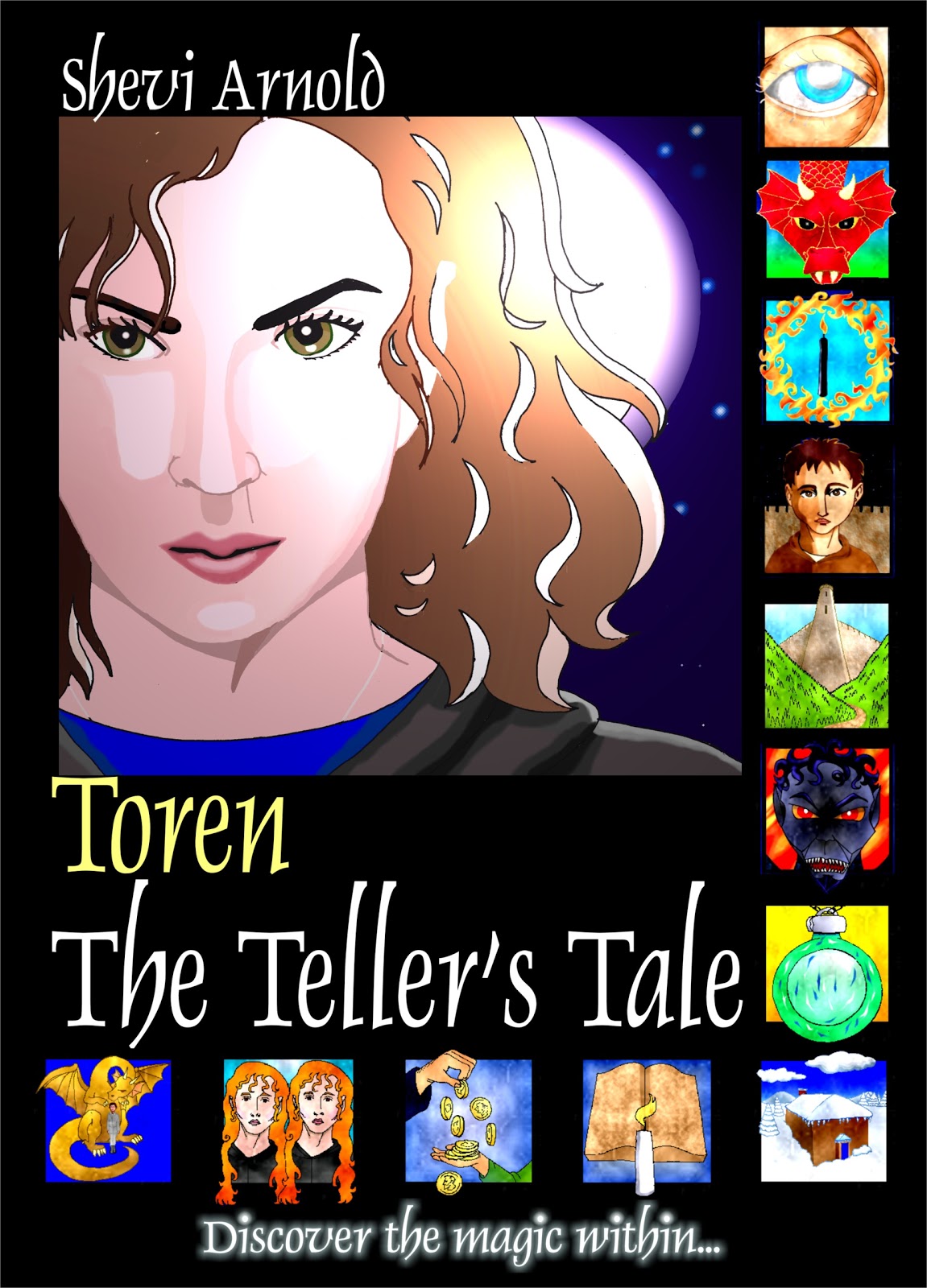

Toren the Teller’s Tale is about real magic. It’s about the magic of stories: the magic that lets you see and hear and touch and taste and smell a story, the magic that transports you to different worlds that could only exist in your imagination, the magic that lets you experience what it’s like to be a boy wizard or a hobbit or a young girl who loves telling stories and is about to discover the magic they hold. Toren the Teller’s Tale is about a kind of magic you know is real. You’ve felt it every time you’ve found yourself swept away by a story.

Those who aren’t very familiar with fantasy and science fiction often think there’s a clear divide between the two genres. Fantasy involves wizards and magic spells and magical creatures, like dragons. Science fiction involves the future and space ships and alien planets and things that could scientifically exist one day.

But there’s more overlap than most people realize. Anne McCaffrey’s Dragonriders of Pern books, for example, have dragons, but they’re science fiction.  Most people would say that Star Wars is a science fiction series, but never say that to a science-fiction purist. Sure, it has aliens, androids and spaceships, but it also has a form of magic called “the force” as well as Jedis, who are basically wizards that live on other planets, have robot companions, and fly spaceships. Star Wars regularly breaks the rules of science, which is fine as long as you don’t call it science fiction.

There are some who have pointed out that the Many Worlds theory of quantum mechanics basically means that all fantasy is actually science fiction, which is true.


That’s a topic that comes up in a conversation between Gilbert Garfinkle and Dungeon Master Dave in Why My Love Life Sucks, the first book in the Gilbert the Fixer series. Gilbert, the young aspiring mad scientist, can’t accept that he’s been turned into a vampire. His life is supposed to be a science-fiction novel. How is it possible that it now contains an urban fantasy trope? In his mind, that’s not scientifically possible.  It makes no sense. Dungeon Master Dave points out that the Many Worlds theory says otherwise. Because if an infinite number of worlds exist, some of those worlds must have vampires, as well as Gilberts that don’t believe in their existence.

The first book in the series shows Gilbert mostly grappling with his strange, new, unscientific predicament. By the second book (Why It Still Mega Bites, which should be out later this year), he’s come to accept that “magic is just science we don’t yet understand.”

Of course, he wasn’t talking about Quidditch.

Tuesday, August 21, 2012

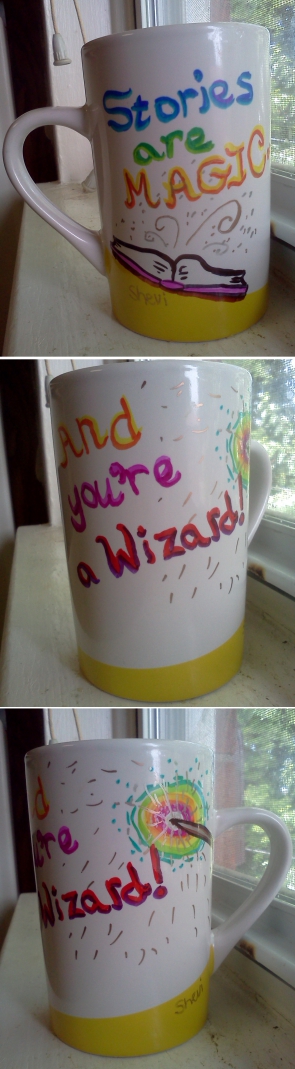
A Mug for Writers: Stories Are Magic...

"Stories are magic...and you're a wizard!" I bought a mug at the local dollar store and used Sharpie brush markers to write and draw on it.

Do you like it?

Tuesday, December 27, 2011

Best review ever!

I'm so excited! I got the best review EVER! Here's just one part of it:

"Do you believe in Magic? I think after reading Toren the Teller's Tale, you will absolutely believe in Magic. The way this story is set up by the author is absolutely mesmerizing." "Even with a black and white Nook, this book is a visual pleasure. I love you Shevi Arnold, and I adore Toren The Teller's Tale."

Thank you, thank you, thank, thank you!

Monday, December 19, 2011

Some illustrations from Toren the Teller's Tale

Toren the Teller's Tale book release!


Toren the Teller's Tale is about a magical storyteller and her struggle to accept the magic within herself. It's a literary fantasy about the greatest magic of all: the magic of stories. It's about the magic that takes us to strange new worlds and allows us to experience that world through another's eyes. It's about the magic that makes us think, feel, laugh, fall in love, and discover things we never knew about ourselves. 

I'm very excited to announce that Toren the Teller's Tale is now available for download in two parts! 

You can pick up book one, Toren the Apprentice's Tale, Amazon,  BN.com, Smashwords and the Apple iBookstore for just $1.99.  My husband and I are currently working on making the complete novel available for download and in paperback. 

I'm now on a Bewitching Book Tour to help promote the book. Thanks so much to all the bloggers below, as well as Roxanne Rhoads, who runs Bewitching Book Tours; and Trista DiGiuseppi, the author of Nails Jane, who also hosted me on her blog. It's very much appreciated.


Dec 19 Guest Blog

Dec 20 Promo
Read2Review

Dec 21 Guest blog

Dec 22 Interview
JeanzBookReadNReview 
http://jeanzbookreadnreview.blogspot.com/                  


Dec 22 Guest Blog 
Natalie Cole Bates

Dec 23 Promo
Roxanne's Realm

Dec 26 Guest Blog
Fang-tastic Books


Dec 27 Guest Blog and review
The Wytch's Mirror


Dec 28 Promo and Review
Book Briefs 

Dec 29 Guest Blog and review

December 30 Guest Post
Lisa’s World of Books


Dec 30 Guest Blog

January 2 Promo and Excerpts
Reader Girls

Review
Sharon
www.swillett.com
swillett11@yahoo.com

Monday, December 05, 2011

The Story Behind Toren the Teller and the Tale


Toren changed my life.
I don’t know how old I was when I first became a storyteller, but I do know I was quite young. I remember telling my youngest cousins and my older cousins’ children stories when I was about ten. I loved the excited look on their faces, how my stories drew them in and captured their imaginations and their hearts. I also remember telling stories to the younger children on the van ride to school. I particularly remember one little girl who would ask over and over, “What happened next?” It was such a delightful question to answer.
As I was growing up, I read anything and everything I could get my hands on. I read encyclopedias and science magazines, because I was very curious, and couldn’t read enough about this world. I also read a ton of comic books, particular collections of Peanuts strips. My favorite books were funny, fantasy or science fiction. I loved the works of Peter S. Beagle, Ursula Le Guin, Anne McCaffrey, J.R.R. Tolkien, Gene Wolfe, Harlan Ellison, Douglas Adams, Isaac Asimov, Orson Scott Card, John Barth, Thomas Pynchon, and so many others.
But while I enjoyed these books, I kept looking for one about a girl like me, a girl who loved stories and loved telling them. I knew stories were magical, perhaps even the most magical thing we can experience. I couldn’t possibly be the only one who felt like this, could I? And who better to write about this particular magic than a storyteller? But the more I looked, the more I realized the book I so desperately wanted to read did not exist. No one had written it yet.
When I was seventeen, my family had moved to Jerusalem, and I had just started college. That first year I studied Hebrew and a variety of other subjects, like Advanced Algebra, Political Science, and Computer Programming. My plan was to eventually study filmmaking, because I wanted to be a director.
You see, I didn’t just love storytelling on paper: I loved it in all its forms, and I thought that movies were the best way to tell a story, because they brought so many of those forms together: with and without words, visually, and through music. I studied the movies I enjoyed, and I tried to figure out how they worked. I still read books, but I read them mostly for entertainment. These were books of my choosing, books that made me laugh and cry, think and feel.
This one night, a book had kept me up late. It was sometime after midnight that my head felt heavy, and I laid it down on the open pages. I looked out of the window of my room. The moon was big and full, far above the horizon. I stood up and walked to the window. I leaned on the windowsill and thought again about that book that didn’t exist, the one about a storytelling girl like me. I closed my eyes and made a wish.
When I turned around, a young woman was standing behind me in my room.
Although she was short, there was something about her that seemed larger than life. She was amazingly beautiful, with her long, dark, curly hair, and her olive-colored, almond-shaped eyes. She was wearing a garment the likes of which I had never seen before.
I asked her for her name.
She said something, but it wasn’t in English. I didn’t understand.
I shook my head.
She slowly reached up and touched my forehead with the tips of her fingers. She closed her eyes, and for a moment, she gave off a golden glow. It was the most amazing thing I’ve ever seen.
“Thank you,” she said, with a voice that reminded me of honey. “You have taught me your language. Both of them, in fact.”
I felt like I should apologize. “I’m still learning Hebrew.” 
 “And now so am I.” She smiled. “I understand you wanted to meet me.”
“I did?”
“A girl like you who understands the magic of stories?”
I was so stunned and happy and excited I couldn’t speak.
“You have taught me your language and about your world,” she said. “How should I repay you?”
Of course, there could only be one answer to that question. “Tell me your story.”  
“I can do better than that.”
Again she touched my forehead. She closed her eyes, and I closed mine. Her name was Toren, and her story flashed inside my mind. I saw, heard, smelled, tasted, and felt all of it. When she pulled her hand away, I was laughing and crying.
I was in awe.
She smiled at me and bowed her head. She looked out the window, and I followed her gaze. A part of me expected to see something magical on the other side. When I turned around again, however, she was gone.
Her story remained with me, and I treasured it. I re-experienced it whenever I was lonely or bored and wanted to be reminded of the magic of stories.
But, like everyone else, I had my life to live. I couldn’t study film, because the university only offered that as an M.A., so I studied English Literature and Theater instead. By the time I had graduated, I realized I didn’t really want to direct movies. I earned a teacher’s certificate, but I didn’t enjoy teaching. Instead I first became an editorial cartoonist, and a comic-strip magazine editor; and then I became an arts-and-entertainment writer, and a consumer columnist. I got married and had two children. I was very happy.
Unfortunately, I had to leave my job and my old life behind when my family moved to New Jersey in search of a better education for my autistic son. I didn’t know what to do. If I couldn’t write, edit, or illustrate for a newspaper or magazine, who was I? What was I?
A few months passed before I realized the answers to those questions. I was still the little girl who loved telling stories to the other children in the van on the way to school. Toren’s story had given me so much joy over the years. And I had been selfish. Somewhere in the world there had to be someone just like the girl I had been, someone who desperately needed a story about the greatest magic of all. It wasn’t just Toren’s story. It was my story, too, and the story of every storyteller who’s ever lived.
Perhaps it’s your story too.

Sunday, September 25, 2011

Fantasy, Science Fiction and the Many Worlds Theory


Before the Many Worlds theory, the separation of fantasy and science fiction was clear. If a story was based on science and scientifically plausible yet not currently possible, it was science fiction. If a story had elements that weren’t based on science and that were not scientifically plausible—like magic, dragons, vampires or ghosts—it was fantasy. The division was clear, and which shelf every book belonged on was simple.
Then along came science fiction writers who used some of the elements of science fiction but sometimes fudged the facts or went beyond what was scientifically possible. So science fiction was divided into hard and soft science fiction. Hard science fiction stuck with what was scientifically possible, and soft science fiction went into the realm of the scientifically impossible. Both were still based on science, but where they went from there on was different.

As time went by, the science in some science fiction became softer and softer, to the point where it was given different labels, like space opera, sci-fi, speculative fiction (or spec-fic or simply SF), or science fantasy. Star Trek, at least after the original TV series, is science fiction. Star Wars, though, is a space opera. Science fiction movies and TV shows that are very weak on their science are generally considered sci-fi. Speculative Fiction tends to be more literary and deal more, as the name implies, with “What if?” rather than what could be. And science fantasy is fantasy with science fiction elements, like Doctor Who. Doctor Who has had episodes with ghosts, vampires, werewolves and so on, usually giving pseudo-scientific explanations for them. You can’t argue that things in Doctor Who are scientifically impossible, because it’s not meant to be science fiction. Stick a bunch of planets in the Earth’s sky without gravity on Earth going haywire, and that’s fine. It’s science FANTASY, so it doesn’t have to follow the laws of science.  


But let’s step back in time a little before all this was going on. In 1957, Hugh Everett formulated a theory that reconciled the indeterministic behavior of subatomic particles with the laws of physics. This theory, which he called the theory of Universal Wavefunction, was later renamed by Bryce Seligman DeWitt and popularized as the Many Worlds theory. According to the Many Worlds theory, our world is one of many—perhaps even an infinite number of worlds—that are like our world but different in ways both big and small. Expansions of the Many Worlds theory have taken this even further by saying that many of these worlds might not even follow our laws of physics.

I repeat: according to expansions of the Many Worlds theory of physics, there are many--perhaps even an infinite number of--worlds out there that don’t follow our laws of physics.    

The Many Worlds theory was both troubling and exciting for the science fiction community. It was exciting because it opened up so many new possibilities. There could be alternate histories, like 19th century worlds with 21st century technology, or to put it another way, there could be steampunk. Time-travel paradoxes no longer existed, because instead of traveling back in time to a world where you weren’t meant to exist yet, you would travel sideways in time to an alternate world to which you were always meant to have time traveled. In a scene near the end of the most recent Star Trek movie, the two Spocks are having a laugh at Kirk because the older Spock managed to convince Kirk that his meeting with the younger Spock would cause a time-space paradox, which according to the Many Words theory couldn’t happen. But the meeting of the Many Worlds theory and science fiction was also troubling, because how do you define hard science fiction as being different from soft science fiction, science fantasy, and even fantasy if EVERYTHING (except for paradoxes) is scientifically possible?

I think the distinctions between fantasy, science fiction and science fantasy remain the same, but with one exception: fantasy that uses science to explain the fantasy in it can be science fantasy or even science fiction.

Back when I was in college, I fell in love with a science fantasy series by Gene Wolfe: The Book of the New Sun (Shadow & Claw: The First Half of 'The Book of the New Sun'


Wednesday, August 31, 2011

Is Fantasy Truer Than Fiction?


If you’ve read any fantasy novel—such as Alice in Wonderland, The Wonderful Wizard of Oz, Harry Potter,  The Lord of the Rings, or Twilight—you knew it wasn’t real. Cats that vanish, leaving behind only a smile? Flying monkeys? Young wizards and witches casting magic spells with wands? Hobbits and dragons? Vampires? How could any of that be real?


And yet . . .


And yet, there’s a magic in these stories, a spell they cast over their readers. If you’ve ever felt it, you know. That magic is real. It’s the magic that takes you to strange and wonderfully magical worlds. It touches your heart. It makes you cry. It makes you cheer. It makes you feel.  


That magic plays a more obvious role in many of my stories, never more so than in Toren the Teller’s take. It’s the topic of discussion in this scene from my soon to be released YA fantasy epic, Toren the Teller’s Tale. Toren, disguised as a boy and a storyteller’s apprentice, is at a tellers’ gathering. Between stories, the tellers discuss their craft:


“Yes,” said another apprentice. “And what about made-up stories, ones about fantastic things that could never be true? Where’s the common starting point, and where’s the greater truth?” 

The elder master said the answer to this question was obvious, and he turned it over to us. No one else spoke, so I asked if I might be allowed to. He nodded.
 
“We all have common hopes and fears,” I said, “from the lowliest peasant to the king. We dream of someone who will love us more than life itself. In her dreams, every maiden is a princess longing for love; in his dreams, every youth is the one who will win her heart. Even the king’s hopes and fears are as common as our own.”

“And what about fantastic stories?” the elder master asked me.

“My master’s story was fantastic,” I said. “And yet it’s true. A man wants a son to follow in his footsteps and may be blinded to a truth he doesn’t wish to see. A woman may know the truth and be afraid to speak it. And a child may suffer for not being what the world demands her to be.”

The elders smiled at my answer, but one of them shook his finger.

“Although what you say is true,” he said, “I believe a story’s truth is even greater than that. One day you’ll see. You’ll think you are telling a story, but the truth of it will take over, and you’ll realize the thing you thought you created was always there, not in this place and time but somewhere in the infinite universe and as true as your own existence. We tellers are bridges from the past to the present, from the present to the future, from distant lands to here, and from here to everywhere.” 

“Of course we are bridges,” the man to his side said, “but only to imaginary worlds.”

“On the contrary!” the first elder shouted. “All worlds are equally real! You may think of stories as mere entertainment, but they are so much more. We spoke of how the audience must shape the story, but responsibility we tellers carry.”

The other elders were silent. One rolled his eyes. It was a man in front of me who dared to speak what was on everyone’s mind.

“The worlds of our stories already exist?” he mumbled. “Old coot’s gone senile.”

A murmur of agreement rose from the crowd, followed by laughter.   

“It is rather ridiculous, isn’t it?” Giddy asked me. “That would make everything imaginable real, and you know that can’t be right, can it, Tor?”

I laughed, but inside I wondered. Of course it did sound impossible.
And yet . . .


Is the first elder truly crazy?
 
The reply Toren gives above is the sort of thing Ursula K. Le Guin wrote about in The Language of the Night: Essays on Fantasy and Science Fiction. Fantasy deals with universal human experiences. Its archetypes are familiar—not from our day-to-day lives that differ from one person to the next, but from the dreams we all share. There is one language we all know, and it’s the language of the night. It’s what Carl Jung referred to as “the collective unconscious.” We all have similar hopes and fears, and they come out in our dreams—and in our fantasy and science-fiction stories.    

And that's why fantasy fiction is more honest than realistic fiction: because fantasy fiction deals with archetypes without the pretense that they are more than--or less than--archetypes. You know that Harry Potter isn't a real, living, breathing person; but you also know that his universal need for a family is real.  You know it because you've felt it too.

But this only fits what Toren says about the nature of stories. What about the first elder teller? Could he be right? Could there be a truth in fantasy that goes beyond touching upon our dreams and nightmares?
 

According to the Many Worlds theory of physics, the answer to this is a resounding yes.
 

Our world is one of many, many worlds that are like ours but different in ways both big and small. Expansions of the Many Worlds theory say that there are even worlds out there that don’t follow our own laws of physics.
 

Do you realize what that means? Disappearing cats, flying monkeys, young wizards and witches casting magic spells with wands, hobbits and dragons, vampires: they could all exist. Every story you’ve ever read—not matter if it’s realistic, science fiction, or fantasy—could be true. Not here, of course, but somewhere out there in our amazing universe.


And our dreams and our stories can show these fantastic worlds to you.


Toren, however, can do so much more. She can build bridges from her world to the worlds of her imagination, and she can take you along for the journey.


Which magical world would you like to visit today?  

And now I'd best step down before someone calls me a crazy old coot.