I've attended several SCBWI NJ Mentoring Workshops, and I feel I've got a lot out of them. This was my first SCBWI NJ Conference, and although I'd heard only wonderful things about it, I did go with some apprehensions. Would I feel overwhelmed by the crowd? How would I work out attending a conference over Shabbat? Would it be worth the cost?
I talked it over with my husband. We could go as a family and spend Shabbat together. A little bit of duct tape over the locks meant we wouldn't have to use the key cards to get into our room, and we could lock all valuables securely in our car. We could bring our own food--that would have been necessary even if I didn't keep kosher because of my anti-yeast diet--and I didn't have to write anything during Shabbat. It was doable, and we agreed it was a good idea. After talking with Kathy Temean, the SCBWI NJ RA, I felt excited about it. We even discussed the possibility that I might give a workshop next year, although it was too late for me to do that this year.
FRIDAY
ARRIVAL
I arrived at the hotel on Friday at noon. Too early to check in, I went straight to the conference center, schlepping my many bags with me. I wanted to hand my portfolio in early, because I couldn’t sign it in on Saturday (for religious reasons), but I couldn’t find the person I was supposed to give it to. (I didn’t bother to bring anything for the juried art show, because I didn’t have the proper equipment.) So I picked up my name tag and information packet, chatted with a few old friends, like Kathy and Laurie, met sweet and helpful Ame--with her happy high voice, her spiky red hair, and her little red bow--and went to my Friday intensive.
I’d had a hard time choosing an intensive, because they all sounded too basic for me. I somehow ended up with “The Craft and Art of Writing” with Stephan Barbara. Too late, I noticed there was one on self-editing. I probably should have gone with that one.
THE CRAFT AND ART OF WRITING
Stephan is a young, amiable, good-looking agent with a Lit degree, who used to work as a book reviewer for the Wall Street Journal. Reviewing books turned out not to be a good job if you were hoping that people would write to tell you how helpful they found your reviews (also not the best if you want to get paid, or at least that’s been my experience). The only time people wrote to him was after he reviewed a book that painted the Boy Scouts in a less than favorable light, and then it was all hate mail.
I didn’t even know the Wall Street Journal reviewed books, but in the week after the conference, a WSJ article on the darkness in YA drew a lot of criticism from YA writers who felt their work was being attacked. Frankly, I think this drew an unnecessary amount of attention to an article that otherwise would have only been read by a handful of people. Hate mail lends more weight to such articles than no attention whatsoever. This isn’t the famous New York Times book review section, after all.
He asked us what the necessary parts of a story were, and he wrote the answers down on a large sheet of paper. Character. Conflict. One of the things he wrote down was an “antagonist.” I said it didn’t belong there. He said, “Name a story that doesn’t have an antagonist.” I said, “When Harry Met Sally.” Silence. (I could have added “Almost every episode of Friends.”) Someone else said that an antagonist didn’t have to be a person. Really? Let me look that up in the dictionary… From Dictionary.com: ”antagonist: noun 1. A person who is opposed to, struggles against, or competes with another; opponent; adversary. 2. The adversary of the hero or protagonist of a drama or other literary work: Iago is the antagonist of Othello.” Sounds like an antagonist has to be a person to me, but I could be wrong.
He wrote down the parts, and then told us to write the start of a story. I did. Then I waited. And waited. And waited. So he suggested I write the starts of three stories, so I did. And I waited. And waited. And waited. It turns out everyone else was writing the outline for half a story, not the start of a story. We went around the room and read what we had written. Lisa had written a great outline for the start of a story, so we picked hers to work on as a class. We then discussed what would be the best opening scene and the best POV (Point Of View), and we wrote opening scenes. We then discussed what scene would make an interesting confrontation between two characters in the story, and we wrote those. After each writing period, we read what we had written out loud. Mine elicited a laugh at the right spot, so I guess it worked.
The intensive lasted four hours, and I can’t say I really learned anything from it, except that if you write book reviews for the Wall Street Journal and you want people to actually read them, review a book that paints the Boy Scouts in a negative light. As for the less experienced writers in the class, I think the main thing they might have taken away is “Authority: set the stage on page one with confidence.” That’s something I do see as a distinction between some newbie writers and those who have been at it for a long time. Sometimes newbie writers can be too timid, not willing to let the story be all that it can be. You have to believe in yourself and in your story if you want your reader to, but it can take time to gain that confidence.
AGENT CRITIQUE
My agent critique came next. I’ve talked with this agent before, and I think if I do get to the point where I need an agent, there’s a good chance I’ll choose him. I like his attitude, and I like his questions. They let me see things in my manuscript I maybe haven’t considered before. He doesn’t micromanage, which is good, because I really don’t need hand holding, just career guidance and help making the right connections and getting the best deal.
We talked about my plans regarding e-publishing (he said I seem to know what I’m doing) and about Why My Love Life Sucks. He loved Gilbert’s voice and the humor, loved the dialogue. I said that’s because I’ll often write the same scene three times, so I can get it just right. He put on a shocked face and said, “You mean you don’t get it right the FIRST time?” I laughed and said, “In Improv they like to say you shouldn’t worry that it’s going to suck--because it’s DEFINITELY going to suck.” He said, “I have a client I’d like you to talk to.” Then it was my turn to laugh.
THE WYNDHAM HOTEL
I found someone who would take my portfolio for me, which lightened my load a little. Then schlepping what was left of my bags, I returned to the lobby and checked in. I got my room key, and then spent the next half hour getting extremely lost in the hotel. It’s not a huge hotel, but it’s very easy to find yourself going back and forth between floors, or maybe I should say half floors. The same floor can actually exist on two levels, and it turned out my second floor room was half a floor below the second floor where the conference was taking place. Eventually I returned to the desk, asked for directions again, and got the right room.
It was very nice, and the beds were extremely comfortable, possibly the most comfortable of any hotel beds I’ve ever slept in. The view was okay, although it mostly consisted of the branches of one tree that extended all the way to our window. Even in the middle of the day, there wasn’t much danger of bright sunlight getting into the room. (A little bit of sunshine would have been nice.) My husband and kids soon arrived with our luggage and flowers for me. It was our anniversary. That was so sweet for him to bring me flowers.
I enjoyed a quiet Friday night with my family. We ate dinner in our room. It was nice. I didn’t go to the Friday night Mix and Mingle because the charge was mostly for the food, and I couldn’t eat any of it. It was right outside our hotel room door, though, so I couldn’t help but walk through it. I guess it would be great if you’re a social butterfly, but parties aren’t my thing.
SATURDAY
BREAKFAST
Saturday started with breakfast, but again I couldn’t eat anything, so I asked my husband to check it out to see if there was anything he could eat. He got one bottle of orange juice, and found my portfolio had been laid out. He returned to the room, grabbed a bunch of the little wind-up robots I’d brought for promotional purposes, and put them next to my portfolio. We kept adding robots as they disappeared, so I’m glad I managed to give most of them away. (They have the URL to my website on them.)
GRACE LIN’S KEYNOTE SPEECH
After eating breakfast in my room, I went to the amphitheater to hear Grace Lin’s keynote. It was funny, heartfelt and sweet. Grace Lin talked about her childhood, how she grew up in a little town where her family was the only Chinese one. She thought of herself as American as anyone else, until someone read Five Chinese Brothers, and another kid turned to her and said, “Chinese just like you!” She grew up wanting to illustrate classic fairy tales, and she was well on the way. But then during a scholarship that took her to Italy, she realized she wanted to learn more about Chinese art. She discovered the bright colors of Chinese folk art, and she embraced it. After publishing one Chinese-American picture book, she had to decide whether she wanted to be labeled a multicultural writer, and she decided to embrace it. And in the end she discovered that by writing books for kids who were “Chinese just like me,” she ended up being a truly multicultural writer, one who is embraced by all children from all cultures.
AGENT PANEL
The Agent Panel mostly centered on ebooks, because that is, after all, the hot topic everyone wants to know about. I asked two questions. First, if one of your clients came to you wanting to self-publish an ebook, would you support that client? Second, with Nook books and ebooks for the iPad offering so many bells and whistles, how are paper books going to compete? The agent from Andrea Brown Literary said they’ve just published an ebook with one of their writers, and they’re looking to see how that goes. As for interactive picture books, most felt hardcover picture books still had a lot to offer, and that ebooks didn’t provide enough added value to make them replace hardcover picture books altogether.
The Agent Panel was very interesting, which is why I regretted having to leave in the middle for my author critique.
AUTHOR CRITIQUE
I learned a lot from my author critique, namely how NOT to run an author critique. People pay extra to get these critiques. They don’t pay for condescension or attitude. At one point the author assumed I was offended by something she’d said. I replied, “No, I get it. It’s not personal. It’s business.” Her reply was, “Oh, it’s ALWAYS personal.” What the heck does that mean?
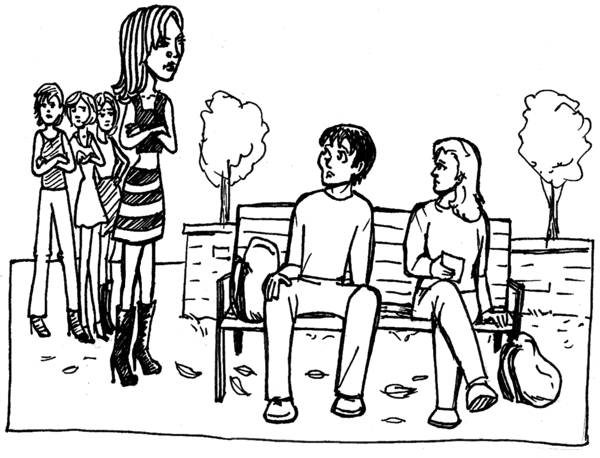
I only paid for an author critique because it was the only way to get an additional editor or agent critique. I had three critique sessions, one pitch session, and one consultation at this conference, and the only one who seemed to go out of her way to be mean was this writer, who is actually less experienced and less qualified than any of the other critiquers I had. Heck, she’s less experienced than I am! She said it was a good “rough draft” (I have edited it many, many times). And after telling me all the things she felt needed to be changed, she wrote, “While it may seem overkill, I have the satisfaction of hearing agents & eds tell me that my mss are polished. That’s a level you want to achieve to capture your publishing dream.” It’s a wonder she can get her shirt on with a head that big.
I have one word for a writer who thinks that much of herself and that little of everyone else, but it’s not a very nice word, so I won’t use it. Still, if I’m ever in a position to give author critiques at a conference, I will definitely go out of my way to be nice. It doesn’t cost anything, and it’s only fair to the person who has paid for the critique. A little respect goes a long way, and you get back what you give.
FIRST PAGES SESSION
After this, I had my first pages session, which didn’t go well. The reader had a monotone voice, and the editor and agent missed the humor in my manuscript. They also ripped apart someone else’s first page, even though it was hilarious. I told the author after the session that I loved her work. I hope that story gets published. It sounds fun, funny and cool.
MINDING YOUR OWN BUSINESS
I went to my room to join my family for lunch, and returned for one of the best workshops: “Minding Your Own Business” with Sudipta Bardhan-Quallen. Sudipta has published many picture books, but she makes only about a third of her money from advances and royalties. The other two-thirds mostly come from school visits, work-for-hire, and professional development (like speaking at teachers conferences). She talked about how to get these jobs and what to do when you give an author visit so it’s all about giving your listeners something, not talking about your books. If you write picture books or Middle Grade novels, I’d say this workshop is a must.
QUERY LETTERS
The next workshop I had was Query Letters with agent Mary Kole, but unfortunately my Agent Pitch session pulled me out for the first 10 minutes, and my editor critique pulled me out for the last 20 minutes, which means I only sat in the class for 15 minutes. I’m sure it was great, but I didn’t really get to hear any of it. There might have been a handout, but I didn’t even get to find out about it.
AGENT PITCH SESSION
I was very nervous about my Agent Pitch, but it still went surprisingly well. She laughed at the right place, and pointed out two things I needed to fix (I didn’t know a pitch needed the word count, but I did know it needed the main character’s age, and I can’t believe I left that out). She also said she’d like me to submit Why My Love Life Sucks to her. Yes!
EDITOR’S CRITIQUE
The critique with the editor went very well too. Among the things she wrote: “This is really hilarious! Great writing and great work! You’ve done a great job at character development with Gilbert! He feels real and totally believable. I love his mom as well. Great, authentic teen language—great work! The voice in this piece is one of your biggest assets. It’s fresh and believable. I think this has a lot of [marketing] potential. I love that it’s a funny twist on the vampire story! I think you’re ready to look for representation.” She gave me some line edits to work on, and she asked to see the entire manuscript! Yahoo!
RELAXING AT THE POOL
I then had a break for an hour and 20 minutes, so I used them to go swimming in the hotel’s pool. I know these conferences tend to revolve around food and eating, but what I wouldn’t give to go to a writing conference that revolved around swimming, going for walks, playing games, and just having fun instead. The swim was great. It helped me unwind, and I really needed it. I can’t be the only one who would have enjoyed a swim.
YA’S LITTLE SISTER: UPPER MIDDLE GRADE
My next workshop was YA’s Little Sister: Upper Middle Grade, with Olugbemisola Rhuday-Perkovich and Audrey Vernick. It was a lot of fun, and not just because when we heard another workshop cheering, we opened the door to our room, clapped, and let out the loudest cheer we could. (That’s right, we messed with their minds, and it was hilarious.) There was a helpful handout, so we didn’t need to take notes, and we could just relax and chat. We talked about what distinguishes upper Middle Grade from YA and regular Middle Grade. Novels for younger readers usually have neat endings, but kids in seventh and eighth grades are in transition, and the endings of novels for them reflect that. Upper Middle Grade can deal with more serious issues, just not sex, and it’s best to avoid any PG language so that Scholastic doesn’t ask for edits if your book is selected as a book-club option. If you’ve written a clean YA, you might want to consider making your main character 13 or younger. Editors are looking for upper Middle Grades, written by writers who know how to capture a 6th-8th grade kid’s voice. We chatted. We laughed. We had a great time. And it was nice meeting Olugbemisola, who until then I’d only met online. She had the cutest yellow smiley ring.
SHUFFLEBOARD, SORT OF
I had dinner with my family, and at some point I played shuffleboard with a writer named Sonia. Okay, technically it wasn’t shuffleboard, because neither of us knew how to play, so we just made up a game as we went along. The shuffleboard table was in the same place the Mix and Mingle had been on Friday night, and so were a couple of pool tables, a foosball table, and a ping pong table. We had no idea what we were doing, but we laughed a lot and had a ball. The other people at the conference had no idea what they were missing.
MARKETING CONSULTATION
I then had a consultation with Harold Underdown. It was great to finally meet him. I’ve chatted with Harold many times online, and I worked with him on the SCBWI Illustrator’s Market Guide a few years ago. Harold critiqued Why My Love Life Sucks, and he had a few ideas about submitting it, namely that I haven’t done that enough. It’s true. I have a fear of submitting my work. It’s so bad that there have been times I felt unable to breathe. I get palpitations. But if I do want to traditionally publish, I need to just do it. Thing is, I haven’t quite made up my mind yet. Indie publishing ebooks is looking better all the time.
THE ART SHOW ON THE BRIDGE
My family had another quiet night. We considering going out for a walk around the hotel, but it was dark, and I have poor night vision. The hotel is located in a lovely wooded area with a lake and a waterfall. There’s a map to tell you were to go if you’d like to jog around the lake. There’s a bridge that connects the hotel to the conference center, and it passes over the water. This is where they set up the artwork for the juried art show, and the pieces illustrators had brought in were wonderful. I particularly liked Penny Weber’s giraffe, with the two boys painting spots on it. The framing and flow of the piece were perfect. I also loved Doris Ettlinger’s piece—how you could feel the heat coming off the sun in the painting—and Leeza Hernandez’s funny “Bad Hair Day,” with an angry girl pulling her huge mass of hair along in a little red wagon. The bridge was the perfect place to exhibit the work. The views from that bridge are gorgeous, particularly when there’s a rowboat or two on the lake. My husband enjoyed taking our son out for a walk during the day when I was busy at the conference, and I wish I could have joined them.
SUNDAY
Another breakfast with my family on Sunday morning, and then it was off to David Caruba’s agents and editors survey.
DAVID CARUBA’S AGENTS AND EDITORS SURVEY
This was definitely the most informative speech that was given in the amphitheater. David Caruba surveyed close to 30 agents and editors, including a few that weren't at the conference. Although the agents and editors reported that 60% of their sales are in YA, and only 40% of their sales are in Middle Grade, they are acquiring almost 80% Middle Grade, and only 20% YA. Agents and editors are predicting that Middle Grade will be a hot age group in a couple of years, and while they are inundated with YA manuscripts, they don't get nearly enough Middle Grade novels.
The good news about the picture books is that they're holding ground, and agents are still acquiring them (although less than 5% of what their acquiring is from picture books). While it wasn't so long ago that the preferred length of picture books had dropped down to 1000 words and then down to 500 words, the preferred length now is under 300 words. Picture books also have to be character driven, because publishers want to know that they will be able to market a series with the character.
Middle Grade does more school and library business than YA, but YA sells better. They are actively looking for Middle Grade --- but not actively buying it! Magical realism in Middle Grade is HOT. They don't want "quiet." Quiet means literary, and when an editor says your manuscript quiet, what she means is "It's great, but it's literary, and I can't sell literary." What they can sell our books like the Percy Jackson and the Wimpy Kid series. Genre fiction sells, and that's what they want.
YA is in transition. "It's the machine and then knows no end. It is the Energizer Bunny." But there is too much of it out there. The competition is tough. And publishers want to see a big success right away. In this market you're better off if you haven't published before, because previous weak or middling sales can really hurt your chances. It's harder than ever to get published without an agent --- but getting known on the Net (and at networking opportunities like this conference) can help you get an agent.
FANTASY is HOT. How hot? 85%. That's pretty hot. But there's too much dystopian. "If you call it dystopian, editors won't take it."
In regard to vampire novels, ironic vampire novels are HOT -- YES! (I half suspect that the agents and editors I talked to at the conference skewed the results here, and if so I thank them!) Fat Vampire and Jane Jones: Worst Vampire Ever are two examples of ironic vampire novels.
The fact that Borders is closing is weighing heavily on their minds. They're hoping the money will transition into e-books sales. David said he believes that bookstores will it evolve to become more about coffee and board games and less about books, but he does think they will continue to exist.
Agents say that editors are offering lower advances.
Science fiction is the next big thing, but that six months from now, and agents and editors need to look two years into the future.
Humor in Middle Grade is good. E-books for YA are good. One major agent said, "People want series, not one-offs. I think it's a drag."
Only genre books are selling. That's all the agents and editors want right now. They're looking for all kinds of genres. While fantasy and science fiction are the hottest, they're also looking for good thrillers and the like. Both agents and editors lament that publishers want a hit out of the gate, and they don't want to build an author anymore. The biggest question right now is Amazon, particularly now that they’ll be publishing. Everyone wants to know what Amazon is going to do next.
So in short: YA is strong, Middle Grade is doing well, Picture Books are holding their own, Amazon is up, Borders is down, and the field is healthy.
OVERVIEW OF BOOK CONTRACTS
My first workshop on Sunday morning was Overview of Book Contracts with Edward Necarsulmer, and it was great, because it allowed us to ask him questions about what an agent does. We learned a lot about foreign rights, movie and TV rights, and more. We learned about the parts of the contract that can be negotiated and the parts that can’t. Very informative.
BANGING YOUR HEAD—15 THINGS I LEARNED THE HARD WAY
The workshop after that was Banging Your Head—15 Things I Learned the Hard Way. Some of the things she learned the hard way I’m rather surprised anyone didn’t find obvious, but what was worse, I felt there were also a few pieces of misinformation. There was a handout, so I can give specific examples. Number one: “No cutesy pictures.” (Apparently, it didn’t occur to her that there might be a few illustrators at a writers AND illustrators conference.) Number five: “Also, substitute other words in place of said; [the semi-colons are hers, not mine] yell, cried, whispered, and the like because they are more descriptive…. Careful about adverbs, though, they are currently out of favor, but sometimes one is necessary; cried softly or cried loudly.” The problem with this is that you shouldn’t use an adjective when you can simply use a more specific verb. You shouldn’t write “cried softly” when you can write “whimpered.” You shouldn’t write “cried loudly” when you can write “wailed.” And very often writers—in trying to substitute words instead of “said”—use words that aren’t verbs of speech, which can produce some silly results. For example, “she breathed” or “she laughed.” You can’t breathe or laugh words.
I could add a 16th item to her list of things I learned the hard way, namely do not sign up for workshops with names like “Banging Your Head.”
CO-AUTHORING A BOOK
Next came Co-Authoring a Book with Natalie Zaman and Charlotte Bennardo. I met Nat at a Mentoring Workshop in the fall, and it was nice to see her again. I’ve been thinking about contacting someone who writes thrillers so we could work on an idea I have for one, and I was hoping to get some information I might be able to apply. I didn’t. Instead we heard how these two writers met and ended up writing Sirenz together. Before they started writing, they decided that they would drop the manuscript if it ended up coming between them. They each wrote one of the two first-person characters. When one was finished writing a chapter in her character’s voice, she passed the manuscript to the other to write the next chapter in the other character’s voice. Charlotte likes to write the first draft, while Natalie likes to edit, so their talents complemented each other. It worked, and the book is coming out now.
LUNCH
At lunch I sat next to a children’s songwriter from a town outside of Philadelphia, although I ate my own sandwich (cold cuts in a brown-rice tortilla). Rob teaches kindergarten, and we talked about ebooks. He’s working with an app developer, and we both agreed that ebooks are the way of the future and the future is coming much sooner than the agents at the conference seemed to imply. Someone at the table suggested we each talk about our work and swap business cards. I got into an argument with someone about The Sun Also Rises. It was one of his favorites, but I hate it, because it ends exactly the way it starts. What’s the point of reading a book if it doesn’t go anywhere? Seriously, would anyone publish that today? And if they did, would anyone want to read it? Yes, it’s very well written. In a way, that makes the utter lack of change in the story all the more frustrating.
HOLLY McGHEE’S KEYNOTE SPEECH
Lunch was followed by agent Holly McGhee’s keynote speech, which I mostly missed because I thought I’d lost my Flip video camera, and I was in a panic. All I remember is that it involved a writer who got cancer, and I think he got better.
RAFFLE
I ran around the hotel looking for the camera, but couldn’t find it. (It later turned up in a compartment in one of my bags, thank goodness!) Then came the raffle, and I was glad when Laurie won the prize I had donated: a custom-designed book trailer, blog, or cover with stock artwork. I won a basket of paper products donated by Connie, which was nice. What writer doesn’t always need more paper? She said it should be lucky paper, and everything I submit on it should be bought. That was very sweet.
AND THAT’S IT, UNTIL NEXT YEAR
I picked up my portfolio and my big basket of paper, said goodbye to everyone, and headed off to the pool. My husband had already taken the kids home, and we’d arranged to meet at the pool. He made it just in time to get one more swim in, and then we went home.
We had a good time, and I’m looking forward to doing it again, although next year I think I’d prefer to give a workshop. It will probably be about the House of Funny method for creating humor, which can be adapted to create an infinite number of story plots too.
Until then, I need to get started on my vlog on that topic. Should be fun!


 --which is here for your viewing pleasure: