Showing posts with label young adult. Show all posts

Friday, May 27, 2016

Words for Nerds #AtoZChallenge--Y is for YA (an interview)

Shevi: Hi, YA!

YA: (Continues to text on her phone, her face partially hidden behind her hair. She shrugs.)

Shevi: We’re here to set people straight about all the mistaken assumptions they have about you.

YA: (Pausing but not looking up from her phone) Yeah! People just don’t get me.   

Shevi: I think most people know that YA stands for “Young Adult.”

YA: (Sighs and rolls her eyes) I don’t like being called that anymore. I’d rather be called “Teen.”

Shevi: Totally understandable, since that’s clearly what you are.

YA: Duh!

Shevi: Okay, so I think most people know that YA books are books with main characters who are between thirteen and seventeen years old.

YA: Yes, but we’re not all the same.

Shevi: Right! There’s younger YA, which is more for teens between thirteen and fifteen. And then there’s older YA, which is more for teens between sixteen and seventeen.

YA: Because we’re dealing with different stuff.

Shevi: Absolutely! For example, the Georgia Nicolson books by Louise Rennison, like Angus, Thongs and Full-Frontal Snogging, deal with friendships, first crushes, everyday family stuff . . .


YA: And the character is younger, so that’s definitely younger YA.

Shevi: Yes. And my Legend of Gilbert the Fixer series that starts with Why My Love LifeSucks has a seventeen-year-old character dealing with the last year of high school and who he wants to be after high school.

YA: Definitely older YA.

Shevi: Yes.


YA: But it’s only like PG-13, so younger teens can read it.

Shevi: Yes, and that’s true of a lot of YA. Younger teens can read it. They just might not necessarily relate to it. It depends on the maturity of the particular reader and what they’re going through.

YA: (Back to texting) Yeah.

Shevi: And that’s one of the misconceptions I’d like to clear up. Some people think that any book with a teenage protagonist is a YA, and that’s just not the case.

YA: (Laughs) Yeah, because if that was true, all those Disney princess movies would be YA, and they’re so not!

Shevi: Right! A YA novel has to deal with same things teens are dealing with today. Like first romantic relationships.

YA: (Blushes) Ewwww . . . Don’t talk about that out loud, okay?

Shevi: Don’t worry. It’s just between the reader and you.

YA: (Nods and goes back to texting)

Shevi: Two other common misconceptions are that a YA book has to be completely clean . . .

YA: (Laughs) Yeah, no.

Shevi: Or that YA books can only be issue books that deal with things like sex, violence, drugs . . .

YA: (Blushes) Yeah, no.

Shevi: A YA book can certainly deal with serious issues. That’s fine. But there are all kinds of YAs.

YA: Yeah, just like there are all kinds of teens.

Shevi: Exactly. And a YA refers to an audience age-group, not a genre. A YA can be in any genre. It can be an issue book, but it can also be a comedy, a fantasy novel, a science fiction novel . . .

YA: (Excited) Have you read The Hunger Games? It’s ah-mazing!


Shevi: That’s another thing. You don’t have to be a teen to appreciate YA. A good book is a good book, no matter how old you are.

YA: Thank you!

Shevi: Before we go, is there anything else you’d like people to know about you?

YA: (Looks up and puts her phone down. She takes a deep breath and lets it out.) I wish people would stop telling me what to do.

Shevi: Meaning?

YA: Some writers treat us like we’re little kids. They don’t understand who we are or what we’re going through. They lie to us. They’re not honest. You don’t have to tell me what to do or think or feel. I can do those things for myself! It’s like . . . it’s like they don’t respect me.

Shevi: (Nods) I think that’s something every writer should keep in mind, no matter who their audience is. No one likes to be condescended to. I know I don’t. And you know what else?

YA: (Shrugs)

Shevi: I love your honesty. I think that’s what makes you one of my favorite categories of books. You don’t waste time but get straight to the point.


YA: (Blushes) I like that about me, too. 

Shevi: So I hope that clears up a few misconceptions. If you want to know more, just check out the books in the the teen section of your local library or bookstore. The more you read, the more you'll realize how great YA books are. 

Thursday, August 08, 2013

Carousel at dusk

I took this photo on Thursday, July 18, 2013 in Hershey Park, Pennsylvania during a heat wave. It's late in the evening and the lights are on. There's something magical about an amusement park at dusk. It reminds me of my YA ghost story romance set in an amusement park, Ride of Your Life.

Monday, July 02, 2012

Download the first chapters of RIDE OF YOUR LIFE for free!

You can now download the first chapters of Ride of Your Life for free!


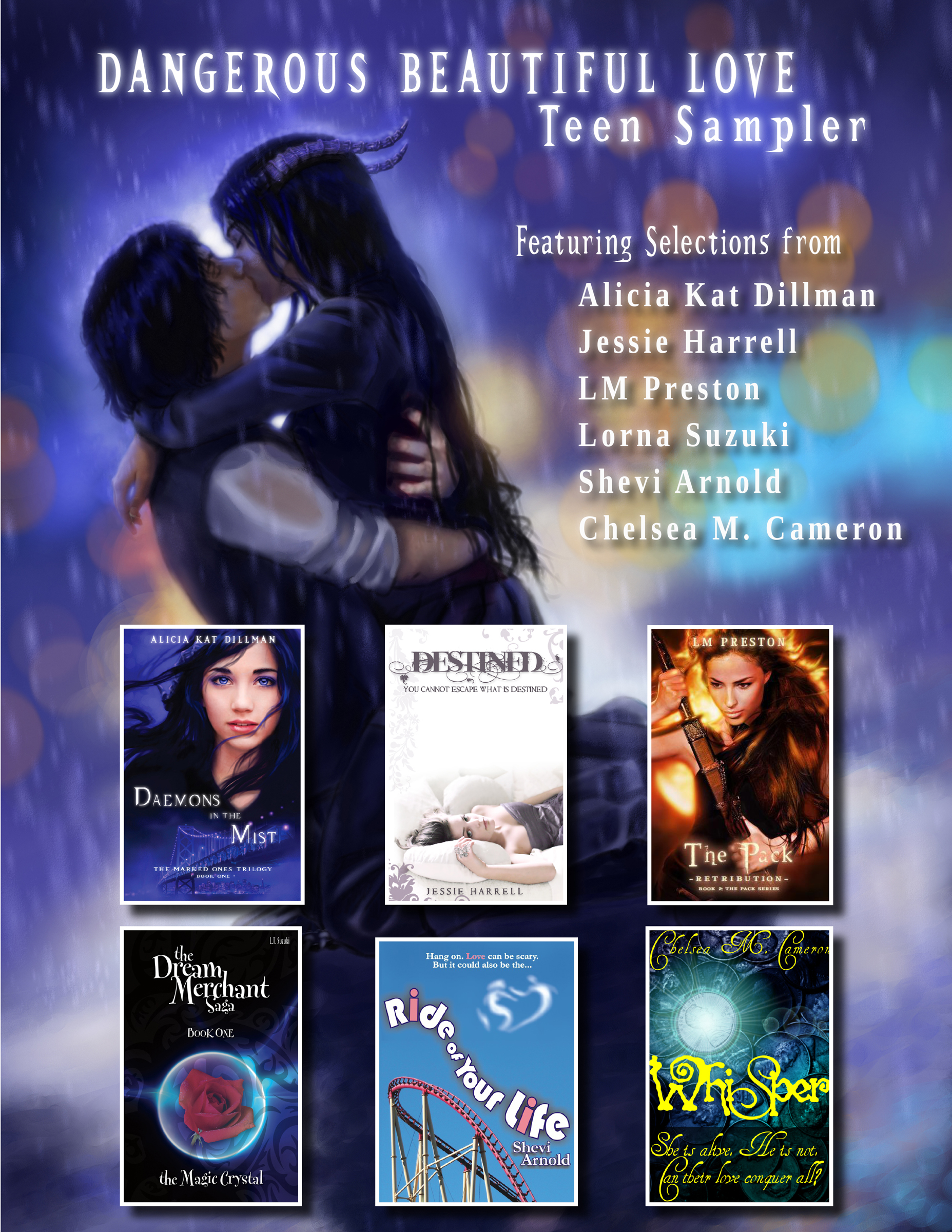
Yes, Ride of Your Life is a part of an exciting new teen fiction sampler put together by the amazing, super-creative Alicia Kat Dillman: Beautiful Dangerous Love.   


Cover of Dangerous Beautiful Love Teen Fiction Sampler


Here's the blurb:


"Do you crave the dangerously beautiful worlds of paranormal suspense, ghostly romances, and otherworldly adventures? The you’ll be swept up in this sampling of six fantastic indie reads including Daemons in the Mist by Alicia Kat Dillman, Destined by Jessie Harrell, The Pack -Retribution- LM Preston, The Magic Crystal by Lorna Suzuki, Ride of Your Life by Shevi Arnold, Whisper by Chelsea M. Cameron."


So what are you waiting for? Start the summer off right by downloading this wonderful mix of teen fantasy, science fiction, paranormal and romance from Smashwords today.  

Sunday, June 17, 2012

The Fine Art of Talking to People Who Aren’t There: Drawing Fictional Characters to Life

 I’m delighted to have a wonderful, multi-talented writer as a guest on my blog today, Jeff Davis. Jeff is the author of a new YA fantasy novel, The Seeds.  

I was surprised to discover that, like me, Jeff likes to draw his characters and put them somewhere he can see them when he writes.

For at least 20 years, I’ve had a drawing of Toren taped under the hutch that goes over my desk. The look on her face tells me that she has a story that needs to be told. More recently I’ve had a drawing of Gilbert Garfinkle taped there too. Unlike Toren, the look on his face says, “Oh, no. What are you going to do to me this time?” Sorry, Gilbert, but I have to follow what I call Murphy’s Law for fiction writers: namely, if anything can go wrong for your main character, it should.

Jeff shared with me his thoughts about drawing characters and how this helps in the writing process. Even if you can’t draw, just having a visual representation of your character—perhaps an illustration or a photo you found online—can help you in the same way. I know some writers who collect photos on Pinterest that they use for inspiration.

So what exactly can a drawing of your character do for you?

Here’s Jeff with the answer to that question:

__________


There’s a demon on my screen giving me attitude.

Matra from The Seeds by Jeff Davis


As a kid, I was always drawing. Usually heroes and dragons. Facing them, riding them, conjuring them, my characters were always captured within an action. Something was going on. I would sit and stare at them, waiting to find out how their stories played out in my mind’s eye. The stories were always so much more intriguing than my meager talents could portray. It was as if each drawing was seen through a window into whatever world I was dreaming up.

Fast forward to the present.

 Writing blog posts, web copy and promotional materials doesn’t leave much room for fantastic characters or muscle-bound heroes, even though that kind of writing does weave a narrative that’s suppose to whisk you off to a more utopian world. But fantasy fiction? Ah! 

That’s the thing.

When I started writing my first fantasy novel, “The Seeds”, it was written in my head far longer than it has existed in print. I would watch the characters move through scenarios in my mind’s eye, just like when I was a kid.  But, where a budding artist can draw a sword in a hand if the situation calls for it, a writer must make having that sword consistent, it must make sense.

 As an exercise in continuity, I decided to create a more complex set of designs for my first major effort. Each of the main characters was created in full color that I could pull up when necessary. Does he carry a sword? I might want to mention that fact somewhere before he whips it out. Physical descriptions? To avoid the characters from becoming perfect in every way, some boundaries are needed.

But, the most surprising and most frequent use of these visual references came when writing dialogue.

Witty banter is fun to write, and usually rolls right across my keyboard. For Varia and Dartura of “The Seeds”, being twins makes their conversations appear pointed and clipped. They know what the other is going to say almost before it's said, so only what is needed is expressed. It’s almost like the lossy compression of video for the web; only the pixels that change from the last keyframe are rendered. (If that makes sense to you, Yay! You’re a geek like me!)

But, it was the shadowy antagonist that vexed me.

How many times can one rely on writing “Bah!” to express contempt? I had to really convey a personality that I didn’t have in me--that of a conniving trickster old enough to be bored with her world, yet sinister enough to care little for the damage she does. So, I created Matra in graphic form.

Her eyes would stare malevolently at me as I posed questions to her. I would form dialogue, out loud, and actually ask if that was what she would say in that scenario. She didn’t really answer. (Thankfully, or I might be writing this from a padded cell.) But the disdain in her expression was enough for me to interpret when something worked (I hope), or when it didn’t.

I usually write whenever I get the chance, but most frequently at night, when the house is quiet. Often, my wife would open the door to my office, only to quietly close it again as I sat arguing with Matra. (“But, you hate this guy! Why would you be cordial?”) More than once my wife searched my eyes for some physical sign of the madness that was surely creeping over me. When I announced that “The Seeds” was complete, I was unsure which of us was more relieved.

Still, not only sketching but fully realizing my characters is a practice that I will continue to use as my writing improves. The illustrations take on a new life when complete, and for me at least, really form the basis of the inner workings of a character. The downside for the reader may be that they interpret the character differently, but that’s okay. I would like nothing more than for a reader to tell me, “I saw this character like this…”

If you are reading my work enough to form such opinions, it can only help me become a better writer.


Jeff Davis

____


Author bio:

Jeff Davis has worked with some of the finest high technology teams in the business and has delivered to some of the world's most recognizable companies the high quality graphics, multimedia and print materials they demand, all over the world. He majored in art and design, and he continues to regard himself as a student of the history and reinvention of popular culture. As an author, Jeff hopes to bring his unique ideas to life in this medium. A visitor to his studio office will be treated to the sounds of Led Zeppelin, Sheryl Crow, Kate Bush and traditional Celtic music. Jeff resides an hour north of Manhattan, N.Y. with his wife and two children. www.jdsavage.com/theseeds.htm


THE SEEDS 


This is not your grandmother's fairy tale. A fantasy novel that turns the genre on its head, "The Seeds" follows Trooper Angus Mayweather as he is thrust into the conflict faced by twin sisters Dartura & Varia, Generals of the Tarol Nation. As the sisters uncover a new threat from an old enemy, Angus must do what he can to help as the Tarol Nation faces all-out war.


Click here to check out drawings of Characters from“The Seeds”.
Order "The Seeds" from Smashwords. 
Find Jeff Davis on Google+, Facebook, or Twitter @JDSavageTV


Do you find drawing from other mediums helps you with writing?  If so, what medium, and how does it help? Do you have a picture of your main character or a place in your story? Does listening to a certain kind of music put you in the right mood? If you haven't thought of using pictures this way before, how do you think they might help  you? What would you ask your main character, and how do you think your main character would respond? 

Please leave your answers in the comments below. Thanks!

Monday, December 05, 2011

The Story Behind Toren the Teller and the Tale


Toren changed my life.
I don’t know how old I was when I first became a storyteller, but I do know I was quite young. I remember telling my youngest cousins and my older cousins’ children stories when I was about ten. I loved the excited look on their faces, how my stories drew them in and captured their imaginations and their hearts. I also remember telling stories to the younger children on the van ride to school. I particularly remember one little girl who would ask over and over, “What happened next?” It was such a delightful question to answer.
As I was growing up, I read anything and everything I could get my hands on. I read encyclopedias and science magazines, because I was very curious, and couldn’t read enough about this world. I also read a ton of comic books, particular collections of Peanuts strips. My favorite books were funny, fantasy or science fiction. I loved the works of Peter S. Beagle, Ursula Le Guin, Anne McCaffrey, J.R.R. Tolkien, Gene Wolfe, Harlan Ellison, Douglas Adams, Isaac Asimov, Orson Scott Card, John Barth, Thomas Pynchon, and so many others.
But while I enjoyed these books, I kept looking for one about a girl like me, a girl who loved stories and loved telling them. I knew stories were magical, perhaps even the most magical thing we can experience. I couldn’t possibly be the only one who felt like this, could I? And who better to write about this particular magic than a storyteller? But the more I looked, the more I realized the book I so desperately wanted to read did not exist. No one had written it yet.
When I was seventeen, my family had moved to Jerusalem, and I had just started college. That first year I studied Hebrew and a variety of other subjects, like Advanced Algebra, Political Science, and Computer Programming. My plan was to eventually study filmmaking, because I wanted to be a director.
You see, I didn’t just love storytelling on paper: I loved it in all its forms, and I thought that movies were the best way to tell a story, because they brought so many of those forms together: with and without words, visually, and through music. I studied the movies I enjoyed, and I tried to figure out how they worked. I still read books, but I read them mostly for entertainment. These were books of my choosing, books that made me laugh and cry, think and feel.
This one night, a book had kept me up late. It was sometime after midnight that my head felt heavy, and I laid it down on the open pages. I looked out of the window of my room. The moon was big and full, far above the horizon. I stood up and walked to the window. I leaned on the windowsill and thought again about that book that didn’t exist, the one about a storytelling girl like me. I closed my eyes and made a wish.
When I turned around, a young woman was standing behind me in my room.
Although she was short, there was something about her that seemed larger than life. She was amazingly beautiful, with her long, dark, curly hair, and her olive-colored, almond-shaped eyes. She was wearing a garment the likes of which I had never seen before.
I asked her for her name.
She said something, but it wasn’t in English. I didn’t understand.
I shook my head.
She slowly reached up and touched my forehead with the tips of her fingers. She closed her eyes, and for a moment, she gave off a golden glow. It was the most amazing thing I’ve ever seen.
“Thank you,” she said, with a voice that reminded me of honey. “You have taught me your language. Both of them, in fact.”
I felt like I should apologize. “I’m still learning Hebrew.” 
 “And now so am I.” She smiled. “I understand you wanted to meet me.”
“I did?”
“A girl like you who understands the magic of stories?”
I was so stunned and happy and excited I couldn’t speak.
“You have taught me your language and about your world,” she said. “How should I repay you?”
Of course, there could only be one answer to that question. “Tell me your story.”  
“I can do better than that.”
Again she touched my forehead. She closed her eyes, and I closed mine. Her name was Toren, and her story flashed inside my mind. I saw, heard, smelled, tasted, and felt all of it. When she pulled her hand away, I was laughing and crying.
I was in awe.
She smiled at me and bowed her head. She looked out the window, and I followed her gaze. A part of me expected to see something magical on the other side. When I turned around again, however, she was gone.
Her story remained with me, and I treasured it. I re-experienced it whenever I was lonely or bored and wanted to be reminded of the magic of stories.
But, like everyone else, I had my life to live. I couldn’t study film, because the university only offered that as an M.A., so I studied English Literature and Theater instead. By the time I had graduated, I realized I didn’t really want to direct movies. I earned a teacher’s certificate, but I didn’t enjoy teaching. Instead I first became an editorial cartoonist, and a comic-strip magazine editor; and then I became an arts-and-entertainment writer, and a consumer columnist. I got married and had two children. I was very happy.
Unfortunately, I had to leave my job and my old life behind when my family moved to New Jersey in search of a better education for my autistic son. I didn’t know what to do. If I couldn’t write, edit, or illustrate for a newspaper or magazine, who was I? What was I?
A few months passed before I realized the answers to those questions. I was still the little girl who loved telling stories to the other children in the van on the way to school. Toren’s story had given me so much joy over the years. And I had been selfish. Somewhere in the world there had to be someone just like the girl I had been, someone who desperately needed a story about the greatest magic of all. It wasn’t just Toren’s story. It was my story, too, and the story of every storyteller who’s ever lived.
Perhaps it’s your story too.