Showing posts with label childrens books. Show all posts

Monday, December 05, 2011

The Story Behind Toren the Teller and the Tale


Toren changed my life.
I don’t know how old I was when I first became a storyteller, but I do know I was quite young. I remember telling my youngest cousins and my older cousins’ children stories when I was about ten. I loved the excited look on their faces, how my stories drew them in and captured their imaginations and their hearts. I also remember telling stories to the younger children on the van ride to school. I particularly remember one little girl who would ask over and over, “What happened next?” It was such a delightful question to answer.
As I was growing up, I read anything and everything I could get my hands on. I read encyclopedias and science magazines, because I was very curious, and couldn’t read enough about this world. I also read a ton of comic books, particular collections of Peanuts strips. My favorite books were funny, fantasy or science fiction. I loved the works of Peter S. Beagle, Ursula Le Guin, Anne McCaffrey, J.R.R. Tolkien, Gene Wolfe, Harlan Ellison, Douglas Adams, Isaac Asimov, Orson Scott Card, John Barth, Thomas Pynchon, and so many others.
But while I enjoyed these books, I kept looking for one about a girl like me, a girl who loved stories and loved telling them. I knew stories were magical, perhaps even the most magical thing we can experience. I couldn’t possibly be the only one who felt like this, could I? And who better to write about this particular magic than a storyteller? But the more I looked, the more I realized the book I so desperately wanted to read did not exist. No one had written it yet.
When I was seventeen, my family had moved to Jerusalem, and I had just started college. That first year I studied Hebrew and a variety of other subjects, like Advanced Algebra, Political Science, and Computer Programming. My plan was to eventually study filmmaking, because I wanted to be a director.
You see, I didn’t just love storytelling on paper: I loved it in all its forms, and I thought that movies were the best way to tell a story, because they brought so many of those forms together: with and without words, visually, and through music. I studied the movies I enjoyed, and I tried to figure out how they worked. I still read books, but I read them mostly for entertainment. These were books of my choosing, books that made me laugh and cry, think and feel.
This one night, a book had kept me up late. It was sometime after midnight that my head felt heavy, and I laid it down on the open pages. I looked out of the window of my room. The moon was big and full, far above the horizon. I stood up and walked to the window. I leaned on the windowsill and thought again about that book that didn’t exist, the one about a storytelling girl like me. I closed my eyes and made a wish.
When I turned around, a young woman was standing behind me in my room.
Although she was short, there was something about her that seemed larger than life. She was amazingly beautiful, with her long, dark, curly hair, and her olive-colored, almond-shaped eyes. She was wearing a garment the likes of which I had never seen before.
I asked her for her name.
She said something, but it wasn’t in English. I didn’t understand.
I shook my head.
She slowly reached up and touched my forehead with the tips of her fingers. She closed her eyes, and for a moment, she gave off a golden glow. It was the most amazing thing I’ve ever seen.
“Thank you,” she said, with a voice that reminded me of honey. “You have taught me your language. Both of them, in fact.”
I felt like I should apologize. “I’m still learning Hebrew.” 
 “And now so am I.” She smiled. “I understand you wanted to meet me.”
“I did?”
“A girl like you who understands the magic of stories?”
I was so stunned and happy and excited I couldn’t speak.
“You have taught me your language and about your world,” she said. “How should I repay you?”
Of course, there could only be one answer to that question. “Tell me your story.”  
“I can do better than that.”
Again she touched my forehead. She closed her eyes, and I closed mine. Her name was Toren, and her story flashed inside my mind. I saw, heard, smelled, tasted, and felt all of it. When she pulled her hand away, I was laughing and crying.
I was in awe.
She smiled at me and bowed her head. She looked out the window, and I followed her gaze. A part of me expected to see something magical on the other side. When I turned around again, however, she was gone.
Her story remained with me, and I treasured it. I re-experienced it whenever I was lonely or bored and wanted to be reminded of the magic of stories.
But, like everyone else, I had my life to live. I couldn’t study film, because the university only offered that as an M.A., so I studied English Literature and Theater instead. By the time I had graduated, I realized I didn’t really want to direct movies. I earned a teacher’s certificate, but I didn’t enjoy teaching. Instead I first became an editorial cartoonist, and a comic-strip magazine editor; and then I became an arts-and-entertainment writer, and a consumer columnist. I got married and had two children. I was very happy.
Unfortunately, I had to leave my job and my old life behind when my family moved to New Jersey in search of a better education for my autistic son. I didn’t know what to do. If I couldn’t write, edit, or illustrate for a newspaper or magazine, who was I? What was I?
A few months passed before I realized the answers to those questions. I was still the little girl who loved telling stories to the other children in the van on the way to school. Toren’s story had given me so much joy over the years. And I had been selfish. Somewhere in the world there had to be someone just like the girl I had been, someone who desperately needed a story about the greatest magic of all. It wasn’t just Toren’s story. It was my story, too, and the story of every storyteller who’s ever lived.
Perhaps it’s your story too.

Monday, November 07, 2011

How to Be an Original Writer

From the Memoirs of Edward R. Hound, Gloria Turkey: Biggest Bird on Broadway


Years ago on the SCBWI (the Society of Children’s Book Writers and Illustrators) boards, the topic of edginess came up. Several writers were upset, because a few editors and agents at a SCBWI conference said they were interested in edgy books. 

“But how can I write edgy?” the writers cried. “I write picture books! I live in the Midwest. I can’t write young-adult novels about sex, violence and drugs. What’s wrong with sweet, cute picture books? Why can’t they like quiet books too?”  

My take on this was that their definition of edgy was wrong. In my opinion, edgy means different. Not in the center, not the mainstream, but on the cutting edge, something people haven’t seen before. And any writer can have that, as long as she is being true to who she is. Each of us has a unique perspective on the world. We’re each capable of telling unique stories. We’re each capable of looking at the world from our own unique edge of it. I think this was what those editors and agents meant too, which is why they’ve stopped asking for edgy and are now asking for something that will surprise them, something with a great and original voice. It’s the same thing, but it helps out those writers who thought they couldn’t write edgy unless they wrote issue books.

The problem with books that aren’t edgy by this definition is that they’ve already been written. If someone is looking for Winnie the Pooh, they’re going to buy Winnie the Pooh. They’re not going to buy a new book that’s like Winnie the Pooh. And that’s why it’s important for each writer to try to find his or her voice and write books that only he or she can write. Agents and editors want to be surprised, so surprise them. Show them something they’ve never seen before, something only you could have written. Show them your own unique take on the world in your own unique voice. 

If you think your life doesn’t have an edge and that you’re just like everyone else, you probably haven’t looked hard enough. Take another, deeper look. What do you see? 

What are you passionate about? 

What scares you?

What moves you? 

What are you insatiably curious about?

What’s the funniest thing you ever saw or heard about?

Your life is filled with stories that only you can tell. 

“Okay,” I hear you saying. “But I’m not writing books based on my real life. What if I write picture books? Or what if I write fantasy? How do I use my unique edge of the world to write picture books or fantasy?”

Everyone says that an aspiring writer has to do three things: read, read, and read some more.
An illustration from Dan Quixote: Boy of Nuevo Jersey by Shevi Arnold


Read classics in your genre of choice. Read current popular books in your genre to get a feel for what what’s already out there and what readers want. And read books on writing, editing, and publishing. 

That’s great advice, but it does, in my opinion, require a couple of clarifications. 

First, when it comes to reading fiction, a writer should learn to read like a writer, not only like a reader.
As a reader, you’re receptive to whatever the writer throws at you. There may be things that bug you, but you don’t dwell on them. You either make the choice to read it or you don’t, but you don’t try to get behind why the things that bug you bug you. There may also be things that excite or move you, or other things that make you laugh. You don’t try to get behind how these things work; you just enjoy that they do. 

As a writer, though, you need to figure out why books, or characters, or chapter breaks during tense scenes, or a specific wording affects you the way it does. You need to figure out how to avoid the things that bug you, and you need to figure out how to make the things that work for you a part of your own writing so that you can excite and move and make readers laugh too.

And that leads me to the second clarification, which is that you shouldn’t let what you read affect you so much that it drowns your own voice. If you are too influenced by another writer’s work, you will never be more than that writer’s shadow. Your aim should never be to become the next J.K. Rowling, Neil Gaiman, Stephanie Meyer, Terry Pratchett or even Amanda Hocking. They never aimed to be the next anybody else, and neither should you. Your aim should always be to become the writer that only you can become. 

Just find your unique edge in whatever genre or type of book you’d like to write.

For example, let’s say you like fantasy, and you have a passion for roses. (I’m just pulling this out of my hat. It could be anything.) Are there any fantasy stories with roses? I can think of two. There’s the rose in Beauty and the Beast, the one Beauty’s father takes from the Beast’s garden in the traditional tale. How could you shake that up? What if you told the story of Beauty and the Beast from the rose’s point of view? Or what if the rose is the only thing the Beast ever loved, and what if he willingly gives it to the Beauty near the end of the story? 

And then there are the Queen of Hearts’ roses in Alice’s Adventures in Wonderland. What if you wrote a story about the Queen of Hearts explaining why she needed the roses to be red? What if there’s a curse that says the roses will be red, and if they’re not, they’ll be painted with blood? Or what if the white roses remind her of Snow White, a child she vaguely remembers was hers before she died?

Or maybe you could write a story based on some facts about roses? Roses have thorns. Thorns are sharp. Sharp things can be weapons. Maybe in your story the rose will be used as a weapon by warring mice who don’t notice the rose’s beauty until a young squirrel captures it in a painting. 

Or maybe you could write a creation myth that explains why roses have thorns. 

You don’t have to stick to facts and old fantasy stories. You can be inspired by poems, songs, art, experiences, and more.  Look at both what the rose is and isn’t. Look at what’s missing in your genre of choice. If you like roses, you must like gardening. You know, I’ve never read a story about a magical gardener, have you? Maybe you could write it? Of you if you want to go science fiction, what if you wrote a story about a gardener who insists on growing roses on Mars, even though they can’t be eaten and have no use? Imagine that gardener explaining why he should be allowed to grow roses on Mars. What if he’s forbidden, but he grows them anyway in secret? Who is he doing this for? What will the gift of a single rose mean? It could be fascinating. 

Reading a lot gives you better idea of what’s already been done, but more importantly, it gives you an idea of what hasn’t been done. And if what hasn’t been done coincides with something that excites, scares, moves, intrigues, or just amuses you, you’ve found the seed of a story that will probably excite, scare, move, intrigue, or amuse others: a story only you can write. 

You’ve found out how—instead of writing like an original—you can be an original.  

Sunday, September 11, 2011

Want to turn your picture book into a multi-media iBook?

Like many writer-illustrators, I've long been fascinated by picture-book apps, and I've been wondering how I can take advantage of this new technology. David Fox (along with Carisa Kluver) co-hosts a weekly Twitter chat with Brooks Jones on this topic. It's called #storyappchat, and it takes place every Sunday at 9pm EST. David is also the producer of a new picture iBook, entitled Are You My Friend? He agreed to answer my questions on how a picture iBook is made.


David, please tell us a bit about this project. Who wrote it? How did you find an illustrator? The drawings are delightful, by the way. And what about the voice talent? Who is she? She’s really good. Where did you find her?

Wow, that’s a lot of questions you snuck into the first one :-)

Annie Fox, internationally known children’s author and anti-bullying activist, wrote the book. She also happens to be my wife, which is how I lucked into the opportunity to turn it into an iBook. Annie has written books for Free Spirit Publishing, mostly for tweens and teens, including the Middle School Confidential™ series. More about Annie and her work at http://www.AnnieFox.com

Annie and David Fox


We first met Eli Noyes, our illustrator, about 18 years ago. At the time he was a director at Colossal Pictures. We told him about Annie’s Raymond and Sheila book series, and he offered to create a drawing for us, to help Annie show the book around.


Interestingly, this wasn’t Are You My Friend? but a different Raymond and Sheila story (which we can now publish as an iBook at some point in the future). Anyway, in 2003 we reconnected with Eli and asked if he might be interested in doing some drawings for Are You My Friend? Eli, wanting to expand his already very impressive skill set, happened to be taking a class on children’s book creation/illustration, so he saw this as a great opportunity. He helped us lay out the entire book, did sketches for each page, and did some beautiful watercolor illustrations for some of his sketches. But despite our attempts, even with an agent, we weren’t able to find a publisher then.


A year ago, we realized we didn’t have to wait to find a publisher... we had all the skills to publish it ourselves on an iPad! So we reconnected with Eli yet again, and this time he completed all the illustrations in color.


A few pages from Are You My Friend? on the iPad
Illustrations by Eli Noyes

For the narration and character voices, we knew we wanted to go the professional route. I contacted an old friend and LucasArts alum, Julian Kwasneski, and told him about our project. He loved the story and Eli’s art and wanted to make sure we had a great actor to play the parts. We worked with the Stars Agency and got back auditions from 10 voice-over actors. While they were all really good, Melissa Hutchison was perfect. She was able to nail all the voices in the audition. And Julian had already worked with her on other projects, so they had an established working relationship. Jory Prum was our sound engineer (another LucasArts alum), and Julian our sound director. Julian also helped with the sound effects we added to the iBook’s soundtrack.


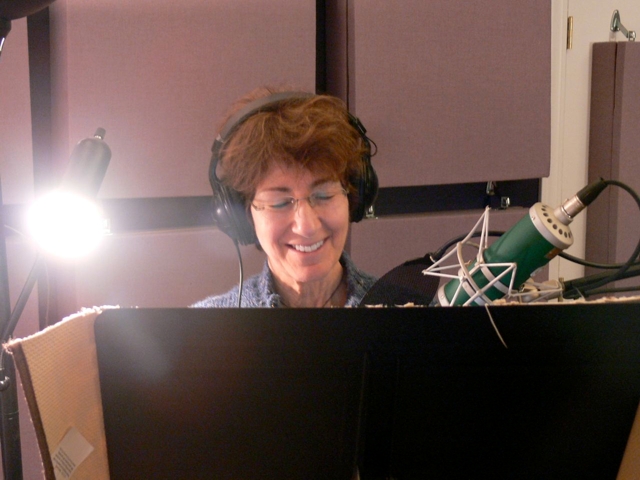
Voice-over actor Melissa Hutchison, really getting into character

Why did you and your wife decide to turn this story into an iBook?

Our original plan was to turn it into an app. Having gone through that process once already, I knew how long it would probably take (about 2-3 months). And then I learned about Apple’s update to their iBooks bookshelf app that enabled background audio and synchronized word highlighting with the narration. That seemed like a perfect vehicle for our story, since we already had the art and narration. With the help of a beta version of RedJumper.net’s Book Creator app, I was able to lay out the book and text in iBooks format. Then I added the sound coding by hand.

What special features does Are You My Friend? have?

In addition to the read-it-to-me narration and soundtrack I mentioned above, and of course, the whimsical illustrations and fantastic narration, we’re using high resolution images so you can pinch-zoom in to see more details. There’s also a unique friendship skills/social and emotional learning guide for parents and teachers at the back of the iBook.

How did you add those features? Was it a lot of work? Did you have to do any coding? Do you think anyone could do it?

Adding the narration with synchronized word highlighting was a lot of work. I used the open source Audacity software on my Mac and imported the narration for each page spread. Then I selected each word and bookmarked it, naming the bookmark to match the spoken word. Audacity then let me export these bookmarks into a text file that contained each word and the start and end point of the sound (in seconds). I converted that data into the format that the iBook required, using an Excel spreadsheet to help.
I then exported from Excel into the pages of the iBook. Yes, there’s “coding”, very similar to the HTML coding of a website. But no programming. There’s no logic code (if-then-else statements), just XHTML statements.

I don’t know if anyone could do it. If you’ve ever built a website (even a small one) and did some hand-tweaking of the underlying HTML code, then yes, you could do this. If that sounds daunting, then hold on a bit... I’m sure that some tools will appear that will make this all much easier, without ever having to touch the code.

Tell me about Book Creator. Where do you get it? What do you need to run it? What does it do? How much does it cost? Is it hard to get the words to light up when they’re read? Did you encounter any problems along the way? How did you solve them?

I was fortunate to be accepted as a beta test for Book Creator. It’s made by RedJumper.net, and was just approved by Apple to go live. You can buy it starting September 15th in the iTunes App Store for $6.99. That’s an amazing deal!
Book Creator does not handle any of the sound features I added to our iBook. It does a great job of letting you position your art assets (jpeg or png files) on the pages, and add/position/resize the text. You can see a video demo of it on their website. http://www.redjumper.net/bookcreator/

How long did each step in the process take? What were the costs involved?

After having all the art assets and text, it took me a few days to resize the art to the best size for an iBook, drop it in, and add the text. But it took me a few weeks to do all the narration and word sync code, music, sound effects, and ambient sound for each page. Part of that was a learning curve for me. I could probably do it all in about 2 weeks now that I know what I’m doing.

Left to right: Sound director Julian Kwasneski, author Annie Fox, sound engineer Jory Prum
Using iPads to hold the database of each sentence the actor was to say

Costs for this last stage were minimal... really just my time, plus about $50 for the royalty free music we used, and some more for sound effects from Julian.
The biggest cost by far was the actual recording session. Of course, this depends on how much text there is to record (we recorded a lot of extra text for a future interactive app version of our book), how much the talent charges, the sound studio, sound effects, etc. Figure a few thousand dollars to do it all at a professional level. Maybe less if you want to cut some corners.

Author Annie Fox adding vocalizations for the last scene in the book


How do you get a picture-book iBook into the iBookstore?

First step is to set up an iBook publisher account. You do it through iTunes Connect:

If you’re already an app developer, you need to register under a different account. There is no fee for this, but you do need a US bank account. You also need an ISBN number for your book. It should be a new one, not one already used for a paper version of your book (if it’s been published already). But it could be the same as an ebook version of your book.

If you don’t have one, you can buy them through Bowker at https://www.myidentifiers.com where the price is $150 for 1, $250 for 10, or $1000 for 100. But there’s a non-profit that bought a block of 1000 ISBN numbers and is reselling them for $5 each. http://www.epubbud.com/isbn.php - only downside is that in the Bowker database, epubbud is listed as the publisher. But you still have control over the meta data you send to Apple, so you can control who the publisher is there.

Once you’re accepted into Apple’s iBook developer program, you can download sample iBook files and their PDF guides on how to do it, like their assets guide. You also download a Mac program called iTunes Producer that walks you through the process of adding all the meta data (title, description, author and illustrator names, pricing, cover) and attaching your epub file. It then checks the syntax to make sure there are no errors, and uploads it all to Apple. It’s then live in the iTunes iBookstore within an hour or two!

Any advice to writers or writer-illustrators who are considering turning their stories into iBooks or apps?
Go for it! If you have any technical skills at all, work with Photoshop, and have an iPad, you can at least do a silent version using the Book Creator app.

If you have HTML skills, and want to invest in recording the narration, then you could go the next step and turn it into an enhanced iBook with sound. Or wait a bit until the tools catch up and it won’t be as difficult to add the sound.

Going the book app route only makes sense if you plan to add some animation and interactivity. Doing a book app is definitely more challenging, though there are several tools that make this easier as well. We list several in the right margin of the http://storyappchat.wordpress.com/ site.

There’s a huge range here, with some taking a percentage of the royalties and publishing the final app themselves, and others, like Kwiksher.com’s tool, where you also need to license the Corona SDK, have an Apple App developer’s license, and submit the final app yourself (but they don’t take a cut of the royalties).


So, unless you plan to do animation and really need a lot of interactivity to make your story work, I’d say stick with the iBook format. Much easier to create. You could always do an app as well.

Are you considering hiring out your services to other writers or writer-illustrators?

Yes, we have considered that. We do have more of our own content to produce, but we’re happy to consider taking on other projects, if they match the types of books we want to work on. The unifying feature of all our iBooks and apps are that they have to be entertaining as well as empowering for kids.


I’m also a consultant for app and iBook developers, and am happy to hand-hold someone through the process. I’ve always enjoyed helping people learn a new tech skill after I’ve successfully completed a project myself.

Anything else you would like to tell us about Are You My Friend?

I’ll let Annie answer that one:

I've been answering email from kids around the world since 1997. For children of any age, nothing matters more than having friends they can trust. Parents do a great job of teaching toddlers to "be nice." But as friendship conflicts become more complex, kids are left to figure things out on their own. The results don't often lead to constructive learning. By telling an engaging story about kids being kids, complete with a set of positive messages, readers can learn what it takes to have a friend and to be a real friend to yourself and others.

Thanks, David and Annie! And here's wishing you both the best of luck with the book.

Thank you for the chance to share this all with you and your readers! If anyone wants to contact us, you can do so through our website, http://www.ElectricEggplant.com

And for those who would like to learn more  from David and others about making picture iBooks or apps, check out #storyappchat on Twitter on Sundays at 9pm Eastern time.
Photos provided by David Fox