Showing posts with label jew. Show all posts

Thursday, April 10, 2014

A Passover Miracle

This is my favorite Passover story, one about a real miracle that happened in my mother's family when she was just a girl. I hope you like it, too. 

My mother, Tova Hacohen, was twelve years old in 1948, the year of Israel's War of Independence. 
Before the British even left, Arabic forces surrounded the city of Jerusalem on all sides and laid siege to it. Brave Jewish men lost their lives attempting to bring truckloads of food from the Tel Aviv area to Jerusalem's residents. What little there was had to be rationed, and it wasn't even safe to venture out for the rationed food. Jewish men had to walk with their backs pressed up against the walls of buildings so they would be harder for the snipers to spot, and sometimes fathers lost their lives while trying to bring home something for their hungry children to eat. 
Tova's family--all eight of them, not counting her eldest brother Shmuel who was married and lived near Tel Aviv--got only one loaf of bread a day, a little bit of beans or peas, and a small amount of flour. Because they had small children, they got powdered milk too.
“Drink, drink,” her Imma said.
“I don’t want it, if you can’t have, too,” young Tova replied.
But her Imma would not hear of it. She didn’t care if she didn’t have enough food. The only things that mattered were her children. They always came first.
That year before Passover, the Ashkenazi rabbis permitted Ashkenazi Jews in Jerusalem to eat Kitniyot, like peas or beans, during the holiday. The rabbis didn’t want anyone to starve because they were trying to keep the Ashkenazi tradition for Passover, which forbids eating legumes. Tova’s family expected to eat only peas, matzo, and a little wine or grape juice over the holiday. It wasn't much, but at least they could try to celebrate the holiday. 
Then they got a surprise. 
Tova’s eldest brother, Shmuel, sent the family a gift.
Shmuel was a member of the Hagannah, which would soon become the army of the new Jewish state. Shmuel found out who was going to attempt to bring food to Jerusalem, and he asked this brave man to help bring something special to his family. Miraculously, that truck made it through. Tova's family received handmade matzos, a few apples and nuts for making Charoset, and--wonders of wonders--a crate with over a hundred eggs!  
Eggs! It was something they hadn't had a chance to eat in a very, very long time. 

A few years before she died, my mother took her grandchildren to the house where she grew up, so they could see it and learn the stories of her childhood. The man she's talking to now lives in the neighborhood. They each know a part of the story, and they are filling each other in. 

Everyone looked forward to it. Family and guests crowded around the dining table on the night of the Seder. Tova's Abba, who was a rabbi, had invited a group of his students, and they were in high spirits. Shmuel’s brother-in-law, Ze’ev, who was also studying in Jerusalem, came too.
There was talking, and learning, and singing. They drank wine and grape juice. They ate matzos, Charoset, eggs, and peas. It wasn’t much, but for them at that time it was a feast. And despite how little they had, the family was more than happy to share it with their guests.  
When the meal was over, Abba’s students sang the rest of the Haggadah. They wanted to do as the rabbis of old did: they wanted to make the Seder last until the sun came up. 
But there was shooting outside.
“Imma!” Tova's sister Yehudit cried.  
“Yes, I heard that too,” Imma said. “We should go down to Savta’s room." Tova's Savta slept in a room on the ground floor. "It’s safer.” 
“No, no!” one of the students shouted. “It’s Passover. We should sing!”
And sing they did. And as their singing grew louder, so did the gunfire outside. And as the gunfire grew louder, so did their singing!
“Abba!” Tova shouted. “Please can we go downstairs?”
Then came a loud “BANG!”
Everyone froze. It sounded like a bullet had entered the room.  
“Enough singing!” Abba cried. “Imma, get the baby.”
Baby Rama had been sleeping soundly when Imma picked her up from her crib. Tova rushed after little sister Sarah to Savta Bat-Sheva’s room on the ground floor. Yehudit followed them. Tova's older brother Menachem went downstairs with the students. Imma carried baby Rama down with Savta Bat-Sheva at her side. Abba came last to make sure everyone was out of harm's way.
The precious crate of eggs was already there. After all, these eggs were a great treasure for them at this time, and Savta Bat-Sheva's room was the safest room in the house.
It wasn’t the first time Tova had heard shooting. But this time was different. It seemed to go on forever. And as time wore on, Tova grew tired. Soon she and her sisters were fast asleep. One at a time, the others joined them in slumber.
In the middle of the night, however, she awoke to a strange sound.
Crack. Plop. Crack. Plop.
Over and over it went.
Crack. Plop. Crack. Plop.
Tova sat up. 
The strange sound was coming from the corner where the crate of eggs sat. In the weak light, she saw her baby sister with a big pot. Little Rama’s hand came down with something in it on the edge of the pot. Crack. Then she put the thing in her hand in the pot. Plop. Rama laughed and clapped. Tova gasped when she realized what the sound was.
Oh, no.
“The eggs!” she cried. “Imma! Imma! The eggs!”
“What?” Imma said, still half asleep. “What about the eggs?”
“Rama broke them!”
Tova and Imma looked inside the pot. It was filled with eggs and eggshells. Imma checked the crate. 
Out of more than a hundred eggs, only eight whole eggs were left.
“What are we going to do?” Tova asked. “The eggs will spoil.”  
 Imma shrugged. “So we won’t have eggs for the whole week of Passover.”
“But we can’t cook them today,” Tova said. “It’s Shabbat.”
“So after Shabbat we’ll have eggs,” Imma said. “Lots and lots of eggs.”
After sunrise the family went back upstairs. Imma put Rama in her crib. There she found a surprise.  
“Look, look!” Imma cried. “It’s a miracle!”
Tova looked. 
There--very close to where Rama’s head always rested when she was asleep--was a bullet.
“It’s the bullet we heard last night during the Seder,” Tova's older brother Pinchas said.
“It’s a miracle she wasn’t hurt,” Abba said. “A Passover miracle.”  
The story of what happened quickly spread through the neighborhood. With it spread the invitation to join the family for a breakfast of scrambled eggs on Sunday morning.
There was nothing to light a stove with, so that Sunday morning they made a bonfire. Neighbors brought wooden boards. Some also brought their rationed oil. Everyone brought plates and forks to eat with. They stood in line and waited to get a delicious, warm breakfast of scrambled eggs. Abba took a picture for the newspaper he edited.
People thanked Tova's Imma, but she laughed and pointed at baby Rama. "Don't thank me. Thank the cook!" 

Here's wishing you and your family a safe, happy, and healthy Passover.

Monday, January 13, 2014

Bathsheba's Daughters: Memory Dominos

Memories are like dominoes, all in a line. One thing in the now pushes a single memory and sets it into action. That memory pushes another, which pushes another, and so on.

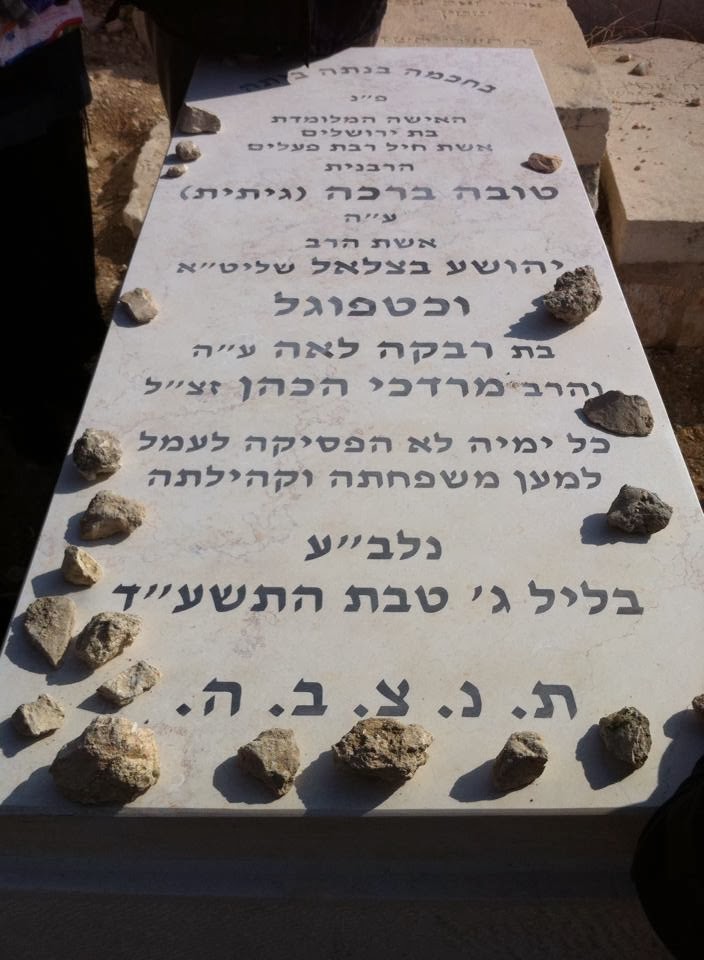
Last Sunday, my mother’s headstone was revealed, a Jewish ceremony that in Israel usually takes place 30 days after the funeral. I wasn’t there to see it, but my niece, Rinat, posted this photo on Facebook. 
My mother's gravestone. (Photo by Rinat Adler Horesh, 2014)
Rinat wrote, “"I don't believe 30 days have passed. It's hard to describe in a few words such an amazing persona true woman of valor, full of life's joy, a saint by her own deeds and her ancestors', and simply a mother and grandmother to everyone! We so very love and miss our darling grandmother.

The photo was a little push in the now. It set off a memory domino, which set off another memory domino, which reminded me of the reason why I decided I needed to write Bathsheba’s Daughters so many years ago.

My mother was buried on the Mount of Olives, as were her parents. My grandmother Rivka’s father and her grandparents were also buried there, but her mother—my great-grandmother Bat-Sheva, whom I’m named after—died in 1964, when the Mount of Olives was in Jordanian hands, so she was buried somewhere else in Jerusalem.

The photo set the memory of my mother’s funeral, a little over 30 days ago, into action, which set off the memory of my grandmother’s funeral, about 14 years ago.  

I remember sitting in the backseat of a car driving up to the Mount of Olives. 

My grandmother had died in her sleep in a senior home. Her health had been deteriorating, and while none of us knew that she would soon leave us, she seemed to know. She seemed to be telling us goodbye in her own subtle way. Although her body gave out, her mind remained sharp until the end, just like my mom's.

After the funeral, one of my cousins, Bat-Sheva Peli Seri, told me that Savtah (grandmother in Hebrew) had asked her, “What do I call you?”

My cousin had shrugged.

And Savtah had replied, “I call you Mamaleh (little mother), because you were named after my mother.”

It was true. Four of us are named after my great-grandmother Bat-Sheva, and my Savtah used to call all four of us Mamaleh. Telling my cousin the reason why was her little way of telling the four of us that no one we love ever leaves us, that the great-grandmother she loved stayed with her through us, and that she would stay with us, too, in our memories and our hearts.

But the final domino in that line of memories was set into action by something else.

On the way up to my Savtah's funeral, I looked at the houses on the side of the road, and I saw something shocking: some of the stones in the walls of the houses had Hebrew letters chiseled into them. 

They were gravestones. 

Someone had stolen gravestones from the Mount of Olives and had used them to build a house. And this wasn’t just one house. House after house in this little Arabic village in East Jerusalem had Jewish gravestones in their walls, each gravestone carrying the name of someone who was buried on the Mount of Olives, someone who had been loved and cared for, someone who now had an unmarked grave, because someone else wanted to erase the fact that they had ever lived at all.

Many of my ancestors are buried on the Mount of Olives, but their story is different, and it’s because of my Savtah Rivka and a kind soul who never forgot a kindness done to him.

I’ve already told you the story of my mother’s first memory, how she was just a toddler on a bus in British Mandate Palestine when she heard Arabic cries of “Slaughter the Jews!”  

The Arab riots continued until Jewish night squads, led by a British Christian officer by the name of Wingate, put a stop to them. But before they ended, some Jews who couldn't take it anymore eventually formed angry mobs determined to return blows for blows. Just like the Arabic rioters didn’t care who they attacked so long as the person was Jewish, the Jewish mobs didn’t care who they attacked so long as they were Muslim men.

My grandfather was a respected rabbi who had a good relationship with his Arabic neighbors. 

Before every Passover, he would sell his community’s chametz (bread, crackers, and other things that aren’t kosher for Passover) to a nearby sheik; and after Passover, when he bought the chametz back, the sheik would send my mother's family a silver tray piled high with bread and rolls. 

My grandfather also had an Arabic man who worked for him, taking care of things that Jews aren’t allowed to do on the Sabbath. I asked my mother what this man’s name was, but she didn’t remember, understandably, considering he had worked for her father when she was very little. She said it might have been Ahmad, so I’ll call him that for storytelling purposes. It’s shorter than saying, “the man who worked for my grandfather.”

 One day, the Jews in the streets were in a panic. There had been another riot in Jerusalem’s Old City. Arabic cries of “Slaughter the Jews!” were being met with Hebrew cries of “Death to the Arabs!” It was a very dangerous time.

Ahmad had been working that day at my grandfather’s synagogue, and he was terrified. How could he return home? The angry Jews in the streets would kill him!

“Don’t worry,” my grandfather said. “You can borrow my clothes and hat. They won’t kill a rabbi.”

Ahmad seemed apprehensive. While it was true the disguise could save him from the angry Jews, what would happen once he reached his own neighborhood? How would they react to this rabbi in their midst? 

“No,” my Savtah said. “Ahmad, you can take my clothes.”


She went to her closet and pulled out a dress, a coat, and a woman’s head scarf. Ahmad put the clothes on and wrapped the scarf around his head and face. Disguised as a woman, he headed out into the dangerous streets, never to return.

My grandparents worried about Ahmed, of course. He had worked for my grandfather for years, and they didn’t know what had happened to him. Had he made it safely home? They wanted to believe that he had, but there was no way to be certain.

Several years later, the British left Palestine. The Arabic countries in the region and beyond united to drive the Jews out, but the Jews fought back. When it was over, Jerusalem was divided. My parents’ families were on the western side of the city, which was in the hands of the newly formed state of Israel, while Ahmed and the Mount of Olives were on the eastern side, which was in Jordanian hands. Between 1948-1967, robbers stole Jewish gravestones from the Mount of Olives. They used them to build houses, like the ones I had seen from the backseat of a car heading up to my grandmother’s funeral.

My grandmother, Rivka Hacohen, probably in the 1960s

Following the Six Day War in 1967, Jerusalem was reunited once more, and Jews could once again visit the ancient Jewish cemetery on the Mount of Olives. So my grandmother went to visit her father and her grandparents’ graves, something she couldn't do for close to 20 years.

I imagine her journey was much like mine. I imagine she, too, was horrified to see those desecrated gravestones in the walls of the houses she passed on her way up. She must have wondered what she wouldn’t find once she reached the Mount of Olives. Would she be able to locate the places where her grandparents and father were buried? Or would she never know because of the workings of some heartless thief?

She reached the Mount of Olives, and who should meet her there but Ahmed! 

They both cried tears of joy, so happy they were to find each other alive after all they had been through. 

But that wasn’t all . . .

“Come, Miss Rivka, come!” he said in Arabic. My Savtah was multi-lingual, so there was no need for him to struggle in another language.  He ran up the hill and directed her to follow him.

And amazingly he led her to her father’s gravestone. It was still there!

“I’ve taken care of all of them,” he said, pointing to her grandparents’ gravestones. “I made sure no one would disturb them.”

They say the greatest mitzvah (good deed) is one performed for someone who cannot repay you. If that is true, Ahmed’s act was possibly one of the greatest mitzvahs anyone has ever performed. 

How could he possibly know that he would ever see my Savtahthe woman whose generosity had helped me return safely homeagain? How could he possibly know that she would ever be able to visit her father and her grandparents’ gravesites again? 

Here he had performed this selfless act for almost 20 years with no way of knowing that anyone alive would ever benefit from it.


And that is the final memory domino in that line of memory dominos: the reason why it’s still possible to find my great-great-grandparents’ and my great-grandfather’s graves on the Mount of Olives. 

Perhaps it shows no good deed is ever wasted. Or perhaps it shows that even if we think it will be wasted, we have to try anyway, because you never know.