Showing posts with label Shevi. Show all posts

Monday, January 27, 2014

Bathsheba’s Daughters: Our Story Begins With an Open Window and a Fall

There’s an odd similarity between the earliest story told about the great-grandmother I’m named after and the earliest story my parents used to tell about me: both involve an open window and a fall.

I’ve already told you about my mother’s earliest memory, how her grandmother held her hand and ran home with her from a pogrom in Jerusalem. I don’t know what my grandmother’s earliest memory or story was, although I do know several fascinating tales from her childhood and teen years that I plan to tell you in another post. The earliest story told about my great-grandmother, however, is so remarkable that it became a part of our family’s legacy.

My great-grandmother was named Bat-Sheva, a name that has been passed down in our family going all the way back to the biblical Queen Bat-Sheva, my royal ancestor and original namesake, the wife of King David and the mother of King Solomon.

My great-grandmother was born in Poland sometime in the 1870s. At the time of this story she was still a toddler, only two or three years old. Her father was a rabbi who also edited a newspaper, making him the first newspaper writer of five generations of newspaper writers in my family, ending with me (unless, somehow, my daughter carries on that legacy or marries a journalist).

I don’t know much about where they specifically lived, although I do know it was in a building that was at least three-stories high, so I have to guess it was a city. I know it was three-stories high, because that’s an important part of the story.

One day when my great-grandmother was just two or three years old, she climbed up to an open window on the third floor and fell out.

Her father saw her.

He saw his precious little daughter fall out of that third-story window, and there was nothing he could do to stop it.

Naturally, he was terrified.

She was just a baby, and it was such a great fall. How could she possibly survive? He had to get down to her as quickly as possible, and he couldn’t waste a second running to the window. Instead, he ran out of the room and raced down the stairs.

He could hear his feet pounding with each step he took. He could hear his heart beating hard and fast with fear in his chest. But he couldn’t hear his daughter. She wasn’t screaming, wasn’t crying.

He called out her name, “Shevaleh! Shevaleh!”

But there was no response.

His precious little girl had fallen out of a third-story window, and she hadn’t made a sound. Why hadn’t she cried out? Why wasn’t she crying now? Why didn’t she answer him?

His mind, of course, came to the only logical conclusion. She wasn’t crying because the fall had knocked her unconscious. Or worse. It had killed her. He prayed to God that he was wrong.

He raced as quickly as he could to the ground beneath the open window.

And he could not believe his eyes.

There was his precious little girl, standing up, not a hair out of place, looking as if nothing at all had happened to her.

He scooped her up in his shaking hands.

“Shevaleh,” he asked, “what happened?”

“Zayde carried me down the stairs,” she replied, as if it was nothing out of the ordinary.

But it was out of the ordinary.  In fact, it was impossible. Not only were there no stairs out of the window, but his daughter’s Zayde, her grandfather, had died two weeks earlier.

Her father was so astounded by this miracle, he had the story printed up in Yiddish, and he posted notices about it everywhere he could. I once saw a photo of that notice, and I would publish it here if I could find a copy of that photo.

You might wonder if I believe this story.

I can’t say that I do, but I do believe that my great-great-grandfather believed it with all his heart, so I don’t disbelieve it either. Like with most things that can’t be proven, I try to keep an open mind.

When I wrote Rideof Your Life—a novel about teenage ghosts falling in love in an amusement park—I treated it as a fantasy. However, as I do with all my novels, I still wanted it to make the most sense that it possibly could.  It seems to me that if ghosts do exist, they must be like the people they were when they were still alive. My great-grandmother’s Zayde was a good man who would have saved his granddaughter if he could. Perhaps he did. I don’t know. I suppose it’s comforting to think he did, and that comforting feeling is something I tried to convey in Ride of Your Life. The afterlife is unknown, but that doesn’t mean it’s scary.

As I said, the earliest story my mother used to tell about me also involves a fall and an open window. Unlike my great-grandmother Bat-Sheva’s tale, however, there’s nothing even remotely miraculous or other-worldly about it. In fact, it’s kind of funny, which I guess is fitting. It is, after all, about me.

A few weeks before I was born, my parents flew to Israel with my sister, Eliedaat. My mother lied to get on the plane, because it was against the rules for a woman to fly in the ninth month of pregnancy. They went to visit my extended family, particularly my mother’s parents and siblings.

At some time during the trip, my grandfather commented about my sister:  “You could draw a little circle around that baby, walk away, come back an hour later, and still find her in that circle.”

My parents agreed. My sister, who was eleven months old, was a natural born sitter. A natural born stay-in-placer. If you wanted to find a baby to pose for an oil painting, this was your girl! She could sit for hours and hours and not move.

Understandably, this led to a false sense of security.   

Enter me.
The oldest of my four younger brothers, me, and my sister. I have a dead tooth in this photo. If you guessed I got it from a fall, you'd be right. We were playing a "let's see how far we can jump" game (my sister's idea), and it turns out it wasn't quite as far as the top of the shelves  after my sister had moved them the second time. The dead tooth eventually fell out, but I still have the huge scar on my right arm from when my sister decided we should play milkman with glass milk bottles. (She says we were bowling, but I'm pretty sure we were playing milkman.) It was also her idea to play doctor with cold medicine that she spooned out to us. There is a slight possibility she wanted to be an only child. 


I was born days after my parents and sister returned from Israel, two weeks and two days before my sister’s first birthday. On the day I was brought home from the hospital, my father took me upstairs to the only bedroom in the house they were renting and laid me down on a bed. It was a hot summer day, and the window was open.

He thought, “This is safe. She’s a newborn baby, so she couldn’t possibly move.”

Yeah, right.

I was not my sister.

He left the room, I’m guessing to check on my mom and my sister. And when he came back, I was nowhere to be seen.

And the window was open.

Now, I know this doesn’t make any sense. I can’t even imagine a scenario where this might make sense. But for some reason the way my father tells this story is that he thought I had fallen out of the window.

I guess when you’re confronted with the realization that your assumption about your newborn being unable to move turns out to be false, you start to question the exact degree to which it is false. If your newborn can, in fact, move, who’s to say she can’t also climb windowsills? Or jump out of windowsills? Or fly? Or perhaps he knew the story about my namesake falling out of a window, and his mind played the most bizarre version of “connect the dots” anyone’s mind has ever played.

Of course, I hadn’t fallen out the window.

There was no miracle, ghost, or magic involved. I hadn’t disappeared. A short while later, my loud screams made it clear that I had merely fallen off the bed and had jammed between the bed and the wall.

To my father, though, this was almost as astounding as it would have been if I had disappeared.

Here was a newborn who could move a heck of a lot more than his almost one-year-old daughter. I couldn’t just move a little. I could move a couple feet right off of a bed. And I was only a few days old.

Over the coming months, my ability to move astounded both my parents over and over. You would think they’d have learned their lesson after that first time, but no. They didn’t.

One of the funniest stories my mother used to tell about me is how when I was a few months old, she put me in one of those baby carrier seats on a counter in a store. She left me alone for a second, just a second. Next thing she knew, I was crying, because I had flipped the seat over and was crawling around on the counter with the seat strapped to my back, like I was a turtle and the seat was a turtle shell I didn’t really like.

Through the years, I’ve tried to find similarities between myself and the great-grandmother I’m named after, and there are a few. I found out during my mother’s Shiva, for example, that my great-grandmother loved games. Someone told me she kept a chess set in a green plastic basket under her bed and would take it out to play chess with him when he was a little boy. But although I love games in general, I don’t like chess. I’ve also heard she loved to read and was usually found with a book in her hand. But she read mostly religious books, and I read mostly nonfiction, humor, fantasy, and science fiction. And several people have told me I’ve inherited her artistic and creative side. But I write and draw, and she expressed her artistic and creative side by sewing and crocheting, which are two things I can’t do at all.

But we do share a name and stories that start with an open window and a fall.


Wednesday, September 19, 2012

Humor: How Can You Tell If It's Windy Outside?

The wind was blowing hard yesterday, so I asked my husband and daughter this question. The replies were so funny, they said I should post them. So here they are.

How can you tell if it’s windy outside?
   
    You see a gnome outside your window.
          It’s a second story window.
               It’s the Travelocity gnome.

     You hear the wind whistling the theme music of the Wicked Witch
          in the Wizard of Oz...
               …quickly followed my Munchkins singing,
                    “Ding, Dong, the Witch Is Dead.”

     You see a cow outside your window.
          It’s a second story window.
               The nearest farm is ten miles away.

     You see Al Roker outside your second story window…
          …quickly followed by Sam Champion.

Got any funny ways to tell if it’s really windy outside? Post your ideas in the comments below.

Monday, December 19, 2011

Some illustrations from Toren the Teller's Tale

Toren the Teller's Tale book release!


Toren the Teller's Tale is about a magical storyteller and her struggle to accept the magic within herself. It's a literary fantasy about the greatest magic of all: the magic of stories. It's about the magic that takes us to strange new worlds and allows us to experience that world through another's eyes. It's about the magic that makes us think, feel, laugh, fall in love, and discover things we never knew about ourselves. 

I'm very excited to announce that Toren the Teller's Tale is now available for download in two parts! 

You can pick up book one, Toren the Apprentice's Tale, Amazon,  BN.com, Smashwords and the Apple iBookstore for just $1.99.  My husband and I are currently working on making the complete novel available for download and in paperback. 

I'm now on a Bewitching Book Tour to help promote the book. Thanks so much to all the bloggers below, as well as Roxanne Rhoads, who runs Bewitching Book Tours; and Trista DiGiuseppi, the author of Nails Jane, who also hosted me on her blog. It's very much appreciated.


Dec 19 Guest Blog

Dec 20 Promo
Read2Review

Dec 21 Guest blog

Dec 22 Interview
JeanzBookReadNReview 
http://jeanzbookreadnreview.blogspot.com/                  


Dec 22 Guest Blog 
Natalie Cole Bates

Dec 23 Promo
Roxanne's Realm

Dec 26 Guest Blog
Fang-tastic Books


Dec 27 Guest Blog and review
The Wytch's Mirror


Dec 28 Promo and Review
Book Briefs 

Dec 29 Guest Blog and review

December 30 Guest Post
Lisa’s World of Books


Dec 30 Guest Blog

January 2 Promo and Excerpts
Reader Girls

Review
Sharon
www.swillett.com
swillett11@yahoo.com

Wednesday, August 10, 2011

A writer's step-by-step plan for using social media

Social media is so confusing. Writers know it's important, but where do you start? Twitter? A blog? Facebook? What do you post? How often? And how does it help you sell your book?

I've read several wonderful books on the topic. Here's a rundown of their top tips:


Author 101: Bestselling Secrets from Top Agents

Author 101: Bestselling Secrets from Top Agents by Rick Frishman and Robyn Freedman Spizman
The main thing I learned from Author 101: Bestselling Secrets from Top Agents is that a writer needs a platform. It doesn't matter if you write nonfiction or fiction, it's all about your platform. So what's a platform? There are actually two kinds (three if you consider that Facebook or Twitter are also platforms, but this refers to a writer's platform).

The first kind of platform is how readers think of you when they think of you. For example, Isaac Asimov will always be known as a science fiction writer, even though he wrote many books that weren't science fiction. J.K. Rowling will forever be identified with Harry Potter. J.R.R. Tolkien will always be remembered for The Hobbit and The Lord of the Rings. Maybe in the future, I'll be known as the writer of Toren the Teller or Gilbert the Fixer. But for now, my platform is that I'm a funny writer, a Geek Goddess, and the author of humorous fiction, fantasy and science fiction for kids and teens. I also have a reputation for helping other writers out.

The second kind of platform is made up of the number of Twitter followers, Facebook fans, blog subscribers, and so on that you have. If you want an agent in today's publishing environment, you're going to need this kind of platform--but how do you get it? That part wasn't so clear, so I kept looking.

Smart Self-Publishing: Becoming an Indie Author

Smart Self--Publishing: Becoming an Indie Author by Zoe Winters
Smart Self-Publishing: Becoming an Indie Author is chock full of information and useful advice, both for self-publishers and traditionally published authors. While the author writes about the things that worked for her, she does acknowledge that other authors have succeeded with things that didn't, and you may succeed with them too. This sets this book apart from almost every other book I've read on self-publishing, which have gone on and on about why you should e-publish and how much success the author had as an indie publisher.

You'll learn why you need a newsletter, where you can create one, and what you should and shouldn't put in yours; working out a marketing schedule and a marketing plat; why you need to set both short-term and long-term goals, and what those goals can be; self-editing, critique groups, and hiring a freelance editor; what kind of prizes lead to more sales (and what kind don't); and all aspects of marketing, from social networking, blogs and blog hopping to marketing with video and paid advertising when you've earned enough to afford it.

This is one of the most helpful books I've read on self-publishing, and I highly recommend it.

Still, even though it talked a lot about the importance of blogging for writers, I still didn't feel I had enough of a grasp on the details. Yes, it mentioned that it's a good idea to post several times a week, but what good is that if no one is checking out your blog? How do you get people to give your blog a glance? And then a second glance? And then maybe subscribe? So I went looking for another book on the details, and I found a great one.
ProBlogger: Secrets for Blogging Your Way to a Six-Figure Income

ProBlogger: Secrets for Blogging Your Way to a Six-Figure Income by Darren Rowse and Chris Garret
Although it's not writer specific, I found ProBlogger: Secrets for Blogging Your Way to a Six-Figure Income invaluable for the depth of information it contains about successful blogging.

There are two ways to make money blogging: either by selling advertising space, or by using your blog to promote your work, for example, as a freelance writer or editor. I went through the book with a highlighter, and I ended up highlighting something on every other page.

I even put stars near some things I found particular helpful. For example, there's a list of question to ask yourself to help you better understand your target audience. There's also a section on useful blog properties, and another wish suggestions for how you can create useful blog content. It was great.

We Are Not Alone: The Writer's Guide to Social Media

We Are Not Alone: The Writer's Guide to Social Media by Kristen Lamb
 Of course, at this point, I had learned so much I felt like my head might explode. I needed one book to help me tie it all together, and luckily I found it in We Are Not Alone: The Writer's Guide to Social Media.

This book is awesome! And in my next blog post, I'll tell you why.

Meanwhile, if you have any questions about social media for writers, please feel free to ask them in the comments section below. I'll do my best to answer them if I can.       

Thursday, May 05, 2011

"Where do illustrations come from?"

It might seem like magic, but it's not. Illustrating is a process, very much like writing. There are many ways to do it. Here's one of them:

1. Find a scene in the text to illustrate. I decided to add one illustration to every chapter in Dan Quixote, so I went through the book and copied and pasted scenes I thought would make good illustrations into a single file. Sometimes I picked more than one scene in a chapter, so I could change my mind later.

2. Draw character sketches. This helps make it easier to be consistent when you're drawing more than one illustration with the same character. It's even better if you can draw the same character in different poses. Find places in the text where the character is described, so the drawing fits the words. With Dan Quixote, I drew the cover first. This showed me what all the main characters looked like.
3. Start sketching thumbnails of the scene. Make these the simplest of outlines, with stick figures and so on Try to look at it from different angles. Work out the vanishing point or points. Don't settle for the first thumbnail, because the next one or the one after that could be even better. Here are two thumbnail sketches for one of the illustrations in this book.
I chose to use the angle at the top left, because it seemed more playful and open. The characters' world seems to go on forever, which is what I want for this scene, that sense of endless possibility.

4. Make an enlarged copy of your chosen thumbnail sketch, either by hand or with a copier. I used my multifunction printer.

I then used an improvised "lightbox" (in this case, placing the copy on a window in daylight and placing a piece of drawing paper over it) to trace the outline of that enlarged copy.

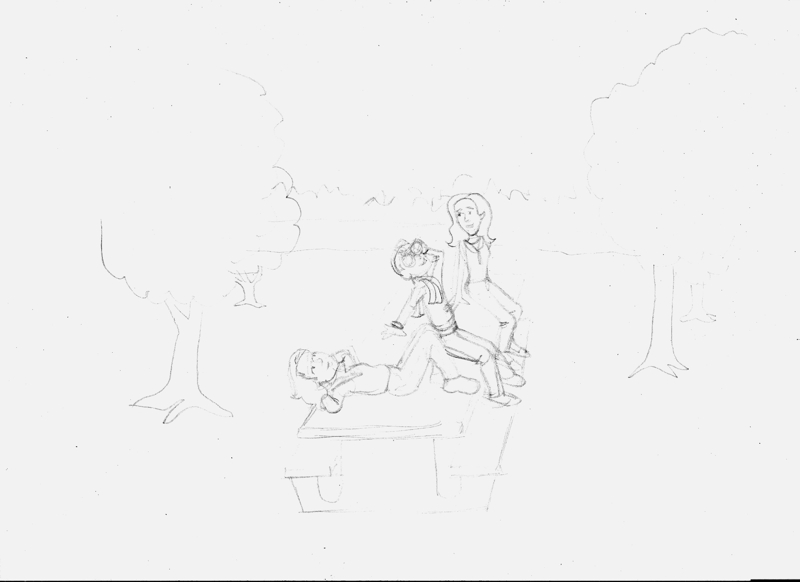
5. Start to sketch in the details. You'll note it says "night sky" where the sky is meant to go. I often mark large spaces that will be colored in black with an X. Draw in guidelines (for example, where the edge of the picnic table is hidden by the characters' legs), skeletal lines and so on.

6. Ask yourself if you're happy with it. If not, why not, and what can you do to fix it? I soon realized the important elements in this drawing were still too small, so I enlarged this drawing too.

7. Add the finishing touches, Play around with texture. This is all in pencil, so nothing is final until it's inked. Even then there are ways to fix mistakes, but it's easier at this stage. When you're satisfied, ink the lines you want to use while ignoring the ones you don't. Erase the pencil outline. Now scan your drawing, and unless you see something that still needs changing, you're done! Here's the finished drawing.
You might notice there are some significant differences between the preliminary sketches and the final one. I relocated the trees on the right, and Sandy's feet are closer to her body. You notice things at each stage you want to fix. (Actually, I just noticed the arm Dan is leaning on should be longer. Oh, well, too late to change that now.)

 8. Make last minute corrections. Computers can make this a lot easier provided you have the right software and hardware. I use Corel PhotoPaint (which is a part of CorelDraw), and I like it, but I haven't got used to using a tablet, and working with a mouse is even worse. That's why I'd rather do my sketches by hand and scan them in. Maybe one day I'll be able to afford a Cintiq tablet or a touch-screen computer, so I can see what I'm doing while I'm doing it.

And that's it. The most important thing to remember is to have fun.