Showing posts with label real. Show all posts

Tuesday, May 10, 2016

Writing Words for Nerds #AtoZChallenge--M is for Magic (Is it real?)

Picture a scene. Harry Potter is playing Quidditch with his friends as the sun begins to set. The young wizards zoom and loop through the sky, chasing the winged golden snitch that remains ever out of grasp.


As night falls, a figure appears in silhouette on the horizon, her long hair flowing in the wind. She’s holding a staff and wearing a long cloak. An extreme close-up reveals the cloak is made of colorful patches. The young woman, still in silhouette, runs her fingers through her hair and raises her hand. There’s a sound, like a woman talking, but the words spoken aren’t of this world.

The young woman glows, and we can see her for the first time. Her hair is dark, her skin pale, and her clothes are colorful.

The dramatic music rises as we once again see Harry trying to catch the snitch. The camera shifts to the snitch itself and follows it zooming straight toward something. The music rises and suddenly ends as the snitch flies into the young woman’s outstretched hand.

“The time for games is over,” she says.

The screen fades to black. Enchanting music starts. The words “This time the magic is real . . .” appear on the screen and then fade. The last screen shows the words “Toren the Teller’s Tale” as the music comes to an end.

Sometimes I think of parts of my books as scenes in a film. This is the trailer that I like to imagine for the film version of Toren the Teller’s Tale. Sure, it will probably never exist in real life. But anything can be real in my imagination.
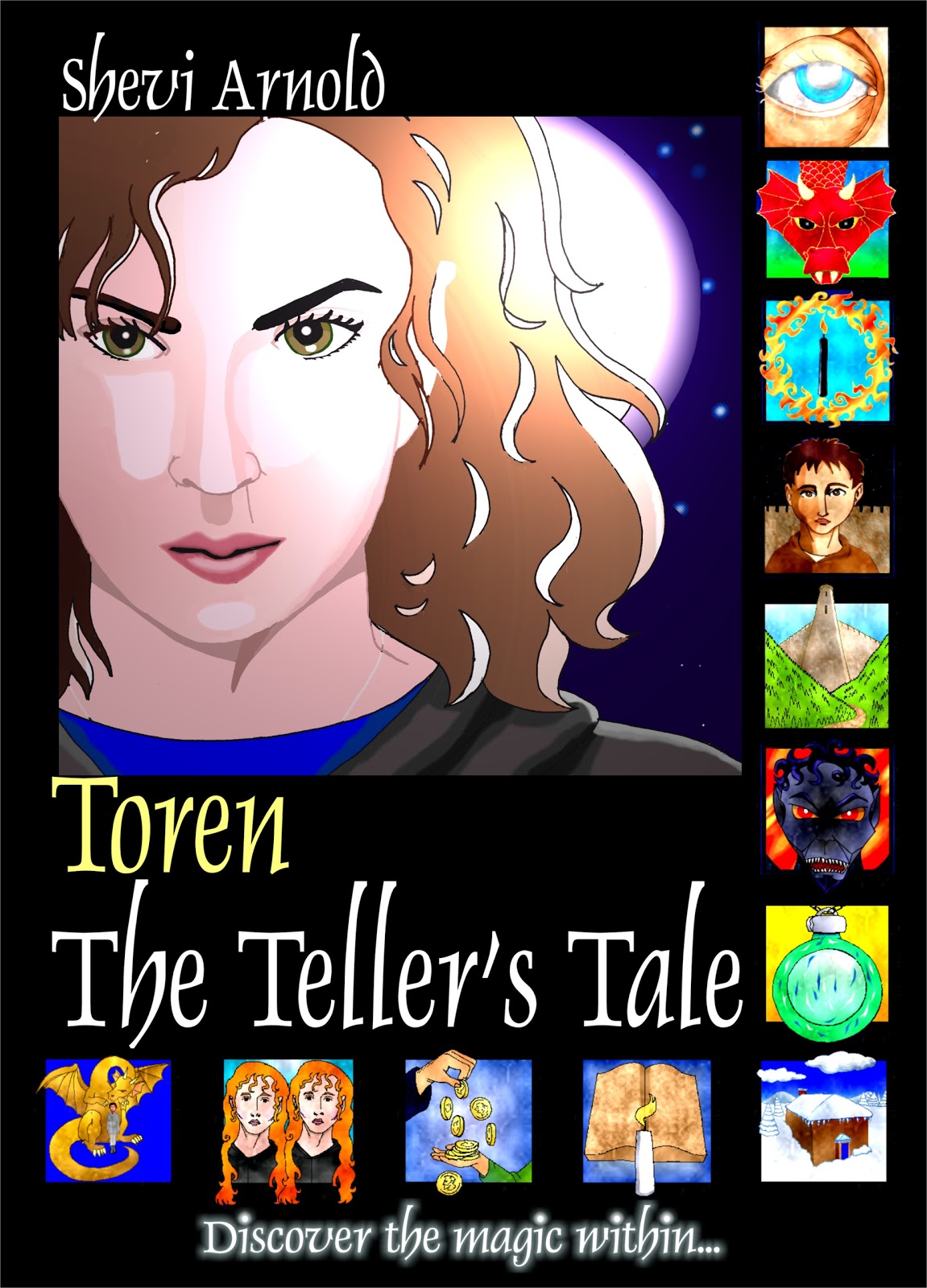

Toren the Teller’s Tale is about real magic. It’s about the magic of stories: the magic that lets you see and hear and touch and taste and smell a story, the magic that transports you to different worlds that could only exist in your imagination, the magic that lets you experience what it’s like to be a boy wizard or a hobbit or a young girl who loves telling stories and is about to discover the magic they hold. Toren the Teller’s Tale is about a kind of magic you know is real. You’ve felt it every time you’ve found yourself swept away by a story.

Those who aren’t very familiar with fantasy and science fiction often think there’s a clear divide between the two genres. Fantasy involves wizards and magic spells and magical creatures, like dragons. Science fiction involves the future and space ships and alien planets and things that could scientifically exist one day.

But there’s more overlap than most people realize. Anne McCaffrey’s Dragonriders of Pern books, for example, have dragons, but they’re science fiction.  Most people would say that Star Wars is a science fiction series, but never say that to a science-fiction purist. Sure, it has aliens, androids and spaceships, but it also has a form of magic called “the force” as well as Jedis, who are basically wizards that live on other planets, have robot companions, and fly spaceships. Star Wars regularly breaks the rules of science, which is fine as long as you don’t call it science fiction.

There are some who have pointed out that the Many Worlds theory of quantum mechanics basically means that all fantasy is actually science fiction, which is true.


That’s a topic that comes up in a conversation between Gilbert Garfinkle and Dungeon Master Dave in Why My Love Life Sucks, the first book in the Gilbert the Fixer series. Gilbert, the young aspiring mad scientist, can’t accept that he’s been turned into a vampire. His life is supposed to be a science-fiction novel. How is it possible that it now contains an urban fantasy trope? In his mind, that’s not scientifically possible.  It makes no sense. Dungeon Master Dave points out that the Many Worlds theory says otherwise. Because if an infinite number of worlds exist, some of those worlds must have vampires, as well as Gilberts that don’t believe in their existence.

The first book in the series shows Gilbert mostly grappling with his strange, new, unscientific predicament. By the second book (Why It Still Mega Bites, which should be out later this year), he’s come to accept that “magic is just science we don’t yet understand.”

Of course, he wasn’t talking about Quidditch.

Monday, May 09, 2016

L is for Love Stories (And how to write one when you don’t read romance)

Sometimes I have ideas for books in genres I don’t read. For example, I read fantasy, science fiction, and all kinds of humor and comedy. I don’t read thrillers, but I have a great idea for a romantic thriller with a little twist of science fiction. Except for the science fiction part, I have no idea how to write it. I also don’t read serious romance. Bridget Jones is awesome, and so are the Georgia Nicolson books. But those are romantic comedies. Serious romance? I generally find it laughable, and not in a good way.

And yet I’ve written a mostly serious YA romance. I even won third place in a national contest with it. So how did that happen? 


The idea for Ride of Your Life came for me soon after I heard about the Great Adventure Haunted Castle fire that killed eight teenagers in an amusement park in New Jersey on May 11th 1984, almost exactly 32 years ago. It was my way of trying to give a pointless tragedy a happy ending. I knew from the start that it was going to be the story of a love greater than death. But I didn’t want it to be a typical romance. That was never a genre that appealed to me. And it seemed wrong to write a book in a genre I didn’t enjoy reading. So what was I to do?


For a long time, I did nothing. The story was one that stayed in my head and gave me comfort when I needed it. It was a story where death was the beginning, not the end. And sometimes that’s a story I need to hear.

Skip ahead about 25 years. I had trouble deciding what to submit to the Smartwriters’ Write It Now contest for the YA category. I told the members of my critique group, Fantasyweavers, that I had this idea for a story about two teenage ghosts meeting and falling in love in an amusement park. I wrote out the first page, and asked them what they thought. They liked it and encouraged me to write the first chapters I needed to submit. So I did—and the first three chapters of Ride of Your Life won third prize. 

I continued working on it, and a few months later, I submitted it for a critique at a conference. The agent I showed it to liked it, particularly how well I captured a male perspective in the scenes that were shown from Josh’s point of view.

I told that agent, “I have a hard time writing the romantic scenes.”

“Why?” he asked.

“Because romance in books always seems so clichéd. It’s not real. I mean, those kisses in romance novels, no one kisses that way.”

And he told me something that I think about to this day. He said, “If you don’t like writing something, don’t write it.”

At first I thought, “Well, how am I going to write a love story without any of that romantic stuff in it?” But then I realized that wasn’t what he was saying. What he was saying was just because people have been writing romantic scenes one way for decades that doesn’t mean I have to write it that way, too. If it feels wrong to me‑‑if I don’t like writing it that way‑‑I shouldn’t. Instead I should write what feels right to me.

That was so freeing. 

Instead of banging my head trying to write what I thought people expected a romance novel to be, I could just write the story I had in mind. It doesn’t matter if it fits someone else’s label. The only thing that matters is that I’m honest to the story I’m trying to tell.

So that’s why Ride of Your Life is probably different from any love story you’ve ever read. I gave up trying to write a romance novel and instead focused on telling the story of how two teenage ghosts named Tracy and Josh met and fell in love in an amusement park. I liked them. I liked their story. And I liked writing it.

I hope you like reading it, too.


Oh, and if you write romantic thrillers, contact me. Maybe we can write that great book together. I can help with the science fiction twist.


Thursday, April 10, 2014

A Passover Miracle

This is my favorite Passover story, one about a real miracle that happened in my mother's family when she was just a girl. I hope you like it, too. 

My mother, Tova Hacohen, was twelve years old in 1948, the year of Israel's War of Independence. 
Before the British even left, Arabic forces surrounded the city of Jerusalem on all sides and laid siege to it. Brave Jewish men lost their lives attempting to bring truckloads of food from the Tel Aviv area to Jerusalem's residents. What little there was had to be rationed, and it wasn't even safe to venture out for the rationed food. Jewish men had to walk with their backs pressed up against the walls of buildings so they would be harder for the snipers to spot, and sometimes fathers lost their lives while trying to bring home something for their hungry children to eat. 
Tova's family--all eight of them, not counting her eldest brother Shmuel who was married and lived near Tel Aviv--got only one loaf of bread a day, a little bit of beans or peas, and a small amount of flour. Because they had small children, they got powdered milk too.
“Drink, drink,” her Imma said.
“I don’t want it, if you can’t have, too,” young Tova replied.
But her Imma would not hear of it. She didn’t care if she didn’t have enough food. The only things that mattered were her children. They always came first.
That year before Passover, the Ashkenazi rabbis permitted Ashkenazi Jews in Jerusalem to eat Kitniyot, like peas or beans, during the holiday. The rabbis didn’t want anyone to starve because they were trying to keep the Ashkenazi tradition for Passover, which forbids eating legumes. Tova’s family expected to eat only peas, matzo, and a little wine or grape juice over the holiday. It wasn't much, but at least they could try to celebrate the holiday. 
Then they got a surprise. 
Tova’s eldest brother, Shmuel, sent the family a gift.
Shmuel was a member of the Hagannah, which would soon become the army of the new Jewish state. Shmuel found out who was going to attempt to bring food to Jerusalem, and he asked this brave man to help bring something special to his family. Miraculously, that truck made it through. Tova's family received handmade matzos, a few apples and nuts for making Charoset, and--wonders of wonders--a crate with over a hundred eggs!  
Eggs! It was something they hadn't had a chance to eat in a very, very long time. 

A few years before she died, my mother took her grandchildren to the house where she grew up, so they could see it and learn the stories of her childhood. The man she's talking to now lives in the neighborhood. They each know a part of the story, and they are filling each other in. 

Everyone looked forward to it. Family and guests crowded around the dining table on the night of the Seder. Tova's Abba, who was a rabbi, had invited a group of his students, and they were in high spirits. Shmuel’s brother-in-law, Ze’ev, who was also studying in Jerusalem, came too.
There was talking, and learning, and singing. They drank wine and grape juice. They ate matzos, Charoset, eggs, and peas. It wasn’t much, but for them at that time it was a feast. And despite how little they had, the family was more than happy to share it with their guests.  
When the meal was over, Abba’s students sang the rest of the Haggadah. They wanted to do as the rabbis of old did: they wanted to make the Seder last until the sun came up. 
But there was shooting outside.
“Imma!” Tova's sister Yehudit cried.  
“Yes, I heard that too,” Imma said. “We should go down to Savta’s room." Tova's Savta slept in a room on the ground floor. "It’s safer.” 
“No, no!” one of the students shouted. “It’s Passover. We should sing!”
And sing they did. And as their singing grew louder, so did the gunfire outside. And as the gunfire grew louder, so did their singing!
“Abba!” Tova shouted. “Please can we go downstairs?”
Then came a loud “BANG!”
Everyone froze. It sounded like a bullet had entered the room.  
“Enough singing!” Abba cried. “Imma, get the baby.”
Baby Rama had been sleeping soundly when Imma picked her up from her crib. Tova rushed after little sister Sarah to Savta Bat-Sheva’s room on the ground floor. Yehudit followed them. Tova's older brother Menachem went downstairs with the students. Imma carried baby Rama down with Savta Bat-Sheva at her side. Abba came last to make sure everyone was out of harm's way.
The precious crate of eggs was already there. After all, these eggs were a great treasure for them at this time, and Savta Bat-Sheva's room was the safest room in the house.
It wasn’t the first time Tova had heard shooting. But this time was different. It seemed to go on forever. And as time wore on, Tova grew tired. Soon she and her sisters were fast asleep. One at a time, the others joined them in slumber.
In the middle of the night, however, she awoke to a strange sound.
Crack. Plop. Crack. Plop.
Over and over it went.
Crack. Plop. Crack. Plop.
Tova sat up. 
The strange sound was coming from the corner where the crate of eggs sat. In the weak light, she saw her baby sister with a big pot. Little Rama’s hand came down with something in it on the edge of the pot. Crack. Then she put the thing in her hand in the pot. Plop. Rama laughed and clapped. Tova gasped when she realized what the sound was.
Oh, no.
“The eggs!” she cried. “Imma! Imma! The eggs!”
“What?” Imma said, still half asleep. “What about the eggs?”
“Rama broke them!”
Tova and Imma looked inside the pot. It was filled with eggs and eggshells. Imma checked the crate. 
Out of more than a hundred eggs, only eight whole eggs were left.
“What are we going to do?” Tova asked. “The eggs will spoil.”  
 Imma shrugged. “So we won’t have eggs for the whole week of Passover.”
“But we can’t cook them today,” Tova said. “It’s Shabbat.”
“So after Shabbat we’ll have eggs,” Imma said. “Lots and lots of eggs.”
After sunrise the family went back upstairs. Imma put Rama in her crib. There she found a surprise.  
“Look, look!” Imma cried. “It’s a miracle!”
Tova looked. 
There--very close to where Rama’s head always rested when she was asleep--was a bullet.
“It’s the bullet we heard last night during the Seder,” Tova's older brother Pinchas said.
“It’s a miracle she wasn’t hurt,” Abba said. “A Passover miracle.”  
The story of what happened quickly spread through the neighborhood. With it spread the invitation to join the family for a breakfast of scrambled eggs on Sunday morning.
There was nothing to light a stove with, so that Sunday morning they made a bonfire. Neighbors brought wooden boards. Some also brought their rationed oil. Everyone brought plates and forks to eat with. They stood in line and waited to get a delicious, warm breakfast of scrambled eggs. Abba took a picture for the newspaper he edited.
People thanked Tova's Imma, but she laughed and pointed at baby Rama. "Don't thank me. Thank the cook!" 

Here's wishing you and your family a safe, happy, and healthy Passover.