Showing posts with label history. Show all posts

Friday, March 14, 2014

Two Purim Stories

Purim is my favorite holiday.

I love the costumes, reading the story of how Esther and Mordechai saved the Jewish people, the joy and noise in the synagogue, the festive meal, and giving out baskets of goodies. It’s a chance for me to express my creativity, and it’s just plain fun!

It’s traditional for children to dress up in costumes on Purim, but this tradition takes an odd and humorous twist in the story of my grandparents’ courtship in Jerusalem in the mid-1920s.

My grandmother fell in love with my grandfather when she was just fifteen. They lived on opposite sides of the same apartment complex, and they sent each other love letters that they pinned to a clothesline that stretched from one side of the complex to the other. It was all very romantic and not at all proper for the son and daughter of two distinguished orthodox rabbis.

Of course, if you read my previous post, you already know that when Rivka Schorr wanted something, Rivka Schorr did not let anything get in her way. The fathers sat down, and the marriage was arranged.

The wedding was a few months away, and it was a Jewish Jerusalem tradition for a girl to give her fiancé gifts on each of the holidays that took place between the engagement and the wedding. Young Rivka looked forward to Purim. She was going to give her beloved the perfect Mishlo’ach Manot. She had even hand crocheted the cloth that covered the tray of homemade foods.

One of my homemade Purim baskets with a garden theme. The Megillah printed scroll came with a story I wrote about Queen Esther asking a bee and a butterfly in the king's garden for advice.
It’s traditional to have someone else deliver Mishlo’ach Manot for you, but on this particular Purim something very strange happened in Jerusalem: it snowed. This put young Rivka in a bind. No one would agree to deliver the gift to her fiancé for her. And she couldn’t do it herself, could she? It wouldn’t be proper to visit her fiancé’s house. Oh, no.

But this was Rivka Schorr. And when Rivka Schorr wanted something, Rivka Schorr did not let anything get in her way.

So Rivka decided to deliver the Mishlo’ach Manot herself . . . disguised as an Arabic man!

At first Rivka had thought that she had managed to pull it off, but it turned out that she had pulled it off a little too well.

The Mishlo’ach Manot included a bottle of wine, and kosher wine can only be served by a Jew. If it isn’t, it becomes unkosher. My grandfather’s father became so enraged at the thought that a non-Jew had handled it that he poured the wine out and called the wedding off!

Of course, Rivka wasn’t going to let that get in the way of her marrying her beloved. She spoke to her father, who spoke to my grandfather’s father, and everything was straightened out.

Now, this is a great story, and I hate to piggyback on it, but there is another great Purim story that I want to tell you.

My parents lived in an ultra-orthodox and mostly English-speaking neighborhood in Jerusalem. I didn’t like being there on Purim, because the neighbors would often get very drunk.

There is a Purim tradition of drinking until you don’t know the difference between blessing Mordechai and cursing Haman. The members of my family have never been big on drinking. My dad, for example, has been known to mix sweetener in semi dry wine. We just don’t like the stuff. But my parents’ neighbors on Purim, oh, boy, do they like to drink! Driving becomes scary because of people stumbling in front of your car. And people bang on your door, because they want to sing and dance for you, loudly and badly.

So this is the story that my mother used to love to tell. It would make her laugh so hard that it would bring tears to her eyes.

My parents’ apartment is on the first floor of a very tall building, and it has a huge balcony. Huge! The apartments above theirs have much smaller balconies.

Well, as I said, this is an English speaking neighborhood, so when people get dressed up for Purim, they’re more likely to choose the kinds of costumes you might see people wear in the United States for Halloween. Not revealing or scary costumes, but costumes that relate American culture.

So this one Purim, my family is about to sit down for the festive meal. All of a sudden my mom sees something dark and big zooming past the glass door that leads to the balcony, and everyone hears a loud bang. She rushes to the balcony to find out what it is and slides the door open.

There’s a man on the balcony. He jumps to his feet, and she sees he’s dressed as Batman! BATMAN! An ultra-orthodox Jewish Batman!

And he is drunk. So drunk he has no idea he just fell two stories and is lucky to be standing at all. He sees the open door, rushes past her with his black cape flying behind him, rushes past my dad who cannot believe what he’s seeing, leaves the apartment, and heads back upstairs.

And that is my mom’s funny story about how Batman literally crashed her Purim feast.

Every year I hand out creative Mishlo’ach Manot baskets. One year, I created a booklet about “Winnie the Pooh-rim.” Another year I made bento boxes with a flower and garden design. Yet another year I created an Alice in Wonderland picnic. This year, however, I’m not allowed to give more than one Mishlo’ach Manot, because my mother passed away in December, and my daughter will be handling the Mishlo’ach Manot instead. Still, I hope you have a wonderful Purim. It is my favorite holiday, and that’s something I can’t disguise.


Wednesday, March 12, 2014

Educating Rivka

If you are one of my siblings or one of my cousins on my mother’s side, and I say that I’m about to tell you the story of Savtah Rivka, the white lace gloves, and the white lace parasol, you’re probably already smiling. It is, after all, a beautiful story that perfectly captures the force of nature that was my grandmother.

Rivka Schorr was born in Jerusalem in the early 1910s, at a time when the Turkish Ottoman Empire stretched over three continents with Jerusalem more or less at the center. World War I raged when she was still a little girl, and when the war was over, and Western Europe had won, the victors broke the Empire apart into numerous new countries. The area of land that the Romans had called Palestine was handed over to the British, and in 1917 the Balfour Declaration vowed that Palestine would become a homeland for the Jews.

Young Rivka Schorr grew up mostly under British rule, and she was still a little girl when the British divided Palestine into two parts. The larger part to the east of the Jordan River was given to a sheikh to create the Hashemite Kingdom of Transjordan. The third to the west of the Jordan River was still promised to the Jews, and she grew up with the hope of seeing that dream become a reality.

Rivka was the daughter of a respected orthodox rabbi, who was also a newspaper editor. She was not my great-grandparents firstborn. She was the youngest. But she was the only one to survive past infancy. Naturally, her parents doted on her.

I don’t know how old she was at the time of this story. My guess is that she was probably twelve or thirteen. Both of my grandmothers grew up in Batei Machaseh, apartments that were built to house Jewish families outside the walls of Jerusalem's Old City, so this is where the story takes place.  

Photo from VirtualJerusalem.com of Batei Machaseh http://www.virtualjerusalem.com/holidays/JerusalemDay/rothsch.jpg


Young Rivka had the proper upbringing for an Orthodox Rabbi’s daughter at the time, which meant she didn’t go to school. There was, as far as I can tell, only one school in the world for Orthodox Jewish school for girls—Bais Yaaakov—and it was very new and very far away in Poland. Orthodox Jewish boys in Jerusalem went to yeshiva, but orthodox Jewish girls were expected to be educated at home by their mothers, governesses or tutors.

This, however, didn’t suit headstrong Rivka Schorr. 

Rivka was determined to go to a real school, never mind what was expected of a rabbi’s daughter!  

The Evelina de Rothschild school for girls in Jerusalem had a required uniform. Rivka couldn’t ask her parents to buy what she needed. Oh, no. They never would have agreed. So she wrote to a cousin in Austria, and asked him to secretly send her a white lace parasol and a white lace pair of gloves. She took them to a hotel in what today is the Armenian Quarter in Jerusalem’s Old City. The hotel belonged to a Jewish woman who later became the grandmother of my writer cousin Emuna Elon’s husband, former Israeli Member of Parliament, Rabbi Binyamin Elon. The hotel’s owner agreed to hold on to the parasol and gloves so that Rivka could pick them up on her way to school.

I imagine young Rivka was very proud of herself, sneaking out behind her parents’ backs, conspiring with her European cousin and with the owner of the hotel, and attending school where no one knew that her parents would have disapproved if only they had known what she was up to.

Unfortunately, however, she couldn’t fool everyone.

Somehow the Maggid, the old Jewish version of the town crier, found out, and he was determined to make sure that everyone heard about it.

One day the Maggid marched back and forth in front of the family’s house and cried over and over, “What can be said of the shepherd that lets his own sheep wander?”

My great-grandfather poked his head out the window and asked, “What’s this about?”

The Maggid told him. My great-grandfather was so embarrassed. And young Rivka Schorr’s secret was a secret no longer.

I wish I could say the story has a happier ending, that my Savtah’s father hadn’t bowed to the expectations of orthodox Jewish society in Jerusalem at the time. But he did. Rivka wasn’t punished, of course. Her parents doted on her too much for that. Instead her father expressed his disappointment and told her he would find tutors for her in any subject she wished to study. And he kept that promise.

My grandmother was brilliant and well educated. While her mother could only speak Yiddish, my grandmother learned to converse in Yiddish, Hebrew, Arabic, Ladino, and three other languages. She made friends everywhere she went, and when she got old and it was time for her to move into a nursing home, she was surprised to discover she already knew most of the residents. The women joyfully cried, "Rivka!" and welcomed her with hugs. 

Still, I love to picture my Savtah as a young girl with white lace gloves and a white lace parasol secretly walking to school in Jerusalem, a young girl determined to get an education who would not let society’s expectations stand in her way. 

Saturday, March 01, 2014

Blessed by Scandal

Picture a young woman nineteen years old standing on the deck of a ship, sometime about 1900. She is on a journey to a land both strange and familiar, the land of her ancient ancestors. Her black dress stretches down to her black shoes, and the lace apron that clings to the top of her dress is something she crocheted with her own nimble fingers. In one hand, she clutches a prayer book. The other pushes her glasses higher up on the bridge of her nose. She brushes back a wisp of hair pulled loose by the wind. She has a sharp mind, a quick wit, and a surprisingly strong sense of irony for someone so young. She is leaving safety and comfort of the only world she has ever known, and she is heading for a new one fraught with peril. She is on a journey to prove to those she left behind that they are wrong about her. There is a prayer on her lips and hope in her heart.

This is my great-grandmother Bat-Sheva, a rabbi’s daughter and, through no fault of her own, a young divorcee.

She is on a journey from Poland to Jerusalem, the city where one of her ancestors—the woman whose name has been passed down in her family for thousands of years—was once a queen. Now it is under strict Ottoman rule, as it has been for centuries, but that will change in a few years. Soon she will be a witness to history.  But on this day she thinks about her tarnished reputation, and still she holds her head high.

It wasn't her choice to get divorced. It wasn't even her choice to get married, not exactly. She was a rabbi’s daughter from Poland. He was a rabbi’s son from Austria. They were from two of the most respected rabbinical families in Europe. Everyone had agreed that it was a good match.

A year later, however, her groom changed his mind. He demanded a divorce, claiming that she was barren. How could he stay married to this girl, if she couldn't bear him any children? What would become of his illustrious family line with no one to follow him? And so a divorce was granted. And so the rumors began. Bat-Sheva wasn't fit to be a wife. She couldn't have children.

But she knew something others did not, and in her old age she would joke about it with her many friends. “How could I have had children with him?” she asked. “We never shared a bed. It would have been a miracle!”

At nineteen years old, though, my great-grandmother could share her secret with no one. After all, who would believe that a rabbi's son would not sleep with his wife for an entire year? The Torah demands it. Nature, for most men, demands it. So what sort of man would not fulfill this mitzvah? She couldn't simply tell people the truth. No one would believe her. She had to prove she was not the barren girl her husband had claimed.

But she was a rabbi's daughter. She couldn't marry just anyone. And no rabbi wanted his son to marry a barren woman. People talked in two countries and in every country in between. Everyone knew the rumors. But only she knew the truth.

As luck would have it, she wasn't alone.

In another part of Europe, there was a rabbi's son whose reputation had been similarly tarnished.

My great-grandfather's first wife had “decided to become nonreligious,” which was a common euphemism in the orthodox Jewish world to describe a woman who had run off with another man. Of course, you can imagine the gossip. No rabbi wanted his daughter to become this young rabbi's second wife.

My great-grandmother and great-grandfather found out about each other, probably through a matchmaker. It was decided that the best course of action would be for both of them to start over in a place where they had no reputations, a place where they would be wanted, a place like Jerusalem.

 Holocaust survivors attempting to get into British Mandate Palestine with the Exodus in the background on July 18, 1947. (The Palmach Archive vis PikiWiki) My great-grandmother Bat-Sheva arrived when the land of Israel was still under Ottoman rule about fifty years earlier.
People sometimes think I'm brave, because I’m raising autistic son. I think I am about as brave as the great-grandmother I am named after. I am brave through lack of choice. What other choice do I have? What other choice did she have? She could have let the lies and the gossip destroy her, or she could try to fix the situation. And so she uprooted herself and set out on a journey to fix it.

I've learned three lessons from my great-grandmother’s story.

First, we shouldn't judge and we shouldn't gossip. No one truly knows what goes on in a marriage, except for the two people involved. Some of my friends have gotten divorced, and I’ve seen their friends take sides and play the blame game. “Whose fault was it?” they say. “I don’t want to take sides, but it was definitely . . .”

I don't want to hear it. They don't know the whole story; and until they do, they have no right to judge. If they are truly my friends, I will support them both.

Second, people who love each other should be together, and people who don't love each other shouldn't. Why is this so difficult for some people to understand? I don’t know why my great-grandmother’s first husband never shared a bed with her, but clearly he didn't love her the way a husband should love his wife. Perhaps he loved someone else, and perhaps societal pressures prevented the two of them from being together. We all deserve love. We all deserve to be happy. And when two people are denied that, the unhappiness it causes ripples out into the world. Love is hard enough to find, and there's nothing we want more. Who are we to deny it to two people who are fortunate enough to have found it in each other?

And finally, I learned that sometimes bad things happen for a reason. Perhaps it was not enough for my great-grandparents to get married, so they could have my grandmother Rivka. Perhaps it was necessary for both of them to suffer from gossip in Europe so that when they married and started a family, it would be in Jerusalem. My great-grandmother saw the Ottoman Empire replaced by the British Empire, and she saw the British Empire give way to the Jewish state. If she had stayed in Poland or Austria . . .

At nineteen, my great-grandmother stood on the deck of a ship, with a prayer book in her hand and something to prove. And soon her prayers were answered. 

Monday, January 13, 2014

Bathsheba's Daughters: Memory Dominos

Memories are like dominoes, all in a line. One thing in the now pushes a single memory and sets it into action. That memory pushes another, which pushes another, and so on.

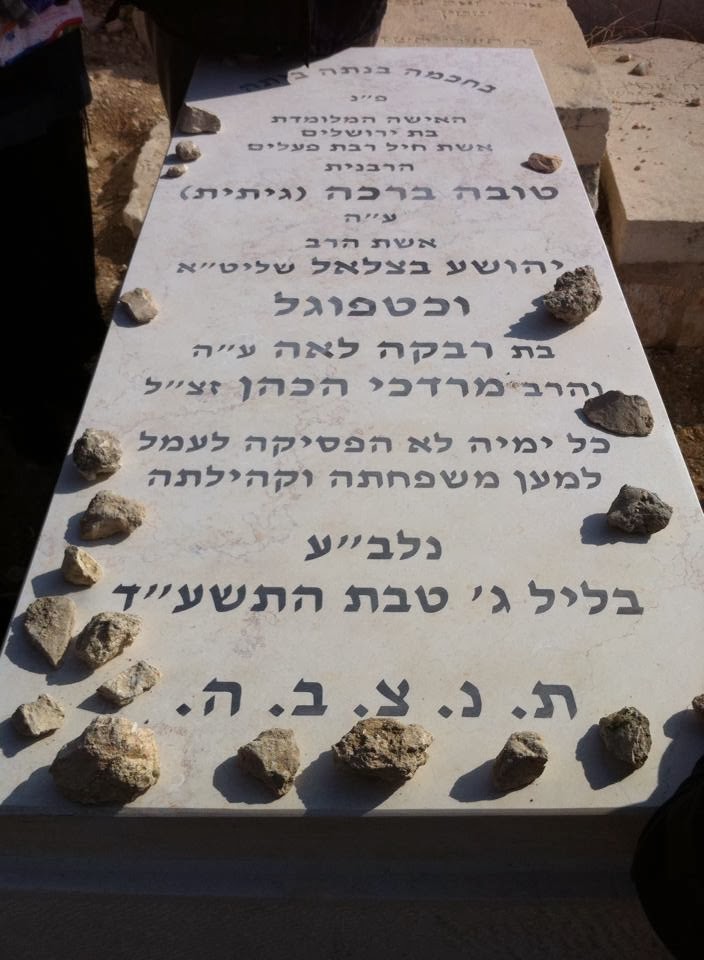
Last Sunday, my mother’s headstone was revealed, a Jewish ceremony that in Israel usually takes place 30 days after the funeral. I wasn’t there to see it, but my niece, Rinat, posted this photo on Facebook. 
My mother's gravestone. (Photo by Rinat Adler Horesh, 2014)
Rinat wrote, “"I don't believe 30 days have passed. It's hard to describe in a few words such an amazing persona true woman of valor, full of life's joy, a saint by her own deeds and her ancestors', and simply a mother and grandmother to everyone! We so very love and miss our darling grandmother.

The photo was a little push in the now. It set off a memory domino, which set off another memory domino, which reminded me of the reason why I decided I needed to write Bathsheba’s Daughters so many years ago.

My mother was buried on the Mount of Olives, as were her parents. My grandmother Rivka’s father and her grandparents were also buried there, but her mother—my great-grandmother Bat-Sheva, whom I’m named after—died in 1964, when the Mount of Olives was in Jordanian hands, so she was buried somewhere else in Jerusalem.

The photo set the memory of my mother’s funeral, a little over 30 days ago, into action, which set off the memory of my grandmother’s funeral, about 14 years ago.  

I remember sitting in the backseat of a car driving up to the Mount of Olives. 

My grandmother had died in her sleep in a senior home. Her health had been deteriorating, and while none of us knew that she would soon leave us, she seemed to know. She seemed to be telling us goodbye in her own subtle way. Although her body gave out, her mind remained sharp until the end, just like my mom's.

After the funeral, one of my cousins, Bat-Sheva Peli Seri, told me that Savtah (grandmother in Hebrew) had asked her, “What do I call you?”

My cousin had shrugged.

And Savtah had replied, “I call you Mamaleh (little mother), because you were named after my mother.”

It was true. Four of us are named after my great-grandmother Bat-Sheva, and my Savtah used to call all four of us Mamaleh. Telling my cousin the reason why was her little way of telling the four of us that no one we love ever leaves us, that the great-grandmother she loved stayed with her through us, and that she would stay with us, too, in our memories and our hearts.

But the final domino in that line of memories was set into action by something else.

On the way up to my Savtah's funeral, I looked at the houses on the side of the road, and I saw something shocking: some of the stones in the walls of the houses had Hebrew letters chiseled into them. 

They were gravestones. 

Someone had stolen gravestones from the Mount of Olives and had used them to build a house. And this wasn’t just one house. House after house in this little Arabic village in East Jerusalem had Jewish gravestones in their walls, each gravestone carrying the name of someone who was buried on the Mount of Olives, someone who had been loved and cared for, someone who now had an unmarked grave, because someone else wanted to erase the fact that they had ever lived at all.

Many of my ancestors are buried on the Mount of Olives, but their story is different, and it’s because of my Savtah Rivka and a kind soul who never forgot a kindness done to him.

I’ve already told you the story of my mother’s first memory, how she was just a toddler on a bus in British Mandate Palestine when she heard Arabic cries of “Slaughter the Jews!”  

The Arab riots continued until Jewish night squads, led by a British Christian officer by the name of Wingate, put a stop to them. But before they ended, some Jews who couldn't take it anymore eventually formed angry mobs determined to return blows for blows. Just like the Arabic rioters didn’t care who they attacked so long as the person was Jewish, the Jewish mobs didn’t care who they attacked so long as they were Muslim men.

My grandfather was a respected rabbi who had a good relationship with his Arabic neighbors. 

Before every Passover, he would sell his community’s chametz (bread, crackers, and other things that aren’t kosher for Passover) to a nearby sheik; and after Passover, when he bought the chametz back, the sheik would send my mother's family a silver tray piled high with bread and rolls. 

My grandfather also had an Arabic man who worked for him, taking care of things that Jews aren’t allowed to do on the Sabbath. I asked my mother what this man’s name was, but she didn’t remember, understandably, considering he had worked for her father when she was very little. She said it might have been Ahmad, so I’ll call him that for storytelling purposes. It’s shorter than saying, “the man who worked for my grandfather.”

 One day, the Jews in the streets were in a panic. There had been another riot in Jerusalem’s Old City. Arabic cries of “Slaughter the Jews!” were being met with Hebrew cries of “Death to the Arabs!” It was a very dangerous time.

Ahmad had been working that day at my grandfather’s synagogue, and he was terrified. How could he return home? The angry Jews in the streets would kill him!

“Don’t worry,” my grandfather said. “You can borrow my clothes and hat. They won’t kill a rabbi.”

Ahmad seemed apprehensive. While it was true the disguise could save him from the angry Jews, what would happen once he reached his own neighborhood? How would they react to this rabbi in their midst? 

“No,” my Savtah said. “Ahmad, you can take my clothes.”


She went to her closet and pulled out a dress, a coat, and a woman’s head scarf. Ahmad put the clothes on and wrapped the scarf around his head and face. Disguised as a woman, he headed out into the dangerous streets, never to return.

My grandparents worried about Ahmed, of course. He had worked for my grandfather for years, and they didn’t know what had happened to him. Had he made it safely home? They wanted to believe that he had, but there was no way to be certain.

Several years later, the British left Palestine. The Arabic countries in the region and beyond united to drive the Jews out, but the Jews fought back. When it was over, Jerusalem was divided. My parents’ families were on the western side of the city, which was in the hands of the newly formed state of Israel, while Ahmed and the Mount of Olives were on the eastern side, which was in Jordanian hands. Between 1948-1967, robbers stole Jewish gravestones from the Mount of Olives. They used them to build houses, like the ones I had seen from the backseat of a car heading up to my grandmother’s funeral.

My grandmother, Rivka Hacohen, probably in the 1960s

Following the Six Day War in 1967, Jerusalem was reunited once more, and Jews could once again visit the ancient Jewish cemetery on the Mount of Olives. So my grandmother went to visit her father and her grandparents’ graves, something she couldn't do for close to 20 years.

I imagine her journey was much like mine. I imagine she, too, was horrified to see those desecrated gravestones in the walls of the houses she passed on her way up. She must have wondered what she wouldn’t find once she reached the Mount of Olives. Would she be able to locate the places where her grandparents and father were buried? Or would she never know because of the workings of some heartless thief?

She reached the Mount of Olives, and who should meet her there but Ahmed! 

They both cried tears of joy, so happy they were to find each other alive after all they had been through. 

But that wasn’t all . . .

“Come, Miss Rivka, come!” he said in Arabic. My Savtah was multi-lingual, so there was no need for him to struggle in another language.  He ran up the hill and directed her to follow him.

And amazingly he led her to her father’s gravestone. It was still there!

“I’ve taken care of all of them,” he said, pointing to her grandparents’ gravestones. “I made sure no one would disturb them.”

They say the greatest mitzvah (good deed) is one performed for someone who cannot repay you. If that is true, Ahmed’s act was possibly one of the greatest mitzvahs anyone has ever performed. 

How could he possibly know that he would ever see my Savtahthe woman whose generosity had helped me return safely homeagain? How could he possibly know that she would ever be able to visit her father and her grandparents’ gravesites again? 

Here he had performed this selfless act for almost 20 years with no way of knowing that anyone alive would ever benefit from it.


And that is the final memory domino in that line of memory dominos: the reason why it’s still possible to find my great-great-grandparents’ and my great-grandfather’s graves on the Mount of Olives. 

Perhaps it shows no good deed is ever wasted. Or perhaps it shows that even if we think it will be wasted, we have to try anyway, because you never know.  

Monday, December 23, 2013

My Mother's Stories

My mother, Tova Hacohen Wachtfogel, at age 72 during a visit to the United States for my son's bar mitzvah
A few weeks before my mother died in Jerusalem, she told me in a telephone conversation that stretched all the way to the United States about sitting down with her sister Sarah and reminiscing about the past. That day they had talked about the time they spent in Tel Aviv in the late 1950s, two young and beautiful ladies in a young and beautiful country—all three with ancient histories and fascinating stories—sipping coffee in a café.

My mom worked back then as a journalist, a children’s page editor, and a publishing assistant for the newspaper owned and run by her father and brothers. Her work didn’t make the front page, but, there in that café and everywhere she went, she had a front seat to history.

“You need to write your stories down,” I told her over the phone. “I want to read them, and I know I’m not the only one.”

Several years earlier, I had interviewed my mother for a book I was writing, which was a fictionalized version of her life in Jerusalem before, during, and a few years following Israel’s War of Independence in 1948. My mother had been twelve years old at the time of the war—a bat mitzvah girl—and the book was a project I was working on for a publisher who specialized in gifts for Jewish girls. The publisher had loved the story . . . until she asked me to add historic facts. The historic facts didn’t agree with her less than Zionistic friends, and her demand that I rewrite history to suit them didn’t agree with my principles and journalistic integrity, so the project fell through.

But I still had all these stories I had gathered when I was researching the book, and they were wonderful stories.

Perhaps it was for the best that the project fell through. Even before I started working on it, I had wanted to write a book about four generations of women in my family that spanned from the very early 1900s until the present in the Holy Land.  I wanted to write that book, Bathsheba's Daughters, because these women had great stories, stories that deserved to be shared. And a few weeks before my mother died, when we still hoped she might be with us for at least a few more years, I wanted her to share more of her stories. It was the greatest inheritance she could possibly leave behind.

“I’m not a writer,” my mother replied, this from a woman who was a journalist for decades.

“But you’re a good storyteller,” I told her.

“I’m not that good a storyteller,” she replied. “You know who’s a good storyteller? Your Aunt Sarah.”

“You are,” I said, although I suppose modesty prevented her from admitting it. “And if you don’t want to write your stories down, you could hire someone to write them down for you.”

She told me a great aunt of mine was doing that, paying someone to listen to her life’s story and turn it into a book for her kids and grandkids. “You should do that, too.”

She said it was a good idea and implied that she would think about it.

I’m sure she did. I’m sure it gave her a reason to want to stay around just a little longer. My mother was the kind of mom who would do anything for her children. Anything.

But God had other plans.

So now it’s up to me, the daughter who writes, the collector of stories.

When we were sitting Shiva for my mom, a few people came to me with stories. Stories about my mother, my grandmother, and my great grandmother. And I grabbed those stories with both hands.

I knew, for example, that my grandmother had been a bit of a rebel when she was a teenager, but I didn’t know that she would lean forward when the seamstress was measuring her for dresses, because she wanted the hemline to be higher than her parents would permit. I knew that my great grandmother was funny, creative and smart, but I didn’t know that under her bed in her old age she kept a green plastic shopping basket that contained a chess set, and I didn’t know that she would pull out that basket and play chess when a young distant cousin came to visit. Even in her old age, she still had a playful side.  

I shared the stories I had collected, too, but there were so many of them. I couldn't possibly tell them all.  

I told them about the book I had worked on and the book I had planned to write.

“I want to read that,” they told me. “Publish it, and I'll buy a copy.”

I promised to post the stories on my blog, and that is what I hope to be doing from time to time over the following weeks. Maybe if I write enough of them and collect enough photos and other material from my family, I’ll put it all together as that book I was planning to write, the one about four generations of women in the Holy Land.


I hope you’ll forgive me for this little detour. I know I usually write about writing, designing books, comedy, and geek stuff. But these stories about the women in my family deserve to be told.