Showing posts with label bullying. Show all posts

Wednesday, October 03, 2012

Your Bully Doesn't Know You. Only You Can Define How You See Yourself.


When a viewer sent her an email calling her a poor role model because of her weight, TV news anchor Jennifer Livingston at first wanted to ignore it. After discussing it with her husband, however, she decided to go on the air to explain why the man who sent that email was wrong, and why this kind of behavior is never okay. 

She did it because she realized it was this man who was being a bad role model. What if a kid overheard him making fun of the "fat news lady" and then went to school and told the kids there that they weren't worthy because of their weight? How would it make those kids feel? 

Kids need to know that it's wrong to judge people based on physical appearance. Each person is so much more than he or she appears on the outside. And more importantly, we can't let the opinions of bullies--who don't really know us--determine how we feel about ourselves. 

This is the same message I hope to get across to kids with Dan Quixote: Boy of Nuevo Jersey, particularly with the lesson plan for that book. Kids need to understand that bullies don't really know who they are and can't define how they see themselves. Every person is special. We each have unique talents, and the world is a better place when we're free to express those talents and be ourselves. Bullies try to take that away from other kids, and it makes the world a sadder place. It's wrong, and we have to let kids know that it's wrong.

Bravo to Jennifer Livingston! For the record, I think you're smart, talented, beautiful and very brave for taking a stand. 

Thursday, August 09, 2012

An Author Visit Program to Help Promote Self-Esteem and Combat Bullying


I need feedback on a possible author visit program that addresses bullying, and I hope you'll help. 

I'm going to be sending out flyers for my funny, middle-grade novel, Dan Quixote: Boy of Nuevo Jersey to schools, and at the bottom of the flyer, I want to offer an option of Skype or local in-person classroom visits. Dan Quixote deals with the power of friendship and self-esteem to overcome peer pressure and bullying, so I want to offer a program focused on that. 

This is the idea I have for the class. Each student will be given two pieces of paper. 

I will start by talking about being a geek and what it means to me. I think geeks are people who are passionate about something to the point where they don't care what other people think. I'm a geek about books, Doctor Who, The Princess Bride, technology, Eureka, Mythbusters, and lots of other things. I just love them all so much. I love books so much that I have a huge library in my apartment with probably around a thousand books. I love The Princess Bride so much that I can quote about half the movie. Some people are geeks about the TV show Glee, which makes them Gleeks. Some people are geeks about Star Trek, which makes them Trekkers. There are also theater geeks, band geeks, rock-climbing geeks, and people who are geeky about pretty much anything you can imagine. 

At the top of the first piece of paper, each student should write down something they're geeky about. I would point out that I think being a geek is a good thing, and I feel sorry for anyone who either hasn't found something they love that much or is too afraid to admit what they're geeky about. When they're done writing, I would explain that, in the book, the class queen bee bullies Dan for being a geek. On the same piece of paper, I want them to write three things a bully like the class queen bee might say to make you feel bad about the one thing you're most passionate about. 
Illustration from Dan Quixote: Boy of Nuevo Jersey--
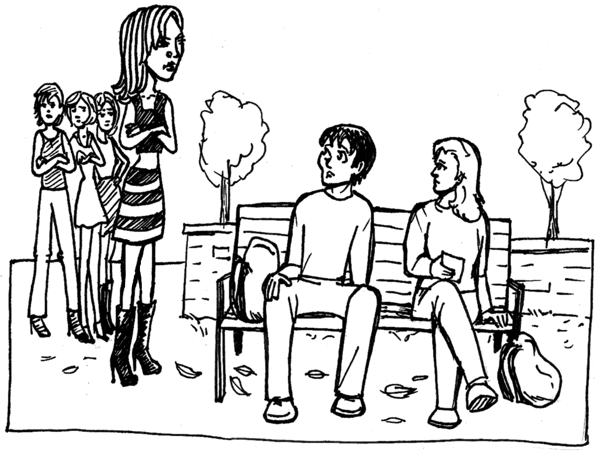
Sandy discovers Dan's beloved notebook after queen bee Jade trashes it

When the kids are done with that, all of those pieces of paper will be folded and put into a box. The students would then randomly pick out one of those pieces of paper. 

I'll then say, "In my novel, Dan realizes that being a geek is a good thing, and Sandy steps in to show her support. She stands up for him. On the second piece of paper, I want you to pretend you're either Dan or Sandy, and I want you to write five things in response to the bully, focusing only on why it's good to be geeky about that one thing, not about the bully or the bullying. Just keep it positive. Pretend you're standing up for something you or your friend loves."  

I would then ask each of the students to read out their five responses. 

In the end, I would ask students how it feels to read the things they wrote and how it feels to hear these things. I would ask them to carry that feeling with them. Each one of them can be Dan or Sandy. They just have to believe in their own passions and support their friends' right to love the things they're passionate about. We're all geeks in some way, and that's a great thing, because passionate people make a difference in the world. 

So what do you think? Does it sound like a good author visit and could it help combat bullying by building self-esteem?

Thursday, June 07, 2012

Write for Children? Here's What You Can Do for School Librarians--and What School Librarians Can Do for You

School librarians don't just help kids find great books. They help  children's book authors find readers too.


Last year at the New Jersey SCBWI (Society of Children’s Book Writers & Illustrators) annual conference, I attended a class called “Minding Your Own Business.” The class was on the one thing all of us who write for children want to know: how to make money as a children’s book author.

The instructor, Sudipta Bardhan-Quallen, explained that the real money isn’t made by selling children’s books, even if you’re lucky enough to get a couple of picture books traditionally published every year. No, the real money is to be made by doing other things, particularly school visits.

Sudipta--who has written numerous picture books, including Pirate Princess and Chicks Run Wild--informed us that she went to two conferences for educators every year, one in New Jersey, the other in California. Getting just two school visits was enough to pay for her entire trip to the Golden State.

After hearing her speak, I put out a new school and library edition of Dan Quixote: Boy of Nuevo Jersey, with discussion questions in the back. Because bullying is such an important topic in schools today, I focused my questions on bullying, peer pressure, friendship and individualism. 

Dan Quixote: Boy of Nuevo Jersey uses humor to show that friendship and respecting our differences can help kids overcome bullying and peer pressure. The bullying isn't sugarcoated, but it also isn't exaggerated. I wanted to show all kinds of bullying, but I also wanted to focus on the kinds of bullying most kids encounter, so that they would be able to relate to the main characters, Dan and Sandy.

The school and library edition of Dan Quixote: Boy of Nuevo Jersey has questions in the back to help teachers and librarians start a discussion with students about what they can do to prevent bullying.


Of course, success like Sudipta’s doesn’t happen overnight. She worked her way up to get into the position she’s in now, while most writers have to start at the bottom.

So where exactly do you start?

Sudipta told us that she charges differently depending on the school and its situation. It’s best to start with a few free visits to work out what you’re doing and what the best way to do it is.

 The first thing that will pop into most writers’ heads is that they should contact teachers they know, particularly the teachers who have taught their own kids. That’s not a bad idea. But there something even better that you can do: contact your local school’s librarian or library media specialist.

I met school librarian Valerie Dewhurst online, and she was eager to answer my question. As a school librarian, she wants to help children’s book writers promote their books. Valerie works in a school in Blackburn in the UK, but I think most of her answers apply to schools in the United States and other countries as well.

Here are my questions and Valerie's answers:

Q. How does a writer find out who the school librarian is, and what's the best way for the writer to contact the librarian? 

A. Writers can email or write to schools, asking for their introduction to be passed on--my personal view on this is to send to the librarian, because sometimes mail does not get passed on. A good way is to find their local SLA (the School Library Association in the UK) branch and get in touch with the secretary. She can inform all members of your work or new book. She can even ask you in to one of their events--getting you a big intro with members. I do this. 

Q. What's the minimum the writer can send? What are the best things a writer can send to make it as easy as possible for the librarian to promote the writer's work? 

A. There is no minimum--I would welcome one book or even a box of books. But again, it's down to each librarian's personal view on this. Finding and asking the branch secretary of groups is always best. 

Q. Should a writer send materials just once, yearly, or more often? What is the best time of year to submit material?

A. Termly, I think--my personal view. We can never get enough material in
. 


Q. Should a writer send a lesson plan if he/she wants to get an author visit?

A. Oh yes, good idea—I would welcome this. I have just had an author in, and he emailed me his lesson plan after the event. We are using it now in library lessons as a follow up.

Q. Does a writer need a website? 

A. No, but it's a good idea these days to have one. 

Q. Does a writer need recommendations from other schools? 

A. Not always. If you’re good, anyway, you'll soon get recommended. I welcome new authors too, everyone deserves that chance to get out and get their work noticed. 

Q. Should the book have discussion questions in the back? 

A. I think this is a really good idea. I wonder if other authors have thought of this. 

Q. If a writer used to be a teacher or has a teacher's certificate, is that something that should be mentioned? 

A. Yes, of course. Why not? Kids love to sit and listen to authors talk and love to know about their past. They are always fascinated when the author says "I used to be a librarian." This goes down very well. 

Q. Does the book need to be on particular topics that fit the curriculum? 

A. No, all good books are welcomed. 

Q. What can writers do to make it as easy as possible for school librarians to promote our books as fully as possible? 

A. Send them their new books or even sample copies/reviews. Get their publisher to send out posters and bookmarks. Librarians are busy each day and don't always have time to make that contact. There are so many new books being published that it's hard to keep up. Hence I do lots of work from home in my own time.

Thanks, Valerie, for answering my questions. There's a lot that children's book writers and school librarians can do to help each other. Thanks for showing me--and my readers--the first steps. 

If you found this helpful or if you have any questions or suggestions you would like to make on this topic, I hope you'll leave a comment below.

Thanks!

Shevi

Wednesday, February 15, 2012

The Why and How of Indie Publishing Hardcover Editions

My husband and I are currently working on the hardcover edition of Toren the Teller's Tale, and I think the information we're collecting might benefit others, so here it is.

Why make a hardcover edition?

Hardcover editions are better for libraries. 

Having a hardcover means your book will be shelved on a shelf and not jammed into a carousel. (We learned this the hard way with our Dan Quixote paperback. After seeing how mangled it got, we created a new "school and library edition" paperback that fits a carousel better and has discussion questions on individualism, conformity and bullying in the back. The largest format that fits the carousels well is 5.25"x8", so I highly recommend sticking to that size when it comes to a paperback.)

J.A. Konrath recommends publishing your book in every possible format to open it to the most markets, and I agree.

Having a hardcover library edition is particularly important if you are considering doing school and libary visits, which are a good way to market a children's book and--more importantly--a potential source of additional income. 

While you'll probably sell paperbacks to students (if you decide to sell copies in connection to your visits), the hardcover edition will be better for readings and will probably appeal more to the librarian or library media specialist. It's less important if your genre is one that's rarely published in hardcover, like paperback romance.


So how do I make a hardcover edition?

Lightning Source is a good POD provider, because it does hardcovers and works with libraries. It's owned by Ingram, which is a distributor that works with everyone, particularly libraries. Working with Lightning Source will get your book into Ingram's catalogs, which are sent to libraries and schools. 

Lightning Source is, however, notoriously difficult to figure out. It can also be rather expensive, not only because of the setup fee, but because it asks that books be formatted in Adobe Acrobat as a PDF/X-1a:2001 compliant file, and Adobe Acrobat costs hundreds of dollars. We're currently trying to see if we can use Nuance PDF Create instead, but unfortunately Lightning Source charges for each upload that isn't formatted correctly. It's risky. One of the reasons we chose CreateSpace for our paperbacks is that the startup cost is $0. CreateSpace will even provide you with an ISBN (Lightning Source doesn't, so you have to buy your own). CreateSpace is also a lot easier to use.

We're still in middle of working with Lightning Source, but here are a few things we've learned.

While most libary books have jackets, there are some children's books that have laminated covers. 

I prefer laminated, because it doesn't rip and it's easier to clean. Some titles like this are the Wimpy Kid books, the Origami Yoda books, and Cornelia Funke's Dragon Rider.  

This means that if your book is similar, there's no reason why it shouldn't have a laminated cover. All of these covers are matte, although they have glossy elements. I don't know if CreateSpace allows for glossy elements, but it does allow for some gold. Dragon Rider has the title and the author's name in gold, so that's something to consider if you're interested, although it will cost more.

The main thing we've been researching lately is pricing. 

How much should you charge for a hardcover edition?

This is what I found out. First, go to page 20 on this PDF document: http://www1.lightningsource.com/ops/files/pod/USPODOpsManual.pdf

You'll find there are several options. 

Your book will probably be a small hardcover, as "small" refers to the dimensions of the book, not the number of pages. (My guess is that "large" hardcover refers mostly to picture-book dimensions.) Your book will therefore cost $6.00 + $0.013 per page (a book with a jacket costs $1.55 more) per copy to print. A 500-page book, for example, costs $12.50 to print.

But that doesn't tell you how much the retail cost of your book should be. 

Lightning Source recommends that you allow for sellers to take 55% of list price if you want the widest distribution. This lets the stores sell your book at a discount.

This means you should divide your printing costs by 0.45 to get the minimum retail price for your book, which in the case of a 500-page book would be $27.78. You should then add a bit so you're not selling at a loss.

The next question then becomes, "How much will the market bear?"

To find out, go to the current New York Times besteller hardcover list for your type of book. 

In the case of my 500-page children's/YA novel, that would be this list: http://www.nytimes.com/best-sellers-books/2012-02-19/chapter-books/list.html 

While most books are priced below $20, Wonderstruck by Brian Selznick is listed at $29.99, which means this is the top of the range of what you can charge for this kind of book. Fortunately, that's stil $2 over the minimum, so it could work out for this particular book.

Don't expect to make a lot on hardcover editions. The main benefit is just to offer that option for those who need it, like some libraries.

Having a hardcover edition of your book can help you get it on library shelves

If you have any additional information, comments, or questions about hardcover editions, please add them below. Thanks, and I hope this helps!

Wednesday, August 24, 2011

Yippee! I just read the nicest review for Dan Quixote: Boy of Nuevo Jersey!

I don't know who J.C. is, but I thank you so very, very much!I hope your eldest enjoys it too.

http://theothersideofthepage.wordpress.com/2011/08/21/359/

"So, I guess to sum it up there are a lot of great messages in this book, delivered in an amusing story without being preachy or too in your face. I think it would definitely appeal to the middle grade reader, and even as an adult I found things to like. I will probably read this with my eldest in the near future."