Wednesday, June 14, 2017

Things to Do in Jerusalem in the Summer of 2017

There are so many fun things to do in Jerusalem this summer, but unfortunately no one seems to have assembled an easy to understand site of events with correct dates, locations, costs, and so on.

One site, Janglo, has a few good articles about events that are currently happening or about to happen in Jerusalem but is over-run by ads, ads, and more ads. It's frustrating trying to weed through it to find actual useful information.

The Jerusalem Film Festival site has an opening and closing date for the festival, but...there's no other info about this year's festival, which starts less than a month from now. It runs from July 13th until July 23rd this year, and if it's anything like last year's festival, it will be amazing. (The festival last year included a zipline, other interactive activities, and screenings under the stars in  Independence Park; moonlight cinema at the First StationOld City screenings; and a free virtual reality complex next to the Cinematheque.)

Even the best sites, like FunInJerusalem (a good site for families), GoJerusalem (mostly for adult tourists, with events like the Opera Festival and the Beer Festival), iTravelJerusalem ("the official Jerusalem Travel Site"), and the Jerusalem Municipality's events calendar have only partial lists. You have to get one thing from one site, another thing from another...it's all so confusing and frustrating.

Screengrab of one part of the Jerusalem Municipality website with some of the things residents and visitors can enjoy this month


The good news is that you can't go wrong by simply walking around the city any evening of the week. The bad news is that there are so many things you're likely to miss!

With that in mind, I've decided to start a new blog: Shop With Shevi. A part of this will be me trying to work out what I might want to do on any given day. Another part will be an attempt to share this information to help anyone else who is looking for something to do, somewhere to eat, the best places to shop, and more in Jerusalem.

Tuesday, June 13, 2017

Where in the World Is Shevi Arnold?

Hi, everyone!

So I haven't been blogging for several months. Here's why.

Whenever my life takes a turn, I like to look at where I am and ask myself how I got there. Was this my goal when I started this path? Is this path bringing me closer to my goal?

The purpose of returning to the USA was to get my son the best education for autistic kids that we could afford, and we got that. But in June of last year, he graduated out of the system at the age of 21. After that, we tried to get him into a program for young adults with autism, but we weren't getting anywhere.

Then the 2016 elections happened, and stability--especially for the disabled community--went out the window in the USA.

I don't know if you've noticed, but withdrawing funding from programs that help the disabled seems to be very high on the GOP's to-do list. It's horrible and shocking, but then so are a lot of things that have been going on in the USA lately. The day after the election, I experienced racism and antisemitism during a trip to my local supermarket. This was not my America, not anymore.

I looked at where I was and saw that being in the USA had fulfilled my goal for a long time...but it no longer was. I decided it was time to return to Jerusalem.

Independence Park in Jerusalem


Jump ahead a few months, and here I am, in the heart of Jerusalem! And I love this place. There are so many fun things to do throughout the week. When I left the USA, I was surrounded by fear and instability. Here in Jerusalem, I feel surrounded by joy and love and understanding. Most Israelis have been so nice to me and my son. It's so good to be back!

So that's what's going on with me.

I'm currently doing the final edits on the second book in the Legend of Gilbert the Fixer. Book one was called Why My Love Life Sucks, so book two is, of course, called Why It Still Mega Bites. (Get it? "Megabytes" and "mega bites," because Gilbert is a computer nerd who's also a vampire? Of course, you do. I knew it. My readers are geniuses.)

I've also started working on a nonfiction book entitled Everything You Never Knew You Wanted to Know about God, which I will be publishing under a pen name. (I don't want anyone to confuse it with my fiction.) Many people know that the three major monotheistic religions began with one man, Abraham. What most don't know is that it started with a logical argument. The book returns us to that logical argument, shows where religion went wrong, and explains how we can return to that logical view of God. It's built on commonly asked questions, like "Does God even exist?" "Does God demand faith?" "Why do bad things happen to good people?"  

But mostly I'm just taking care of my son and enjoying what Jerusalem has to offer. This city is amazing! If you go to my Facebook page, you'll see lots of photos I've taken of just about everything.

I'm feeling a lot better now, and hopefully I'll start blogging a lot more.

Stick around for more stuff about writing, my books, and Jerusalem. I love you all so much and look forward to sharing my continuing journey with you.

Sunday, July 31, 2016

How to Get Rid of the Ugly Green Lines Under Your Lovely Words in Microsoft Office Word

Are you writing fiction or blog posts? Is Microsoft Office Word telling you contractions are a problem? Incomplete sentences are a problem? And other things that are stylistic choices you're free to make as a writer are problems? 

No, the rules of writing haven't changed. It's just that Office is now set for academic writing, not any old kind of writing (Why do they think there's only one kind of writing?!), but you can fix this issue. I found solutions online, but they weren't very helpful, probably because they were for older versions of Word. This solution is for the latest version (although it's possible it might be good for slightly older versions, as well).

Here's how you can fix this problem: The next time you see that pesky green line under your beautiful words, right-click it and then click "grammar" in the pop-up window. That will open this screen: 

(Please don't try to read the words under the window in this screen grab. They contain several huge spoilers for Why It Still Mega Bites, the second book in the Legend of Gilbert the Fixer, and you don't need that.)

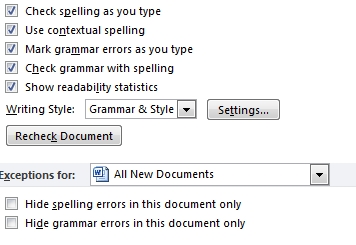
See where it says Options at the bottom left? Click that. The next screen should open with"Proofing" highlighted in the left-hand column. In the pop-up menu to the right of that, scroll down to where it says "Writing Style: Grammar & Style" and click the "Settings" button next to it. That will give you the "Grammar Settings" menu shown here:


Go through the options and unclick the things you don't want to be corrected on, like fragments and run-ons, contractions, sentence fragments, sentences beginning with and, and so on. Then click "Okay." This will take you back to the previous menu.

Near the bottom of the menu on the right, you'll see "Exceptions for." Click to open the drop-down menu and select "All New Documents" and then click "Okay" at the bottom of that menu.


And that's it. Yay! You've made those pesky green lines go away!

You're welcome.

Tuesday, May 31, 2016

#AtoZChallenge links

Here are all the links to all of my Writing Words for Nerds #AtoZChallenge posts:


J is for Justice (and why we need it in stories) http://www.sheviwrites.com/2016/05/im-middlechild.html


L is for Love Stories (and how to write one when you don’t read romance) http://www.sheviwrites.com/2016/05/l-is-for-love-stories-and-how-to-write.html


P is for POV. What’s the right one for your story? http://www.sheviwrites.com/2016/05/writing-words-for-nerds-atozchallenge-p.html


R is for Raise [the Stakes] and why you NEED to do that NOW! http://www.sheviwrites.com/2016/05/writing-words-for-nerds-atozchallenger.html


Z is for Zigzag http://www.sheviwrites.com/2016/05/words-for-nerds-atozchallenge-z-is-for.html

Sunday, May 29, 2016

Words for Nerds #AtoZChallenge--Z is for Zigzag (the easy way to bust that cliché!)

I’m about to give you a piece of advice I got from an agent at a SCBWI New Jersey workshop. The workshop and one-on-one critique with the agent cost me a nice bit of money and a trip to Princeton, but I’m about to give it to you for FREE!

How lucky does that make you?

During my critique, the subject of clichés came up, not because my manuscript had any clichés, but because I wanted tips on how to avoid them.

The agent told me, “If everyone else goes ones way, go the other way.”

Simple, right? If everyone turns right, you turn left. If everyone zigs, you zag. If everyone is doing something one way, then it’s a cliché. Don’t do it that way. Do it the opposite way. Leave the beaten path and forge your own. It’s that easy.

When we think of clichés, we usually think of over-used expressions, like “head over heels in love.” But clichés can be bigger things, too.

All kissing scenes zig one way? Zag, and write a kissing scene that’s almost the opposite of that. That’s what I did in Ride of Your Life. If you read it, you’ll see there’s a first kiss that couldn’t have been written in any other book. It’s just so different! Gilbert’s first kiss with Amber in Why My Love Life Sucks also zags . . . and so does a kiss in the upcoming sequel, Why It Still Mega Bites. I hate kissing clichés, so of course I write kisses differently.


Everyone is writing dystopian? Zag, and write whatever the opposite of dystopian is in your eyes. (For me, that would be a science-fiction comedy.) Or zag, and write a dystopian that breaks all the clichés and completely changes what people think a dystopian novel is supposed to be! After all, no one need another dystopian novel that’s exactly like the hundreds of others already out there.

So how do you zag?

In my blog post on humor, Writing Words for Nerds #AtoZChallenge—H is for Humor (and how to create it), I mentioned the mirrors and lenses of the House of Funny. While any mirror or lens can help you zag, the best to use here is the “lens of character.” Because if you have a truly different character with a completely different way of seeing the world and interacting with it, anything viewed through the lens that is that character will be different.

Should you always zag where everyone else zigs?

 I don’t think so. But you should always zag when zigging feels somehow wrong to you, it doesn’t fit your story, or it makes your story less of what you’re trying to make it.

You should also try to consider the possibility of zagging, even if you choose to zig in the end. It should always be a choice, not something you did because you were following the crowd—or trying hard not to follow the crowd. You shouldn’t zag for zagging’s sake. You should do it because you like that’s your preferred choice.

And now I’m down to another Z: Zero!

I’ve reached the end of this blog post, which means I have zero posts left to write in the #AtoZChallenge. I did it! Hope you liked it and that it helped or at least entertained you in some way.


Maybe I’ll do it again next year, this time in April!  

Friday, May 27, 2016

Words for Nerds #AtoZChallenge--Y is for YA (an interview)

Shevi: Hi, YA!

YA: (Continues to text on her phone, her face partially hidden behind her hair. She shrugs.)

Shevi: We’re here to set people straight about all the mistaken assumptions they have about you.

YA: (Pausing but not looking up from her phone) Yeah! People just don’t get me.   

Shevi: I think most people know that YA stands for “Young Adult.”

YA: (Sighs and rolls her eyes) I don’t like being called that anymore. I’d rather be called “Teen.”

Shevi: Totally understandable, since that’s clearly what you are.

YA: Duh!

Shevi: Okay, so I think most people know that YA books are books with main characters who are between thirteen and seventeen years old.

YA: Yes, but we’re not all the same.

Shevi: Right! There’s younger YA, which is more for teens between thirteen and fifteen. And then there’s older YA, which is more for teens between sixteen and seventeen.

YA: Because we’re dealing with different stuff.

Shevi: Absolutely! For example, the Georgia Nicolson books by Louise Rennison, like Angus, Thongs and Full-Frontal Snogging, deal with friendships, first crushes, everyday family stuff . . .


YA: And the character is younger, so that’s definitely younger YA.

Shevi: Yes. And my Legend of Gilbert the Fixer series that starts with Why My Love LifeSucks has a seventeen-year-old character dealing with the last year of high school and who he wants to be after high school.

YA: Definitely older YA.

Shevi: Yes.


YA: But it’s only like PG-13, so younger teens can read it.

Shevi: Yes, and that’s true of a lot of YA. Younger teens can read it. They just might not necessarily relate to it. It depends on the maturity of the particular reader and what they’re going through.

YA: (Back to texting) Yeah.

Shevi: And that’s one of the misconceptions I’d like to clear up. Some people think that any book with a teenage protagonist is a YA, and that’s just not the case.

YA: (Laughs) Yeah, because if that was true, all those Disney princess movies would be YA, and they’re so not!

Shevi: Right! A YA novel has to deal with same things teens are dealing with today. Like first romantic relationships.

YA: (Blushes) Ewwww . . . Don’t talk about that out loud, okay?

Shevi: Don’t worry. It’s just between the reader and you.

YA: (Nods and goes back to texting)

Shevi: Two other common misconceptions are that a YA book has to be completely clean . . .

YA: (Laughs) Yeah, no.

Shevi: Or that YA books can only be issue books that deal with things like sex, violence, drugs . . .

YA: (Blushes) Yeah, no.

Shevi: A YA book can certainly deal with serious issues. That’s fine. But there are all kinds of YAs.

YA: Yeah, just like there are all kinds of teens.

Shevi: Exactly. And a YA refers to an audience age-group, not a genre. A YA can be in any genre. It can be an issue book, but it can also be a comedy, a fantasy novel, a science fiction novel . . .

YA: (Excited) Have you read The Hunger Games? It’s ah-mazing!


Shevi: That’s another thing. You don’t have to be a teen to appreciate YA. A good book is a good book, no matter how old you are.

YA: Thank you!

Shevi: Before we go, is there anything else you’d like people to know about you?

YA: (Looks up and puts her phone down. She takes a deep breath and lets it out.) I wish people would stop telling me what to do.

Shevi: Meaning?

YA: Some writers treat us like we’re little kids. They don’t understand who we are or what we’re going through. They lie to us. They’re not honest. You don’t have to tell me what to do or think or feel. I can do those things for myself! It’s like . . . it’s like they don’t respect me.

Shevi: (Nods) I think that’s something every writer should keep in mind, no matter who their audience is. No one likes to be condescended to. I know I don’t. And you know what else?

YA: (Shrugs)

Shevi: I love your honesty. I think that’s what makes you one of my favorite categories of books. You don’t waste time but get straight to the point.


YA: (Blushes) I like that about me, too. 

Shevi: So I hope that clears up a few misconceptions. If you want to know more, just check out the books in the the teen section of your local library or bookstore. The more you read, the more you'll realize how great YA books are. 

Words for Nerds #AtoZChallenge--X is for eXtreme Writing (the ONLY way to write)

Improv says you have to “commit 100%.”

One of my rules of comedy is that you should, “take it as far as it will go. All the way up to the edge . . . and then push.”

And as I’ve told members of my critique group (please excuse the PG language), “Don’t do anything half-assed. It should be full-assed or nothing!”

I honestly mean that.  

What I’m talking about is extreme writing—and it’s the only way you should write.

I think if you look at any successful book, you’ll see the author didn’t hold back, didn’t do things by half. Whatever the author was doing, the author did it all the way. You might like it. You might hate it. But either way, you have to respect that whatever the writer’s vision was, that writer went for it.

Take Harry Potter as an example. That book isn’t just about a boy with magical powers who waves a wand and recites spells. There’s a whole magical world around him that’s rich with detail. Hogwarts has a history. Letters are delivered by owls. Food comes alive. Trees can attack you. Staircases move. Paintings talk. Ghosts roam the halls. J.K. Rowling didn’t do things by half. She took it all the way up to the edge and then pushed.


Or Gilbert Garfinkle from Why My Love Life Sucks (The Legend of Gilbert the Fixer,book one). I didn’t set out to write a series about just any geek; I set out to write a book the ultimate geek. Gilbert isn’t just a hacker; he’s the ultimate hacker. He’s not just a nerd fighter; he’s the ultimate nerd fighter. He’s not just a fan of Star Trek; he’s a fan of pretty much every form of geek or nerd culture. And I wasn’t going to give him a little problem. I gave him the ultimate teenage geek’s ultimate nightmare: getting stuck with a gorgeous vampire girl who wants to be his platonic BFF, literally forever!

Now that’s extreme writing.

You don’t have to write fantasy, science fiction or comedy for your writing to be extreme. You can commit 100% to writing a quiet book, too. Just don’t set out to make a quiet book with a few exciting scenes, or an exciting book with a few quiet scenes. Whatever choice you make, stick with it! Commit to it! Don’t waffle. Unless, of course, you’re all about waffling, in which case, I want to see you waffle like an IHOP! I want to see you waffle like no one has ever waffled before! I want you to be the King or Queen of Waffles!


Like many people, The Shawshank Redemption is one of my favorite movies. I love it because the hero, Andy Dufresne, isn’t just ordinary—he is extremely ordinary. He isn’t just boring—he is extremely boring. He’s an accountant, for goodness sakes! His hobbies include playing chess and reading. How boring (in the eyes of most people, not a book addict like me) can you get? His favorite music is opera. Opera! Andy is as ordinary as a piece of coal, but here’s the thing about coal: under a great deal of pressure, a piece of coal can turn into a diamond. And that for me is the beauty of this movie. Andy Dufresne succeeds—not despite being extremely ordinary and boring—but because of it.  

And that, I think, is a metaphor for extreme writing. Take something that could be boring and ordinary, put it under the pressure of making it extreme, and watch it shine. 

It honestly doesn’t matter what you’re writing about. As long as you make it extreme, your story will be more compelling for it. 

Wednesday, May 25, 2016

Words for Nerds #AtoZChallenge--W is for Who, What, Where, When, Why (and How)

From an "ugly" stepsister's
perspective
I suspect the most widely known rule when it comes to writing an article is that you must answer the six W questions: Who, What, Where, When, Why (and How). 

Answer these six questions, and you’ll have a complete article. Don’t answer these six questions, and your readers will be left asking questions you should have answered.

Fictional stories answer these six questions, too, but there’s one very important difference: the answers for an article are supposed to be based on fact, but the answers for a work of fiction can be anything the author chooses. 


Cinderella, for example, has an evil stepmother and evil stepsisters in the original fairy tale, but in your version? You can do anything you want.

This Cinderalla is running away
from the prince

The truth is every existing story has an infinite number of story possibilities. All you have to do is change the answers to the six questions.

Who? In the original, it’s Cinderella, her evil stepmother and evil stepsisters, her fairy godmother, and the prince. But what if you make one of the stepsisters the main character? Or the fairy godmother? Or what if Cinderella isn’t so good? What if she’s kind of mean and she chooses to sleep in the cinders to embarrass her step family?


What? In the original, she gets magic clothes, goes to the ball, falls in love with the prince, loses a glass slipper, and is found to be the prince’s true love when the glass slipper fits her. But what if she doesn’t have a fairy godmother, or magic clothes, or any of that stuff? What if she doesn’t even like the prince? What if she doesn’t want to go to the ball?


All she wants is to get rid of the
curse of obedience
Where? The original takes place in a fairytale land. But what if it didn’t? What if it took place in the 21st century? (Time is a part of the setting, not the “when.”) What if it took place on another planet? What if it took place in the Wild West?

When? The story begins with Cinderella being mistreated by her stepmother and stepsisters. But what if it started before all of that happened? Or what if it started after? And how much after? What if starts with Cinderella trying to adjust to a royal life and being unable to accept how the servants at the castle are treated? What if it deals with political intrigue behind the scenes as noblemen and women try to get rid of Cinderella? Or what if it skips ahead a couple of decades as the daughter of Cinderella and the prince has doubts about marrying a prince?

Why? Cinderella gets her happy ending because she’s good and obedient and doesn’t complain despite all the hardships she endures. But what if she isn’t so good and obedient? Or what if she is obedient, but not by choice?


How? The “how” of a story is about how the story is told: in other words, its style or genre. Cinderella is fairytale, but it doesn’t have to be. What if you turned it into a mystery? I mean, how did Cinderella’s parents die (or at least disappear) anyway? What if you turned it into a screwball comedy? Or into a science fiction novel with robots?


Six questions, infinite answers, and infinite story possibilities.  

Tuesday, May 24, 2016

Writing Words for Nerds #AtoZChallenge--V is for Voice (Have you found yours?)

There’s a fun improv game you can play where you say the same thing in a bunch of different ways.

For example, try saying “I love you” in the following ways: bashfully, sarcastically, like Captain Kirk (remember . . . to pause in the . . . most unexpected of places), like a rock star (yeah, baby!), like a slimy politician (don’t forget to vote for me), angrily, drunk, like a little kid, like a parrot, and like Siri.

These are just a few examples. Maybe you want to come up with a few on your own. Or maybe you’d like to try different words. I used to play a similar game with my daughter and her friends, where we would read a children’s book in different ways. Believe me, Dr. Seuss sounds a lot funnier if you read his words furiously.

What makes this game interesting is that you soon discover that words change their meaning depending on how you say them. Spoken bashfully, “I love you” sounds deep, so deep that it scares the speaker just a bit; but spoken sarcastically, it sounds more like “I despise you.”  

You might be thinking, “What does any of this have to do with writing?”

While different literary agents and editors are looking for different genres, one thing that almost all of them are looking for is a unique and interesting voice.

Written words actually do have a “voice.” It’s the thing that differentiates one writer from another, the way each of us can express the same thing in a different way.

Some of us are like standup comedians. We write in our own voice. Jane Austen was like that. Her words are uniquely hers. No one else could have written them, not unless they were great at mimicking her voice.

Others are more like actors. We write in the voice of a character we’re playing. Daniel Handler wrote the Series of Unfortunate Events books like that under the name Lemony Snicket. I’d say Louise Rennison wrote her Georgia Nicolson books like that, although I’ve been told by people who heard her speak that Georgia’s voice was Rennison’s. They say she actually spoke like a teenage girl “on the rack of lurrrv,” and she really was the bestie every girl wanted to have.

Of the books that I’ve written, Toren the Teller’s Tale is close to my writer’s voice, although it’s heavily influenced by the voices of the various storytellers in it, particularly Toren herself. Dan Quixote: Boy of Nuevo Jersey has a lot of my voice in it, although a younger version of it.  I think Ride of Your Life comes closest to my true writer’s voice. Yes, it has focal characters, so the voice adjusts depending on the point-of-view character in a scene. But I do think you get a lot of my voice, my style, the way I put words together into sentences and sentences into paragraphs.


On the other hand, Why My Love Life Sucks was written in Gilbert Garfinkle’s voice, not mine.  I suppose parts of me get into his voice, just a bit. We’re both proud geeks, after all, both love science and both want to fix the world in our own way. He’s a lot smarter and younger than I am, though, and male. And I’ve given him some things that are the opposite of me, just so I could try on his way of seeing things. Gilbert loves heights, because I’m afraid of heights. Gilbert loves extreme sports for the same reason. He’s brave where I’m scared, and sometimes he’s scared where I’m brave. 

I think I prefer to write in someone else’s voice. I know I prefer to write in Gilbert’s. When I write in my own voice, I feel self-conscious. What will readers think of me? What if they don’t find me funny? What if they don’t like my writing? What if they don’t like me at all? Gilbert, on the other hand, could hardly care less. He just sees the world the way he sees it, and it doesn’t matter what anyone thinks. Writing in his voice also makes me feel like I’m not doing this alone. I have a friend in my head. I can take him anywhere I like. And he is geeking awesome.  I would listen to his voice all day if I could.

While different literary agents and editors are looking for different genres, one thing that almost all of them are looking for is a unique and interesting voice.

So how do you, the writer, give them what they want?

That’s a good question. After all, if there were an easy answer, everyone would be doing it.

When it comes to a personal voice, you probably already have one. You probably already have a unique way of saying things that’s different from how other people say them. You can develop that voice by reading a lot books and seeing how you would say things differently.

Maybe you wouldn’t say “I love you.” Maybe you would say “I hate you” in such a way that deep down everyone reading it would know you actually mean “I love you.” 


Maybe you would say, “As you wish,” like Westley in The Princess Bride


Or maybe when told “I love you,” you’d say “I know,” like Hans Solo tells Princess Leia in The Empire Strikes Back.  


Or maybe you wouldn’t say it at all. Maybe you’d show it with the things that you do, or maybe you’d think it and be too scared to say it out loud.

Whatever way you have that’s unique to you, pay attention to it. Cultivate it.

Many new writers try to write like someone else, but you need to write in the way that only you can. That’s the only way you’ll stand out. That’s the only way your voice can be heard above the rest.

As for writing in a character’s voice . . . This one is a bit trickier to explain.

I think you need to know the character inside and out. It could help to write down their entire life’s story, all the things they like and don’t like and why, all their greatest dreams and deepest fears. It could also help to draw them or find a photo of someone who makes you think of them. You have to know who they truly are, and you have to let your characters speak for themselves. You can’t try to control their voices. If you can treat them like they’re real people—not puppets for you to manipulate—they’ll be more likely to have their own unique voices, the way that real people do.

Two small technical notes: first, avoid writing things like “he saw,” “she thought,” or “I felt.” There’s nothing between your character and the things that are affecting them, so don’t put your character between them.  Instead of writing “He saw her as she left,” simply write “She left.” Instead of writing “she thought it might be nice to meet him for coffee,” write “Meeting him for coffee might be nice.” Instead of writing “I felt reassured,” write “So it wasn’t all bad.” And second, if you’re writing in first person, watch out for the “evil I.” You’ll probably have to sprinkle a few I’s in your first-person manuscript, but you don’t want to overdo it. People who say “I” a lot are usually self-absorbed, so if your character isn’t meant to be an egomaniac, try to edit most of those out.

I’m currently writing the end of Why It Still Mega Bites, the sequel to Why My Love Life Sucks. It’s fun, but also challenging, because a big part of the book is written in Amber’s voice. Getting inside her head and seeing things through her bright blue eyes and strange mix of hope and insecurity feels weird, I’ve really enjoyed it. I think it helps not to judge your point of view character too harshly, to accept that they are who they are, to see them as they see themselves. It probably helps to view the people around you that way, too. Try to have an open mind and put yourself in another’s shoes. Maybe it will make you a better writer. It probably couldn’t hurt.

Whatever you do, try to keep your voice authentic to yourself or your character. Don’t write anything for convenience or because that’s the way you think the character is supposed to be or the way the genre is supposed to be written. An authentic voice is rarely convenient and often breaks the rules.

And that, I think, is the kind of voice literary agents and editors are looking for, a voice that’s different because it breaks the rules. 

Monday, May 23, 2016

Writing Words for Nerds #AtoZChallenge--U is for Unique

“My book is fantastic!” he said. “And it’s unique! There’s no way anyone has ever written anything like it.”

I rolled my eyes, which was okay, because no one can hear you roll your eyes over the telephone. I think.

This was a friend of my husband, and he needed to talk to me because he had just written a children’s book, and he wanted someone to publish it.

Unlike me, he didn’t have a literature degree and he wasn’t published even once in some local magazine, forget about having years of experience as a newspaper and magazine writer and illustrator. He was just a dad who had made up a story that entertained his kid. But in his heart he knew it was the best thing since The Cat in the Hat, only better.

Too bad he wasn’t a celebrity. Then maybe his story would have had a shot.

“Are you sure?” I asked. “How many picture books have you read?”

“I don’t need to read any picture books,” he said. “I just need to you to tell me how you get a publisher.”

“It doesn’t work like that.” I sighed. “You have to read children’s books to make sure it hasn’t been done before.”

“I know it hasn’t, because it’s unique.” There he went again.

I wasn’t about to ask him what made it unique. The way he skirted the subject, I could tell he was afraid that I was going to steal his fantastic and unique idea.


Yeah, it doesn’t work like that, either. Real writers like me have more ideas than we know what to do with. We don’t go around stealing them.

Eventually, I gave up and told him to buy a copy of the latest Children’s Writer’s & Illustrator’s Market guide. I felt bad about helping someone add to the world’s slush piles. Stuff like that gives the rest of us a bad name. It makes publishers close their doors to submissions, which makes everything harder for those of us who know what we’re doing. Sometimes we even give up on the submission process, which means the slush piles get worse and worse, and the door openings get narrower and narrower.  

But there wasn’t anything else I could do. In his eyes, his story was amazing. He said so, so it had to be true! Why couldn’t I just take his word for it? And why was I standing in the way of his obviously brilliant idea? So I didn’t. I gave in. I wasn’t about to destroy his day-old dream of publishing a picture book and becoming richer than J.K. Rowling all because of his brilliant and unique idea that took him all of five minutes to come up with. I left that up to the publishers.

So I how do I know his story wasn’t all that he thought it was?

Because he made it clear that he didn’t read children’s books.

That means his story had either been written a hundred times before, or it actually WAS unique—but only because there was something so horrible wrong with it that no decent editor would allow it to be published. 

This isn’t to say that it’s impossible to write something unique and worthy of publication. It certainly IS possible, and it’s something every writer should aim for.

But the way to get there isn’t by refusing to read the books that already exist in your intended genre.

No, the way to get there is by reading and reading and reading some more in your chosen genre. It’s by analyzing those books to figure out what works and what doesn’t and why. It’s by reading nonfiction books that show you how to analyze and understand your chosen genre. It’s by reading until you discover there’s a book you need to read in that genre but can’t because it hasn’t been written yet. Only once you’ve made that discovery, will you have truly found the seed of something unique.

But that’s just the seed.

To help it grow into a beautiful and unique flower, you’re going to have to plant it in good soil, water it, feed it, and nurture it.

Because a story isn’t just an idea. That’s why you can’t copyright an idea. A story is an idea expressed in a unique way. Only the way the idea is expressed can be copyrighted. 

J.K. Rowling wasn’t the first person to write a kids’ book about a school of wizardry, but she was the first person to create Harry Potter, Hermione Granger, Ron Weasley and all the things that make Harry Potter one of the most popular series of all time.

So how do you come up with a unique way of expressing a story idea?

It starts by reading and reading and reading some more. By analyzing those books to figure out what works and what doesn’t and why.  By looking for the things you can say that no one else has said—not because they’re horribly wrong, but because no one with your unique way of looking at the world and expressing what you see has ever tried it before.

That’s how you develop the one thing every editor and every agent says he or she is looking for: a unique voice.

All of this takes time. If you just decided to be a children’s book writer yesterday, trust me, you’re nowhere close. Pick up a bunch of children’s books are start reading.  Analyze what you read. How many pages are there? How many words are on a page? How much of the story is told through the text, and how much through the illustrations? Is there dialogue? Who’s the main character? What age? Is there something on the right-hand page that makes you want to turn the page to find out what happens next? To quote Mem Fox, “Writing a picture book is like writing War and Peace in haiku.” This job is a lot harder than it looks.

Or as Pablo Picasso put it, “Learn the rules like a pro, so you can break them like an artist.”

You first need to learn what a voice is before you can develop one that’s unique to you. You need to understand the rules before you can break them, or at least make them your own.


So what exactly is a writer’s voice? More on that in my next blog post.