Tuesday, September 13, 2011

Stories within stories: from Scheherazade to Toren

For as long as I can remember, I've loved fantasy.

I've loved high fantasy, low fantasy, epic fantasy, sword and sorcery, urban and paranormal fantasy, portal fantasy, fantasies about hidden worlds inside our world, humorous fantasy, magical realism, and more. But I think that of all the different kinds of fantasy, metafiction is probably the kind I've loved the most.

I remember when I was a little kid listening to the story of Scheherazade for the first time.

Tales from the Thousand and One Nights (Penguin Classics)

In the ancient Persian story called The Thousand and One Nights, Scheherazade bravely volunteers to marry the king, even though she knows that the king will likely have her beheaded in the morning. But unlike the many ill-fortuned royal brides that have come and gone before her, Scheherazade has a plan.

After the wedding, she asks the king to let her bid her sister, Dinazade, goodbye. As instructed by Scheherazade, Dinazade asks Scheherazade for one last story. Scheherazade tells half the tale, while the king overhears.

When the sun comes up in the morning, Scheherazade says she can’t finish her story because it’s time for her to die. The king, however, wants to hear the end of the story, so he lets her live another night.

On the following night Scheherazade finishes the first tale, and then start a second. So the king lets her live another night, and so it continues for 1,000 stories told over 1,000 nights. By the time Scheherazade runs out of tales to tell, her stories have softened his heart and made him fall in love with her. He rescinds his decree and makes her his queen.

While some of the stories inside One Thousand and One Nights--like Aladdin and Sindbad--are more famous than the story about Scheherazade that frames them, I always liked her story best. Scheherazade was smarter and braver than the women and girls in most of the fairy tales I knew. Sleeping Beauty just waited for her prince. Cinderella was a doormat to her stepmother and stepsisters. Snow White did housework for the dwarves and stupidly took an apple from a stranger. Rapunzel had to be rescued, and so did little Red Riding Hood. The Little Mermaid died because she cared more about a self-centered prince than he cared about her. This was all before Disney and others fixed (in my opinion, although I know many disagree) these fairy tales with movies like Hoodwinked and Tangled. Scheherazade was the only story-book with a backbone I knew. Not only was she smart and brave, but she taught me that the magic of stories was greater--and more real--than any magic could be. I loved her. I wanted to be her.

As I grew up, I continued to look for other stories like Scheherazade, stories about the magic of storytelling. I also wanted them to have smart and brave heroines, and I soon became frustrated, because I couldn’t find any. The closest I found was one short story in John Barth’s Chimera, which was the story of Scheherazade as told by her sister, Dinazade. (It’s an adult book, but I was seventeen and ready for adult books. I didn’t discover A Little Princess until much later.) Chimera was good, but it wasn’t exactly the book I was looking for. I just couldn’t find that book. And if I couldn't find it, I knew I had to write it. Which is how I started to write the story of Toren the Teller in my head when I was seventeen. It's the book I'm now editing for publication and plan to e-publish in a few months.


I continued to read as many stories about stories as I could find. Back then there wasn’t a word for them, but nowadays they’re called metafiction.

What is metafiction?

According to Encarta, metafiction is “fiction writing that deals, often playfully and parodically, with the nature of fiction, the techniques and conventions used in it, and the role of the author." In short, metafiction stories are stories about stories, writing, or storytelling. It’s the storytelling equivalent of art on art.

The Canterbury Tales (Oxford World's Classics)

Metafiction goes back many hundreds of years. Beyond One Thousand and One Nights, which is believed to have taken form about the 8th century, there’s Chaucer’s The Canterbury Tales, which is from the end of the 14th century. One of the earliest works in English, The Canterbury Tales is about people who tell each other stories while on a pilgrimage.

Don Quixote, which was written in the early 1600s and which many consider the first novel, deals with a man who believes all the made up stories he’s reads, so it could also be labeled metafiction.

Between the 16th and 17th centuries, Shakespeare’s Hamlet has a play within the play, and so does A Midsummer Night’s Dream. A few centuries later, Hamlet was taken a step further in Rosencrantz and Guildenstern Are Dead, which is a play about a play with a play in it.

In Alice's Adventures in Wonderland and Through the Looking Glass , which were written in 1865 and 1871, Lewis Carroll included parodies of poems that were famous in his day, marking those books as metafiction.

Some have even argued that Homer’s The Odyssey, guessed to be from about 1170 BC, qualifies as metafiction. That’s how long metafiction existed before there was even a label for it.

For me, reading stories about stories is like looking at a watch with the back off and seeing the marvelous cogs and springs exposed. You can see how all the pieces move as it ticks, ticks, ticks. Metafiction gives you a chance to peek behind the scenes. The magic of storytelling is exposed for all to see, and that's what I love about it. Because this is the real magic: not in the wizards and dragons that some fantasy stories are about, but in the act of storytelling itself.

Today there are so many stories about stories. Some of them are books, while others are songs, plays and movies. You don’t need to know what metafiction is to be touched by the special magic of stories about stories. Here’s a quick list of just a few.

Children’s Books:

·                     The Monster at the End of this Book
·                     Frances Hodgson Burnett's A Little Princess
·                     Cornelia Funke’s Inkheart
·                     The Neverending Story


Adult Books:

·                     The Illustrated Man
·                     Even Cowgirls Get the Blues
·                     Jasper Fforde’s Thursday Next series
·                     Jasper Fforde’s Nursery Crime series
·                     Everything written by Tom Robbins, like Even Cowgirls Get the Blues
·                     Everything written by John Barth, like Chimera
·                     Jorge Luis Borges’s short stories
·                     Kathryn Stockett’s The Help

Movies:

·                     Inception
·                     Isn't She Great
·                     The Truman Show
·                     Shrek
·                     Romancing the Stone
·                     Capote
·                     Shakespeare in Love
·                     Miss Potter
·                     Becoming Jane
·                     Finding Forrester
·                     Finding Neverland


Some—perhaps even most—of the people who have enjoyed these books and movies never really stopped to consider whether they were stories about stories. But they still enjoyed that magical peek behind the scenes.

Of course, as you can see from this list, not all metafiction is fantasy. Hamlet isn’t (okay, except for the part with the ghost), and neither is The Help. But I think that adding fantasy to metafiction gives writers more room to explorer the nature of stories.

Like Tigger in an old Disney Winnie the Pooh movie, fantasy lets you turn the book sideways to help a character get out of a very tall tree. It lets characters have conversations with their writers. It lets metafiction be all that it can be.


Do you have a favorite story about storytelling or a storyteller? If so, which one? 

Sunday, September 11, 2011

Want to turn your picture book into a multi-media iBook?

Like many writer-illustrators, I've long been fascinated by picture-book apps, and I've been wondering how I can take advantage of this new technology. David Fox (along with Carisa Kluver) co-hosts a weekly Twitter chat with Brooks Jones on this topic. It's called #storyappchat, and it takes place every Sunday at 9pm EST. David is also the producer of a new picture iBook, entitled Are You My Friend? He agreed to answer my questions on how a picture iBook is made.


David, please tell us a bit about this project. Who wrote it? How did you find an illustrator? The drawings are delightful, by the way. And what about the voice talent? Who is she? She’s really good. Where did you find her?

Wow, that’s a lot of questions you snuck into the first one :-)

Annie Fox, internationally known children’s author and anti-bullying activist, wrote the book. She also happens to be my wife, which is how I lucked into the opportunity to turn it into an iBook. Annie has written books for Free Spirit Publishing, mostly for tweens and teens, including the Middle School Confidential™ series. More about Annie and her work at http://www.AnnieFox.com

Annie and David Fox


We first met Eli Noyes, our illustrator, about 18 years ago. At the time he was a director at Colossal Pictures. We told him about Annie’s Raymond and Sheila book series, and he offered to create a drawing for us, to help Annie show the book around.


Interestingly, this wasn’t Are You My Friend? but a different Raymond and Sheila story (which we can now publish as an iBook at some point in the future). Anyway, in 2003 we reconnected with Eli and asked if he might be interested in doing some drawings for Are You My Friend? Eli, wanting to expand his already very impressive skill set, happened to be taking a class on children’s book creation/illustration, so he saw this as a great opportunity. He helped us lay out the entire book, did sketches for each page, and did some beautiful watercolor illustrations for some of his sketches. But despite our attempts, even with an agent, we weren’t able to find a publisher then.


A year ago, we realized we didn’t have to wait to find a publisher... we had all the skills to publish it ourselves on an iPad! So we reconnected with Eli yet again, and this time he completed all the illustrations in color.


A few pages from Are You My Friend? on the iPad
Illustrations by Eli Noyes

For the narration and character voices, we knew we wanted to go the professional route. I contacted an old friend and LucasArts alum, Julian Kwasneski, and told him about our project. He loved the story and Eli’s art and wanted to make sure we had a great actor to play the parts. We worked with the Stars Agency and got back auditions from 10 voice-over actors. While they were all really good, Melissa Hutchison was perfect. She was able to nail all the voices in the audition. And Julian had already worked with her on other projects, so they had an established working relationship. Jory Prum was our sound engineer (another LucasArts alum), and Julian our sound director. Julian also helped with the sound effects we added to the iBook’s soundtrack.


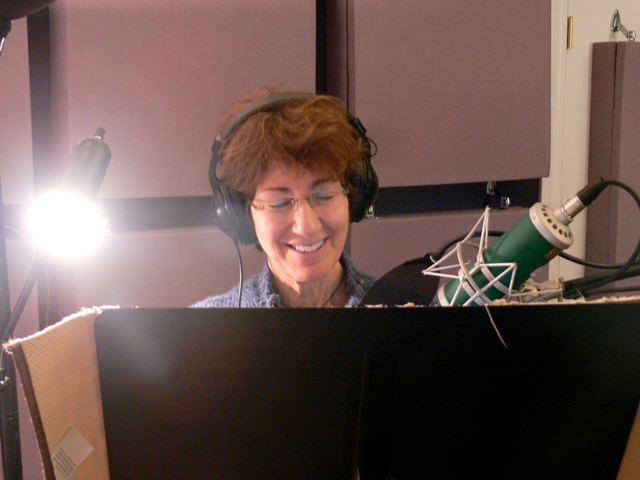
Voice-over actor Melissa Hutchison, really getting into character

Why did you and your wife decide to turn this story into an iBook?

Our original plan was to turn it into an app. Having gone through that process once already, I knew how long it would probably take (about 2-3 months). And then I learned about Apple’s update to their iBooks bookshelf app that enabled background audio and synchronized word highlighting with the narration. That seemed like a perfect vehicle for our story, since we already had the art and narration. With the help of a beta version of RedJumper.net’s Book Creator app, I was able to lay out the book and text in iBooks format. Then I added the sound coding by hand.

What special features does Are You My Friend? have?

In addition to the read-it-to-me narration and soundtrack I mentioned above, and of course, the whimsical illustrations and fantastic narration, we’re using high resolution images so you can pinch-zoom in to see more details. There’s also a unique friendship skills/social and emotional learning guide for parents and teachers at the back of the iBook.

How did you add those features? Was it a lot of work? Did you have to do any coding? Do you think anyone could do it?

Adding the narration with synchronized word highlighting was a lot of work. I used the open source Audacity software on my Mac and imported the narration for each page spread. Then I selected each word and bookmarked it, naming the bookmark to match the spoken word. Audacity then let me export these bookmarks into a text file that contained each word and the start and end point of the sound (in seconds). I converted that data into the format that the iBook required, using an Excel spreadsheet to help.
I then exported from Excel into the pages of the iBook. Yes, there’s “coding”, very similar to the HTML coding of a website. But no programming. There’s no logic code (if-then-else statements), just XHTML statements.

I don’t know if anyone could do it. If you’ve ever built a website (even a small one) and did some hand-tweaking of the underlying HTML code, then yes, you could do this. If that sounds daunting, then hold on a bit... I’m sure that some tools will appear that will make this all much easier, without ever having to touch the code.

Tell me about Book Creator. Where do you get it? What do you need to run it? What does it do? How much does it cost? Is it hard to get the words to light up when they’re read? Did you encounter any problems along the way? How did you solve them?

I was fortunate to be accepted as a beta test for Book Creator. It’s made by RedJumper.net, and was just approved by Apple to go live. You can buy it starting September 15th in the iTunes App Store for $6.99. That’s an amazing deal!
Book Creator does not handle any of the sound features I added to our iBook. It does a great job of letting you position your art assets (jpeg or png files) on the pages, and add/position/resize the text. You can see a video demo of it on their website. http://www.redjumper.net/bookcreator/

How long did each step in the process take? What were the costs involved?

After having all the art assets and text, it took me a few days to resize the art to the best size for an iBook, drop it in, and add the text. But it took me a few weeks to do all the narration and word sync code, music, sound effects, and ambient sound for each page. Part of that was a learning curve for me. I could probably do it all in about 2 weeks now that I know what I’m doing.

Left to right: Sound director Julian Kwasneski, author Annie Fox, sound engineer Jory Prum
Using iPads to hold the database of each sentence the actor was to say

Costs for this last stage were minimal... really just my time, plus about $50 for the royalty free music we used, and some more for sound effects from Julian.
The biggest cost by far was the actual recording session. Of course, this depends on how much text there is to record (we recorded a lot of extra text for a future interactive app version of our book), how much the talent charges, the sound studio, sound effects, etc. Figure a few thousand dollars to do it all at a professional level. Maybe less if you want to cut some corners.

Author Annie Fox adding vocalizations for the last scene in the book


How do you get a picture-book iBook into the iBookstore?

First step is to set up an iBook publisher account. You do it through iTunes Connect:

If you’re already an app developer, you need to register under a different account. There is no fee for this, but you do need a US bank account. You also need an ISBN number for your book. It should be a new one, not one already used for a paper version of your book (if it’s been published already). But it could be the same as an ebook version of your book.

If you don’t have one, you can buy them through Bowker at https://www.myidentifiers.com where the price is $150 for 1, $250 for 10, or $1000 for 100. But there’s a non-profit that bought a block of 1000 ISBN numbers and is reselling them for $5 each. http://www.epubbud.com/isbn.php - only downside is that in the Bowker database, epubbud is listed as the publisher. But you still have control over the meta data you send to Apple, so you can control who the publisher is there.

Once you’re accepted into Apple’s iBook developer program, you can download sample iBook files and their PDF guides on how to do it, like their assets guide. You also download a Mac program called iTunes Producer that walks you through the process of adding all the meta data (title, description, author and illustrator names, pricing, cover) and attaching your epub file. It then checks the syntax to make sure there are no errors, and uploads it all to Apple. It’s then live in the iTunes iBookstore within an hour or two!

Any advice to writers or writer-illustrators who are considering turning their stories into iBooks or apps?
Go for it! If you have any technical skills at all, work with Photoshop, and have an iPad, you can at least do a silent version using the Book Creator app.

If you have HTML skills, and want to invest in recording the narration, then you could go the next step and turn it into an enhanced iBook with sound. Or wait a bit until the tools catch up and it won’t be as difficult to add the sound.

Going the book app route only makes sense if you plan to add some animation and interactivity. Doing a book app is definitely more challenging, though there are several tools that make this easier as well. We list several in the right margin of the http://storyappchat.wordpress.com/ site.

There’s a huge range here, with some taking a percentage of the royalties and publishing the final app themselves, and others, like Kwiksher.com’s tool, where you also need to license the Corona SDK, have an Apple App developer’s license, and submit the final app yourself (but they don’t take a cut of the royalties).


So, unless you plan to do animation and really need a lot of interactivity to make your story work, I’d say stick with the iBook format. Much easier to create. You could always do an app as well.

Are you considering hiring out your services to other writers or writer-illustrators?

Yes, we have considered that. We do have more of our own content to produce, but we’re happy to consider taking on other projects, if they match the types of books we want to work on. The unifying feature of all our iBooks and apps are that they have to be entertaining as well as empowering for kids.


I’m also a consultant for app and iBook developers, and am happy to hand-hold someone through the process. I’ve always enjoyed helping people learn a new tech skill after I’ve successfully completed a project myself.

Anything else you would like to tell us about Are You My Friend?

I’ll let Annie answer that one:

I've been answering email from kids around the world since 1997. For children of any age, nothing matters more than having friends they can trust. Parents do a great job of teaching toddlers to "be nice." But as friendship conflicts become more complex, kids are left to figure things out on their own. The results don't often lead to constructive learning. By telling an engaging story about kids being kids, complete with a set of positive messages, readers can learn what it takes to have a friend and to be a real friend to yourself and others.

Thanks, David and Annie! And here's wishing you both the best of luck with the book.

Thank you for the chance to share this all with you and your readers! If anyone wants to contact us, you can do so through our website, http://www.ElectricEggplant.com

And for those who would like to learn more  from David and others about making picture iBooks or apps, check out #storyappchat on Twitter on Sundays at 9pm Eastern time.
Photos provided by David Fox

Wednesday, August 31, 2011

Is Fantasy Truer Than Fiction?


If you’ve read any fantasy novel—such as Alice in Wonderland, The Wonderful Wizard of Oz, Harry Potter,  The Lord of the Rings, or Twilight—you knew it wasn’t real. Cats that vanish, leaving behind only a smile? Flying monkeys? Young wizards and witches casting magic spells with wands? Hobbits and dragons? Vampires? How could any of that be real?


And yet . . .


And yet, there’s a magic in these stories, a spell they cast over their readers. If you’ve ever felt it, you know. That magic is real. It’s the magic that takes you to strange and wonderfully magical worlds. It touches your heart. It makes you cry. It makes you cheer. It makes you feel.  


That magic plays a more obvious role in many of my stories, never more so than in Toren the Teller’s take. It’s the topic of discussion in this scene from my soon to be released YA fantasy epic, Toren the Teller’s Tale. Toren, disguised as a boy and a storyteller’s apprentice, is at a tellers’ gathering. Between stories, the tellers discuss their craft:


Yes,” said another apprentice. “And what about made-up stories, ones about fantastic things that could never be true? Where’s the common starting point, and where’s the greater truth?” 

The elder master said the answer to this question was obvious, and he turned it over to us. No one else spoke, so I asked if I might be allowed to. He nodded.
 
“We all have common hopes and fears,” I said, “from the lowliest peasant to the king. We dream of someone who will love us more than life itself. In her dreams, every maiden is a princess longing for love; in his dreams, every youth is the one who will win her heart. Even the king’s hopes and fears are as common as our own.”

“And what about fantastic stories?” the elder master asked me.

“My master’s story was fantastic,” I said. “And yet it’s true. A man wants a son to follow in his footsteps and may be blinded to a truth he doesn’t wish to see. A woman may know the truth and be afraid to speak it. And a child may suffer for not being what the world demands her to be.”

The elders smiled at my answer, but one of them shook his finger.

“Although what you say is true,” he said, “I believe a story’s truth is even greater than that. One day you’ll see. You’ll think you are telling a story, but the truth of it will take over, and you’ll realize the thing you thought you created was always there, not in this place and time but somewhere in the infinite universe and as true as your own existence. We tellers are bridges from the past to the present, from the present to the future, from distant lands to here, and from here to everywhere.” 

“Of course we are bridges,” the man to his side said, “but only to imaginary worlds.”

“On the contrary!” the first elder shouted. “All worlds are equally real! You may think of stories as mere entertainment, but they are so much more. We spoke of how the audience must shape the story, but responsibility we tellers carry.”

The other elders were silent. One rolled his eyes. It was a man in front of me who dared to speak what was on everyone’s mind.

“The worlds of our stories already exist?” he mumbled. “Old coot’s gone senile.”

A murmur of agreement rose from the crowd, followed by laughter.   

“It is rather ridiculous, isn’t it?” Giddy asked me. “That would make everything imaginable real, and you know that can’t be right, can it, Tor?”

I laughed, but inside I wondered. Of course it did sound impossible.
And yet . . .


Is the first elder truly crazy?
 
The reply Toren gives above is the sort of thing Ursula K. Le Guin wrote about in The Language of the Night: Essays on Fantasy and Science Fiction. Fantasy deals with universal human experiences. Its archetypes are familiar—not from our day-to-day lives that differ from one person to the next, but from the dreams we all share. There is one language we all know, and it’s the language of the night. It’s what Carl Jung referred to as “the collective unconscious.” We all have similar hopes and fears, and they come out in our dreams—and in our fantasy and science-fiction stories.    

And that's why fantasy fiction is more honest than realistic fiction: because fantasy fiction deals with archetypes without the pretense that they are more than--or less than--archetypes. You know that Harry Potter isn't a real, living, breathing person; but you also know that his universal need for a family is real.  You know it because you've felt it too.

But this only fits what Toren says about the nature of stories. What about the first elder teller? Could he be right? Could there be a truth in fantasy that goes beyond touching upon our dreams and nightmares?
 

According to the Many Worlds theory of physics, the answer to this is a resounding yes.
 

Our world is one of many, many worlds that are like ours but different in ways both big and small. Expansions of the Many Worlds theory say that there are even worlds out there that don’t follow our own laws of physics.
 

Do you realize what that means? Disappearing cats, flying monkeys, young wizards and witches casting magic spells with wands, hobbits and dragons, vampires: they could all exist. Every story you’ve ever read—not matter if it’s realistic, science fiction, or fantasy—could be true. Not here, of course, but somewhere out there in our amazing universe.


And our dreams and our stories can show these fantastic worlds to you.


Toren, however, can do so much more. She can build bridges from her world to the worlds of her imagination, and she can take you along for the journey.


Which magical world would you like to visit today?  

And now I'd best step down before someone calls me a crazy old coot.

Tuesday, August 30, 2011

Some fun stuff coming up this week:

  • The truth behind fantasy fiction. Harry Potter, Twilight, The Lord of the Rings--can any of it be real?

  • An interview with the very funny Sarah Billington, author of Life Was Cool Until You Got Popular. There will be a chance to win a copy of this great eBook for older middle-grade or younger YA readers, and you don't want to miss it.

  • A discussion about picture-book apps and how to make them with David Fox, who has done just that. 

Wednesday, August 24, 2011

"Where do you get your ideas?” 12 things a writer can use to create an infinite number of story ideas

Writers, want to have more stories ideas than you can shake a pencil at? Well, here’s a secret that will let you do just that. It’s given me more story ideas than I could ever write in a lifetime, and it can do the same for you.

Science fiction writers know that at the root of every story are two little words: “What if?” “What if we could travel into the future?”  “What if robots took over the world?” “What if robots from the future could travel to our time?” “What if?” 

But you don’t have to write science fiction to take advantage of the power of these two little words. In fact, you can use “What if?” to create stories in any genre or for any age group: from humorous fiction to thrillers and from picture books to romance novels. The only difference is that--if you aren’t writing science fiction--your “What ifs” probably won’t involve time travel or robots. 

“What if?” is really just what I call “Surprise” in my House of Funny formula. It’s all about taking something and looking at it in a new, unexpected way, a way that asks, “What if?” 

There’s an infinite number of things you can ask “What if” about. Here is a list of 12 to get you started:


1.       Old stories--Old myths or legends, fairy tales, Shakespeare’s plays, nursery rhymes, jokes,  and so on make great setups. Just make sure they’re really old—like at least 100-years old—so you don’t infringe on the original creator’s copyright. Percy Jackson and the Olympians came from Greek mythology combined with the question: “What if these stories were real and took place today?” My book, Dan Quixote: Boy of Nuevo Jersey, came from asking the same question about the classic novel Don Quixote.
Percy Jackson and the Olympians Paperback Boxed Set (Books 1-3)
2.       The news--In print, online or on TV, it doesn’t matter how you get the news, only what you do with it. My YA romantic ghost story, Ride of Your Life, was inspired by a true event: the Great Adventure theme park Haunted Castle fire, which killed eight people. I wanted to give that event a happy ending, and that inspired my story. My picture book, Click the Dog, was inspired by a news item about a dog that ate something strange. Of course, when you base your story on real events it’s necessary to change all names, quotes, details and the like, so you don’t write something that might be considered defamation of character. (That’s why all works of fiction have a disclaimer like “Any similarity to any person living or dead is completely coincidental.”)


3.       Anything you would change—one of the wonderful things about being a writer is that you have the power to change anything you like. What if you had told off that bully? What if you could solve a murder? Write a story with a character who does just that, and see what happens. Read a really awful book? How would you completely change it? Mahatma Gandhi said, “We must become the change we want to see in the world.” Well, as a writer you can write the change you want to see in the world.

4.       Fears—What are you afraid of? Fears make great topics for stories, particularly horror stories. Think about what’s the worst thing that can happen, and make it happen to your character. But make sure you find some sort of resolution to your story. No one wants to feel invested in a character only to find out the character died without dying for something. I started Why My Love Life Sucks: The Legend of Gilbert the Fixer by asking myself what a teenage super geek's worst nightmare would be. Getting stuck with a gorgeous girl who only want to be his platonic best friend forever? Yeah, that's it.


5.       Dreams—These could be actual dreams, but they could also be aspirations. Supposedly, the story of Frankenstein came from an actual dream. But if there’s something you want to do but haven’t or can’t, writing might be a good way to experience it through your characters. They could be famous, read minds, predict the future, or fly for you. So ask yourself, “What if?”
Frankenstein: The Graphic Novel (Classic Graphic Novel Collection)

6.       Science—It doesn’t matter which science, from archeology to zoology, there are story possibilities in there. Archeological digs reveal stories of actual people, but archeologists themselves can have stories too. Indiana Jones was an archeologist (sort of), and he is one of Hollywood’s greatest heroes. When it comes to zoology, you could write a story about an animal or a person’s relationship with an animal, or you can create a story based on an animal society in the past, present or future. You can even mix animal qualities with human qualities, like Brian Jacques does in his Redwall series. Most science fiction has its roots in some kind of science, but science can be a part of any genre. 

  Redwall (Redwall, Book 1)

7.       History—The past is full of amazing stories. Child emperors? Parents trusting their children to strangers in another country to save them? Tribes nearly wiped out by strange new diseases? Empires rising and then falling? History has them all. The simplest “What if?” to ask when writing historical fiction is “What if I were there?” And if you don’t want to write historical fiction, there’s always Steampunk, fantasy based on history, science fiction that mixes the past and the future, and so much more.  

8.       Movies , TV and comic books--When you watch a TV show, try to imagine how you would do it. What if you were the writer? I’ve been writing episodes in my head since I was a kid, and it’s fun. This is more of an exercise than something you can use to create your own story, because the characters on a TV show belong to that show’s creator. But maybe you’ll create a character who can be spun off into a new series, something completely yours. And if you ever find yourself on The Tonight Show, you’ll have what you want to say all prepared.  

9.       Your life--Some people like to say that every writer’s first novel is autobiographical. (If that’s true, I’m a magical storyteller, because Toren the Teller’s Tale was the first novel I wrote.) But you don’t have to write an autobiography or something semi-autobiographical to turn pieces of your life into stories. If something deeply affects you, there’s a good chance it will deeply affect your readers too.  

10.   People around you--When I was little and my mom would take me shopping, she’d frequently sigh and tell me, “Shevi, we’re shopping for clothes, not people.” Even back then I liked to observe and make up stories about what I saw. There’s no shortage of story ideas at a mall. Anywhere you can find people, you can find something to turn into a story.   

11.   Photos, paintings, or other works of visual art--In a way, this is like using the people around you as inspiration; but when it comes to visual art, the artist has already chosen the focus of your story. It’s whatever is in the photo, painting, or other piece of art. Ursula Le Guin started writing her award-winning science-fiction novel The Left Hand of Darkness with just a single image in her head, the image of two people and a sled. She asked herself who these people were, how they got there, and where they were going. Questions like this can turn almost any image with people into stories.
The Left Hand of Darkness

12.   Mash-ups—As I mentioned in a previous blog post, conflict is an essential part of a good story, and one of the easiest ways to achieve it is by putting together things that don’t go together.  You could use two conflicting characters, two conflicting desires, or one character who conflicts with his or her world. You can also combine genres or mediums in new and original ways. There are already novels in verse, eBooks with animation, and books written like email correspondences. Or you can also take an old classic or fairy tale and put it into a different genre, like Jasper Fforde’s The Big Over Easy. Or you could take a serious work and make it funny, which is the essence of parody, like the movie Airplane!, Mad Magazine, any Weird Al Yankovic song.   
The Big Over Easy: A Nursery Crime


So the next time you hear an old story, watch the news, observe people at the mall or on the street, or look at an image of people interacting, ask yourself “What if?”  And if you think the answer holds some potential, write it down. Pretty soon you’ll have more story ideas than you can shake a pencil at too.
_________________________________________________

Oh, dear. I forgot one, and it's a biggie:

13. Word play--I often come up with great story ideas just by playing with words. I have an idea for a middle-grade science-fiction series that came from the expression "a stitch in time." Can't believe I left that out. Are there any others I'm missing?

Yippee! I just read the nicest review for Dan Quixote: Boy of Nuevo Jersey!

I don't know who J.C. is, but I thank you so very, very much!I hope your eldest enjoys it too.

http://theothersideofthepage.wordpress.com/2011/08/21/359/

"So, I guess to sum it up there are a lot of great messages in this book, delivered in an amusing story without being preachy or too in your face. I think it would definitely appeal to the middle grade reader, and even as an adult I found things to like. I will probably read this with my eldest in the near future."