Showing posts with label what is. Show all posts

Friday, May 27, 2016

Words for Nerds #AtoZChallenge--Y is for YA (an interview)

Shevi: Hi, YA!

YA: (Continues to text on her phone, her face partially hidden behind her hair. She shrugs.)

Shevi: We’re here to set people straight about all the mistaken assumptions they have about you.

YA: (Pausing but not looking up from her phone) Yeah! People just don’t get me.   

Shevi: I think most people know that YA stands for “Young Adult.”

YA: (Sighs and rolls her eyes) I don’t like being called that anymore. I’d rather be called “Teen.”

Shevi: Totally understandable, since that’s clearly what you are.

YA: Duh!

Shevi: Okay, so I think most people know that YA books are books with main characters who are between thirteen and seventeen years old.

YA: Yes, but we’re not all the same.

Shevi: Right! There’s younger YA, which is more for teens between thirteen and fifteen. And then there’s older YA, which is more for teens between sixteen and seventeen.

YA: Because we’re dealing with different stuff.

Shevi: Absolutely! For example, the Georgia Nicolson books by Louise Rennison, like Angus, Thongs and Full-Frontal Snogging, deal with friendships, first crushes, everyday family stuff . . .


YA: And the character is younger, so that’s definitely younger YA.

Shevi: Yes. And my Legend of Gilbert the Fixer series that starts with Why My Love LifeSucks has a seventeen-year-old character dealing with the last year of high school and who he wants to be after high school.

YA: Definitely older YA.

Shevi: Yes.


YA: But it’s only like PG-13, so younger teens can read it.

Shevi: Yes, and that’s true of a lot of YA. Younger teens can read it. They just might not necessarily relate to it. It depends on the maturity of the particular reader and what they’re going through.

YA: (Back to texting) Yeah.

Shevi: And that’s one of the misconceptions I’d like to clear up. Some people think that any book with a teenage protagonist is a YA, and that’s just not the case.

YA: (Laughs) Yeah, because if that was true, all those Disney princess movies would be YA, and they’re so not!

Shevi: Right! A YA novel has to deal with same things teens are dealing with today. Like first romantic relationships.

YA: (Blushes) Ewwww . . . Don’t talk about that out loud, okay?

Shevi: Don’t worry. It’s just between the reader and you.

YA: (Nods and goes back to texting)

Shevi: Two other common misconceptions are that a YA book has to be completely clean . . .

YA: (Laughs) Yeah, no.

Shevi: Or that YA books can only be issue books that deal with things like sex, violence, drugs . . .

YA: (Blushes) Yeah, no.

Shevi: A YA book can certainly deal with serious issues. That’s fine. But there are all kinds of YAs.

YA: Yeah, just like there are all kinds of teens.

Shevi: Exactly. And a YA refers to an audience age-group, not a genre. A YA can be in any genre. It can be an issue book, but it can also be a comedy, a fantasy novel, a science fiction novel . . .

YA: (Excited) Have you read The Hunger Games? It’s ah-mazing!


Shevi: That’s another thing. You don’t have to be a teen to appreciate YA. A good book is a good book, no matter how old you are.

YA: Thank you!

Shevi: Before we go, is there anything else you’d like people to know about you?

YA: (Looks up and puts her phone down. She takes a deep breath and lets it out.) I wish people would stop telling me what to do.

Shevi: Meaning?

YA: Some writers treat us like we’re little kids. They don’t understand who we are or what we’re going through. They lie to us. They’re not honest. You don’t have to tell me what to do or think or feel. I can do those things for myself! It’s like . . . it’s like they don’t respect me.

Shevi: (Nods) I think that’s something every writer should keep in mind, no matter who their audience is. No one likes to be condescended to. I know I don’t. And you know what else?

YA: (Shrugs)

Shevi: I love your honesty. I think that’s what makes you one of my favorite categories of books. You don’t waste time but get straight to the point.


YA: (Blushes) I like that about me, too. 

Shevi: So I hope that clears up a few misconceptions. If you want to know more, just check out the books in the the teen section of your local library or bookstore. The more you read, the more you'll realize how great YA books are. 

Thursday, May 12, 2016

Writing Words for Nerds #AtoZChallenge—O is for Outline. Do you need one?


Do you need an outline? The answer is...it depends. 

Those who write outlines are called outliners (duh!), and those who don’t are called “pantsers,” which refers to how they write by the proverbial seat of their pants.

I recently ran a survey in a Facebook writer’s group I belong to, and what I discovered surprised me. While there are more pantsers than people who consider themselves outliners, the biggest group was made up of people who consider themselves both! Sometimes they outline, and sometimes they don’t. Some will outline the beginning and then let the story work itself out from there. Others outline certain kinds of projects but not others.


Me? I’m an outliner. Not only do I need to outline the entire book before I sit down to write it, I also need to outline individual chapters before I write them. I like to outline the next thing I have to write when I finish writing for the day. It gives me something to work toward when I return to the manuscript. I have a terrible sense of direction, and the outline is my road map. I need one, so I don’t get lost. For me, being a pantser just isn’t an option.

But I don’t just need to have an outline; I LIKE having one. It means that I can always “start with dessert.” I know what all the scenes are and where they go, so I can start with the scene or conversation I’m most excited about. And I do. My full outlines have bits of dialogue and some fully fleshed out scenes in it, because those are the desserts I’ve already eaten. I only move onto the things that aren’t dessert when I’ve eaten all the desserts I can. And you know what? Very often I find the things that I’m not really excited about writing don’t need to be written at all. It’s cool how that works out.

I know that many outliners feel that pantsers should be outliners too, but I’m not one of them. I believe you should do what works for you, and if that’s writing without an outline, then you should definitely do that.

Some pantsers think that outliners should be pantser, too. Very often it’s because they see an outline as something that restricts creativity. Being a pantser gives them freedom to take their story anywhere at any time. I don’t like getting lost, but for many pantsers, that’s a part of the joy of writing. They love getting lost in their story, discovering it as they go along, and seeing where it leads. They love discovering the characters and being surprised, just like a reader would.

Again, that’s not me. I don’t enjoy getting lost. I’d rather fly straight to Orlando, check into a hotel I’ve researched well so I know what to expect, and take Disney transportation into Disney World, a detailed schedule of what I’m going to do in each of the parks tucked away in my bag. Have a great time getting lost and wrestling alligators in a Florida swamp, pantsers. It sounds exciting. It’s just not my idea of fun.

And outlines really aren’t as restrictive as many pantsers seem to think. Who says that just because you have a detailed schedule in your hand you have to pass up a better opportunity if one comes along? Outlines are flexible. They can be rewritten. And it’s a lot easier to rewrite a five page outline than it is to rewrite a 250-page book, which is what most pantsers who write novels end up having to do.

Some strict outliners and pantsers don’t see it as a choice.

Some outliners say, “I can’t write without knowing where I’m going.” Are you sure? Have you ever tried it? Who knows, it might be fun.

And some pantsers say, “How can I write an outline if I don’t know where my story is going? I don’t have a plot. I just have these characters. I don’t know what they’re going to do until they do it.” Then how do you know they’re good characters? How do you know they have a story worth telling? Of course, if it turns out they aren’t and they don’t, you can always rewrite the whole thing. Me? I have too many great characters with stories that I’ve already fully outlined in my head, and not enough time to follow around characters who may or may not get anywhere. Of course, it’s the finished result that matters, not how you get there.

The answer to what you can do if you’re an outliner who wants to be a pantser is easy: just do it! 

It may be scary, but maybe that’s a good thing. And if you find yourself stuck, just give yourself a timer and a goal. How does 500 words in an hour sound? Don’t be surprised if after the hour is up, you feel the urge to write more.  

The answer for the pantser who wants to be an outliner is a little more complicated: instead of being a long-form pantser, writing every little detail as you go along, try being a pantser of a short story.

You can write on paper, but you can also write it in your head. Just go and get lost in your story, but try not to do it for more than a page. If you need to, add another page. And another. It could be a series of short stories with the same characters and a single character arc. You can keep writing those short stories until you find a satisfying end to that character arc. And then you’re done. You’ve just pretty much pantsed your way to an outline.


I hope this helps, or at least gives you some food for thought. Again, there’s no right or wrong way. There’s only what works for you, and you won’t know what that is until you’ve tried both options.   

Tuesday, May 10, 2016

Writing Words for Nerds #AtoZChallenge--M is for Magic (Is it real?)

Picture a scene. Harry Potter is playing Quidditch with his friends as the sun begins to set. The young wizards zoom and loop through the sky, chasing the winged golden snitch that remains ever out of grasp.


As night falls, a figure appears in silhouette on the horizon, her long hair flowing in the wind. She’s holding a staff and wearing a long cloak. An extreme close-up reveals the cloak is made of colorful patches. The young woman, still in silhouette, runs her fingers through her hair and raises her hand. There’s a sound, like a woman talking, but the words spoken aren’t of this world.

The young woman glows, and we can see her for the first time. Her hair is dark, her skin pale, and her clothes are colorful.

The dramatic music rises as we once again see Harry trying to catch the snitch. The camera shifts to the snitch itself and follows it zooming straight toward something. The music rises and suddenly ends as the snitch flies into the young woman’s outstretched hand.

“The time for games is over,” she says.

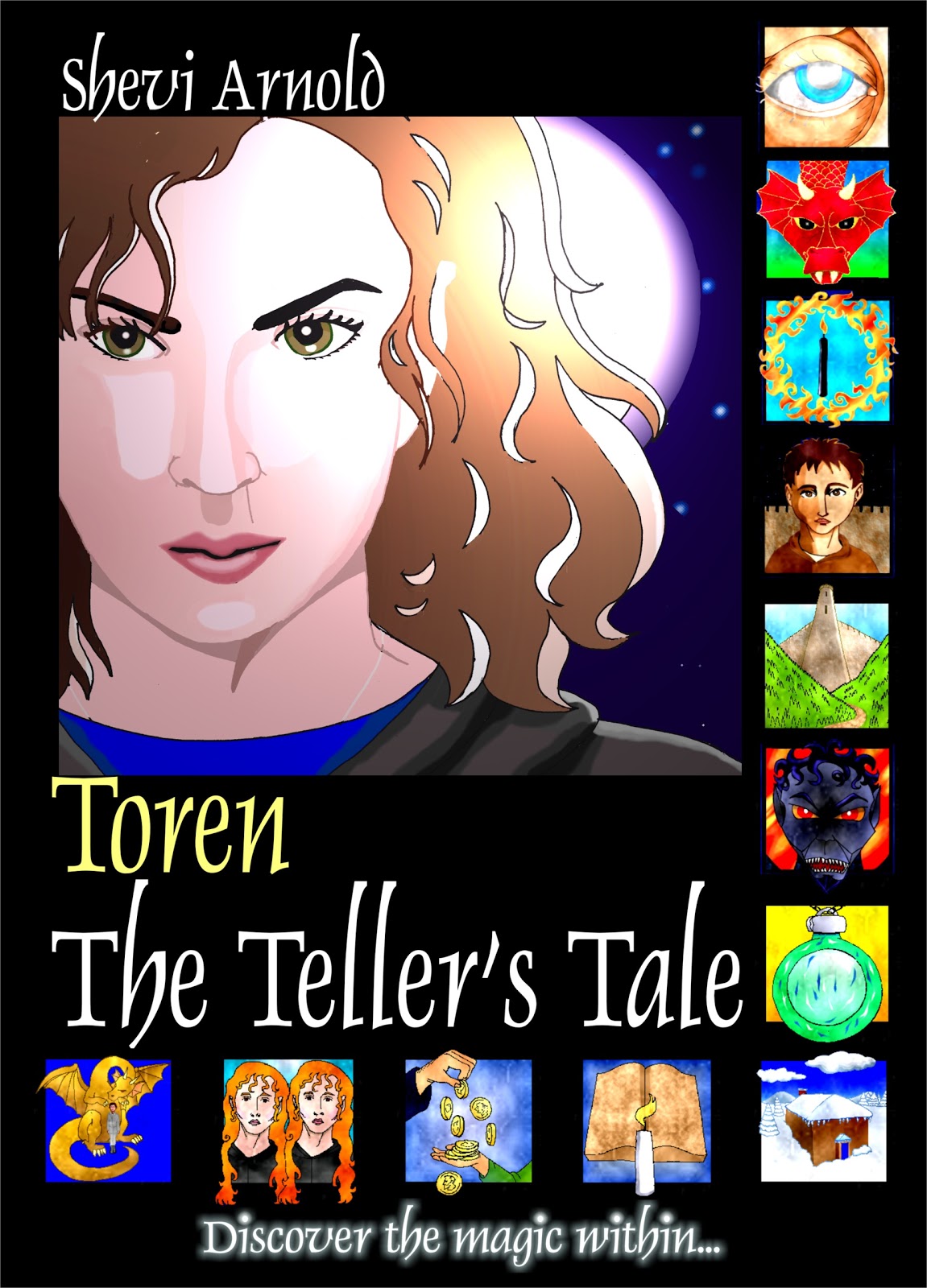
The screen fades to black. Enchanting music starts. The words “This time the magic is real . . .” appear on the screen and then fade. The last screen shows the words “Toren the Teller’s Tale” as the music comes to an end.

Sometimes I think of parts of my books as scenes in a film. This is the trailer that I like to imagine for the film version of Toren the Teller’s Tale. Sure, it will probably never exist in real life. But anything can be real in my imagination.


Toren the Teller’s Tale is about real magic. It’s about the magic of stories: the magic that lets you see and hear and touch and taste and smell a story, the magic that transports you to different worlds that could only exist in your imagination, the magic that lets you experience what it’s like to be a boy wizard or a hobbit or a young girl who loves telling stories and is about to discover the magic they hold. Toren the Teller’s Tale is about a kind of magic you know is real. You’ve felt it every time you’ve found yourself swept away by a story.

Those who aren’t very familiar with fantasy and science fiction often think there’s a clear divide between the two genres. Fantasy involves wizards and magic spells and magical creatures, like dragons. Science fiction involves the future and space ships and alien planets and things that could scientifically exist one day.

But there’s more overlap than most people realize. Anne McCaffrey’s Dragonriders of Pern books, for example, have dragons, but they’re science fiction.  Most people would say that Star Wars is a science fiction series, but never say that to a science-fiction purist. Sure, it has aliens, androids and spaceships, but it also has a form of magic called “the force” as well as Jedis, who are basically wizards that live on other planets, have robot companions, and fly spaceships. Star Wars regularly breaks the rules of science, which is fine as long as you don’t call it science fiction.

There are some who have pointed out that the Many Worlds theory of quantum mechanics basically means that all fantasy is actually science fiction, which is true.


That’s a topic that comes up in a conversation between Gilbert Garfinkle and Dungeon Master Dave in Why My Love Life Sucks, the first book in the Gilbert the Fixer series. Gilbert, the young aspiring mad scientist, can’t accept that he’s been turned into a vampire. His life is supposed to be a science-fiction novel. How is it possible that it now contains an urban fantasy trope? In his mind, that’s not scientifically possible.  It makes no sense. Dungeon Master Dave points out that the Many Worlds theory says otherwise. Because if an infinite number of worlds exist, some of those worlds must have vampires, as well as Gilberts that don’t believe in their existence.

The first book in the series shows Gilbert mostly grappling with his strange, new, unscientific predicament. By the second book (Why It Still Mega Bites, which should be out later this year), he’s come to accept that “magic is just science we don’t yet understand.”

Of course, he wasn’t talking about Quidditch.

Thursday, January 14, 2016

What Writers Can Learn from DOCTOR WHO


I'm a big fan of Doctor Who. Like most Whovians, I don't like every single episode. I have my favorites, just like I have my favorite Doctors and my favorite companions.
So what exactly makes Doctor Who so great? And what exactly is Doctor Who?

Doctor Who is a BBC science-fiction series that has been around for over 50 years--even before I was born--although there was a long break between the late eighties and 2005 when the new series began.

Doctor Who tells the ongoing story of the Doctor: a Time Lord from the planet Gallifrey and the last of his kind.

The Doctor is hundreds of years old, and he’s seen a lot of terrible things. He has a lot of enemies, like the Daleks and the Cybermen.  He’s lost a lot of friends along the way, which makes him very lonely.


That’s why the Doctor likes to take people along for the ride. These special people are the Doctor’s companions. They get to travel with the Doctor is his time machine, which is called the TARDIS.

TARDIS stands for Time And Relative Dimension In Space. On the outside, the TARDIS looks like a blue police call box from England in the 1960s. It’s much bigger on the inside, though. Sometimes bigger than others.


The Doctor’s real name is a secret he must keep, because if it falls into the wrong hands… Actually, I don’t know what would happen, but apparently it’s something really bad.

When the Doctor dies, he regenerates and turns into someone new. So far 13 actors have played the Doctor, and each one has brought something different to the role.


Some people say that this is what makes Doctor Who so great: because the Doctor can become anyone, the show can be anything… Except apparently a woman, but that's something I hope will change. I've even written a first episode for her, and I've entitled it "Madam with a Box," a play on somethin the Doctor sometimes calls himself: a "madman with a box." I'd like to someday create a Kickstarter project so I can turn Madam with a Box into a fanfic graphic novel. Someday... 
Anyway, remember how I said that the TARDIS is bigger on the inside? Well, I think that what makes the show great is that the show itself is bigger on the inside.

The show makes you feel, and it makes you feel BIG time.


For example, I’ve never seen a more romantic couple on TV than the 11th Doctor’s companions, Amy Pond and Rory Williams.

He dies over and over for her, and as the Last Centurion he waits over a thousand years to guard her in the Pandorica. And when Amy has to choose between Rory and all of time and space, she chooses him. “Together or not at all.” Try to beat that, any other TV couple out there.   


Looking for something scary? Try the episodes entitled “Blink,” “Silence in the Library,” “The Time of Angels,” “Flesh and Stone” and finally “The Angels Take Manhattan.” I don’t know of any other show that’s made thousands of viewers too scared to even blink.


Looking for something funny? Donna Noble probably would win a funniest companion competition, and one of the funniest things I’ve ever seen on TV was near the end of companion Donna Noble’s storyline in the episode entitled “Journey’s End.” Of course, it very soon becomes one of the saddest things ever. (Maybe that's a spoiler, although soon after Donna Noble is introduced as a companion we're told that something very sad is going to happen to her. The only spoiler here, really, is that it's true.)


And that’s what makes Doctor Who so great! It makes you feel so much and so deeply.

You fall in love with the characters. You feel their terror and sadness and joy. In a way, everyone who watches Doctor Who BECOMES the Doctor’s companion. We’re all onboard the TARDIS for this wonderful, scary, funny, exciting ride!

So it’s not that the show can be anything; it’s that the show can take your emotions ANYWHERE, and it does.

There's a lesson there for any storyteller: don’t let the audience half feel things. Go as far as you can. Make your story like a TARDIS: bigger on the inside.

And that’s why I love the “Madman in a Box.”